
Training Data Disclosure on Qiwa Before 31 January 2027: What Is Required and How to Gather It
Private-sector businesses with 50 or more workers must disclose training data through Qiwa before 31 January 2027. Businesses that ran no training must disclose too. Here are the four data types and a plan to collect them.
Author:سامي الحيدري
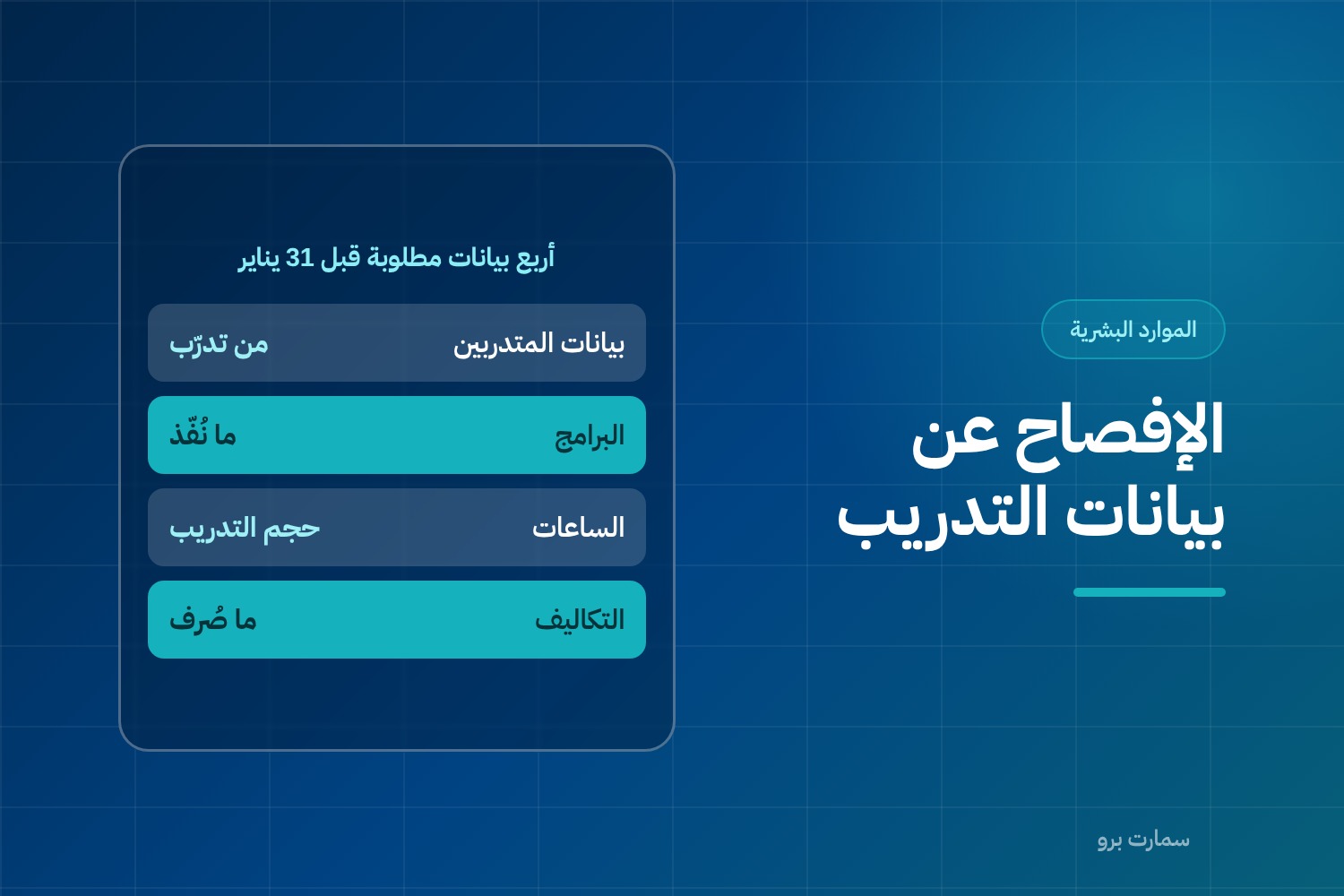
Training data disclosure now has a hard deadline. Private-sector businesses with 50 or more workers must disclose their training data through the Qiwa platform before 31 January 2027. The Ministry of Human Resources and Social Development (HRSD) issued the call on 2 November 2026, which leaves about ten weeks from today.
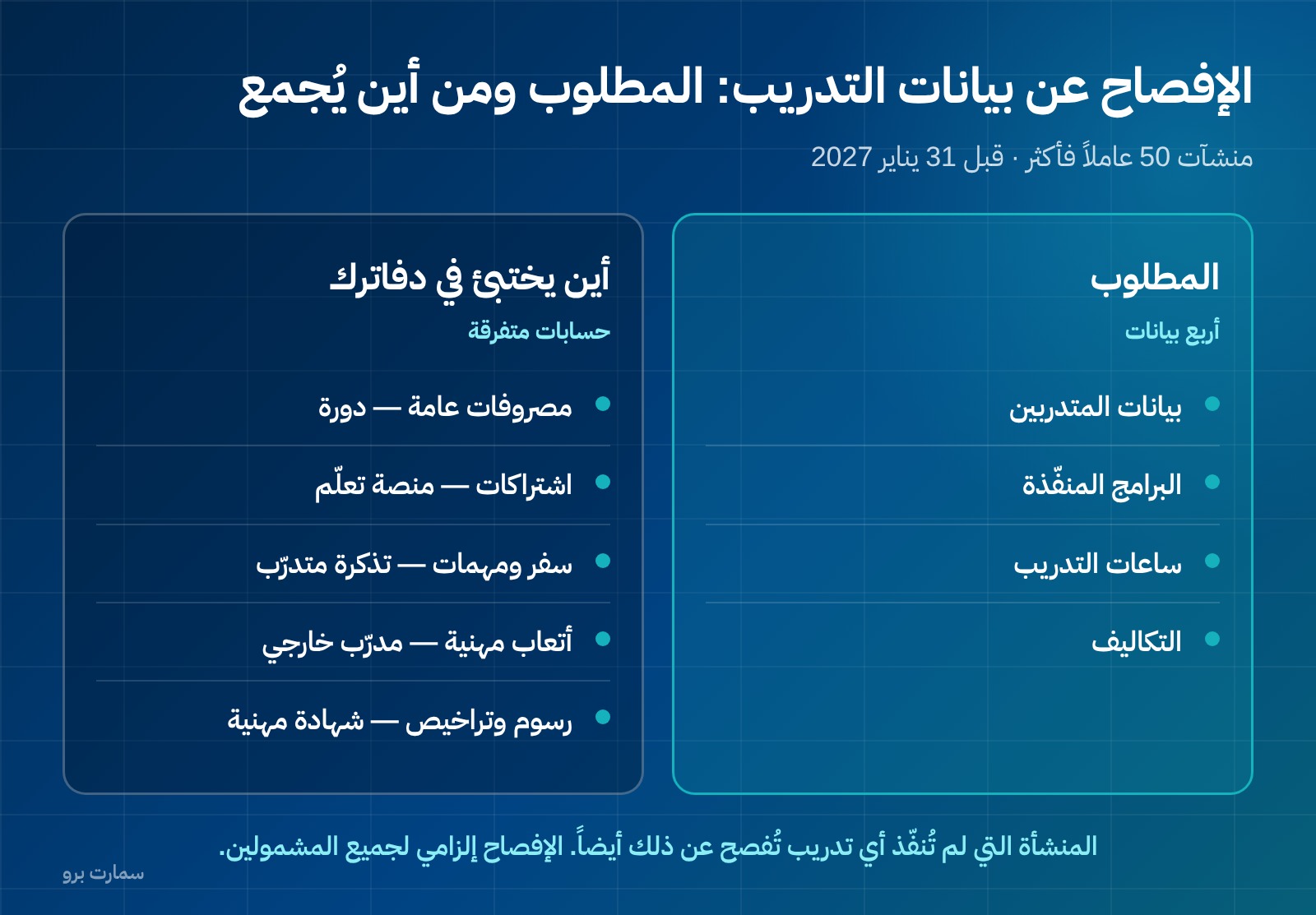
One clause is easy to miss: a business that ran no training at all must disclose that too. Disclosure is mandatory for every business in scope, not only for those with something to report. "No training" is a required answer, not a reason to skip the form.
What does training data disclosure cover?
Four types of data are required:
- Trainee data: who was actually trained.
- Programmes: which training programmes were delivered.
- Hours: the volume of training, measured in hours.
- Costs: what was spent on it.
The cost item is what turns this from an HR task into a joint task with finance. The question is not "how much did we spend on training?" but "how much did we spend on training that we can prove?"
Why is training spend so hard to find in the books?
In most small and medium businesses, training expense is not one account. It is scattered:
- A course booked under "General expenses".
- A learning-platform subscription under "IT expenses" or "Subscriptions".
- A trainee's flight and hotel under "Travel and assignments".
- An external trainer's fee under "Professional fees", or inside a contractor's invoice that was subject to withholding tax.
- An employee's professional certification under "Fees and licences".
So whoever is asked for 2026 training cost and searches for an account called "Training" will find a figure far smaller than the real one. This is not a disclosure problem; it is a chart of accounts problem. A chart of accounts is the structured list of every account a business posts its transactions to.
The lasting fix is not to collect the numbers by hand this year. It is to add an analytical dimension or a cost centre called "Training and development" and tag each entry with it when it is posted, whatever the main account. A cost centre is a label that groups income and expenses by activity or department across accounts. Once that is in place, the report becomes a query rather than an investigation. You can start from a structured layout with our chart of accounts Excel template for Saudi businesses.
How do you gather the figures before 31 January?
Here is a two-week plan for a business that has not tracked this during the year.
- Confirm you are above the 50-worker threshold. Check first that you are in scope: 50 or more workers. The count is based on registered workers, so if you are close to the threshold, the safer choice is to disclose.
- Pull a detailed ledger for every candidate account for 2026: general expenses, subscriptions, travel, professional fees, fees and licences, hospitality.
- Filter by description, not by account. Search for words such as course, training, workshop, certificate, accreditation, platform and conference.
- Link every item to an employee or group of employees. Data is required about trainees, so an amount with no trainee is only half a disclosure.
- Calculate the hours. This is usually your weakest data, because invoices rarely state hours. Review certificates and programme descriptions, and where hours cannot be confirmed, estimate them openly rather than inventing them.
- Record zero if it is zero. A business that ran no training discloses that fact.
- Submit through Qiwa before 31 January 2027, and do not leave it to the last week. Platforms get busy near deadlines.
Is your business in scope at all?
Answer this before you collect a single number. The threshold is 50 or more workers, counted on the workers registered to the business. Three situations deserve a closer look.
A business that moves around the threshold. A business with 48 workers in summer and 53 in peak season is not a clear case. The safer choice here is to disclose: the cost of an unnecessary disclosure is zero, while the cost of missing a required one is a violation.
A business with several entities. If you have more than one commercial registration (CR) or more than one establishment on Qiwa, the count is per establishment, not per group. An entity with 30 workers and another with 25 are not one establishment of 55.
A business that relies on outsourced labour. Someone who works for you under a contract with a manpower services company is registered to that company, not to you. The count covers workers registered to you, the same logic that governs Saudization ratios.
Is training an expense or an asset?
This question comes up when you gather costs, and it is worth settling before you disclose, not after. Most training programmes are an expense in the period they occur, because the benefit is not controlled by the business: a trained employee can leave. Some cases differ:
- An employee's professional certification fees are treated as an expense, not an intangible asset, because the certificate belongs to the employee, not the business.
- An annual learning-platform subscription is spread over the subscription period as a prepaid expense, not charged in full to the month of payment. Charging it all at once shows an inflated training cost in one month and an understated one in the other eleven.
- Developing in-house training content is assessed case by case, and the rules for intangible assets under IAS 38 may apply if the capitalisation criteria are met.
What matters for the disclosure is consistency: use either cash spent during the year or expense charged to the year. Mixing the two produces a figure that will not match your books if you are asked about it.
Why is this worth a permanent setup rather than a one-off fix?
Training data disclosure is not the only item you are now measured on. The direction of the authorities is clear: data is collected from platforms, not from manual reports. Wage Protection checks that salaries are paid on time and in the amounts stated in documented contracts, through a real-time technical link. And Saudization ratios in Nitaqat are calculated from contracts documented in Qiwa from 15 April 2026.
This means that what is not recorded on time cannot be recovered later. A business that enters its employee data, contracts and expenses as they happen answers any disclosure with a query. One that enters them only when asked spends two weeks of its team's time every time, and ends up with an estimate.
So the right investment is not a disclosure project but three habits:
| Habit | Effect on the disclosure |
|---|---|
| Tag every entry with a cost centre | The cost report becomes a query |
| Link every training expense to an employee | Trainee data is ready |
| Document every contract in Qiwa at hiring | Saudization ratios and employee data stay accurate automatically |
Tying these habits to one system, with payroll, attendance and expenses in one place, is what makes them sustainable without constant manual discipline. In SmartPro, for example, cost centres sit inside Finance & Accounting, and employee files, attendance and payroll sit in Human Resources, with an optional Training management system for courses, trainees, attendance and results. Whether that setup fits your business depends on your size and how you run training today.
What is still unclear?
The published call defines who is in scope (50 or more workers), the deadline and the four data types. The entry form itself and its field details will only be visible on the Qiwa platform when you submit, and they may require a finer breakdown than the call describes. So the sensible approach is to open the form early to see what will actually be asked, rather than gathering data on an assumption and discovering a missing field in the final week. The text of the call is published on the Ministry of Human Resources and Social Development website.
Key takeaway: Every private-sector business with 50 or more registered workers must disclose trainees, programmes, hours and costs on Qiwa before 31 January 2027, even if the answer is zero. Gather the data now, and tag training costs with a cost centre so next year's disclosure is a simple query.
To see how cost centres and employee records work together in practice, start a free SmartPro trial or book a demo.
Article visuals
Frequently asked questions
Who must make the training data disclosure on Qiwa?
Private-sector establishments with 50 or more workers, and the deadline is before 31 January 2027. Disclosure is mandatory for every covered establishment, including those that delivered no training, which must disclose that as well.
What data does the disclosure require?
Four types: trainee data, the training programmes delivered, training hours, and costs. Costs are usually the hardest in practice, because in most establishments training expense is spread across several accounts rather than held in one.
How do I gather training costs if there is no separate training account?
Pull a detailed ledger for the candidate accounts for the year, such as general expenses, subscriptions, travel, professional fees and fees and licences. Filter by description rather than account, using words like course, workshop, certificate, accreditation and conference, and link each item to an employee. The lasting fix is to tag entries with a “Training and development” cost centre.
What if the establishment delivered no training during the year?
It still discloses. The call states that an establishment that delivered no training must disclose that too, because disclosure is mandatory for all covered establishments, not only those with something to report. Recording zero is a required answer, not a reason to skip the form.
How does this disclosure relate to other obligations?
It is part of a wider move towards collecting data from platforms rather than manual reports. Wage protection checks payments against documented contracts through a real-time technical link, and Nitaqat Saudization ratios are calculated from contracts documented on Qiwa from 15 April 2026. Data that is not recorded on time cannot be recovered later.