
The Three Depreciation Methods: One Example Worked Three Ways in SAR
Straight-line, declining balance and units of production, with one SAR example that shows the total depreciation is the same and only the timing differs.
Author:سامي الحيدري
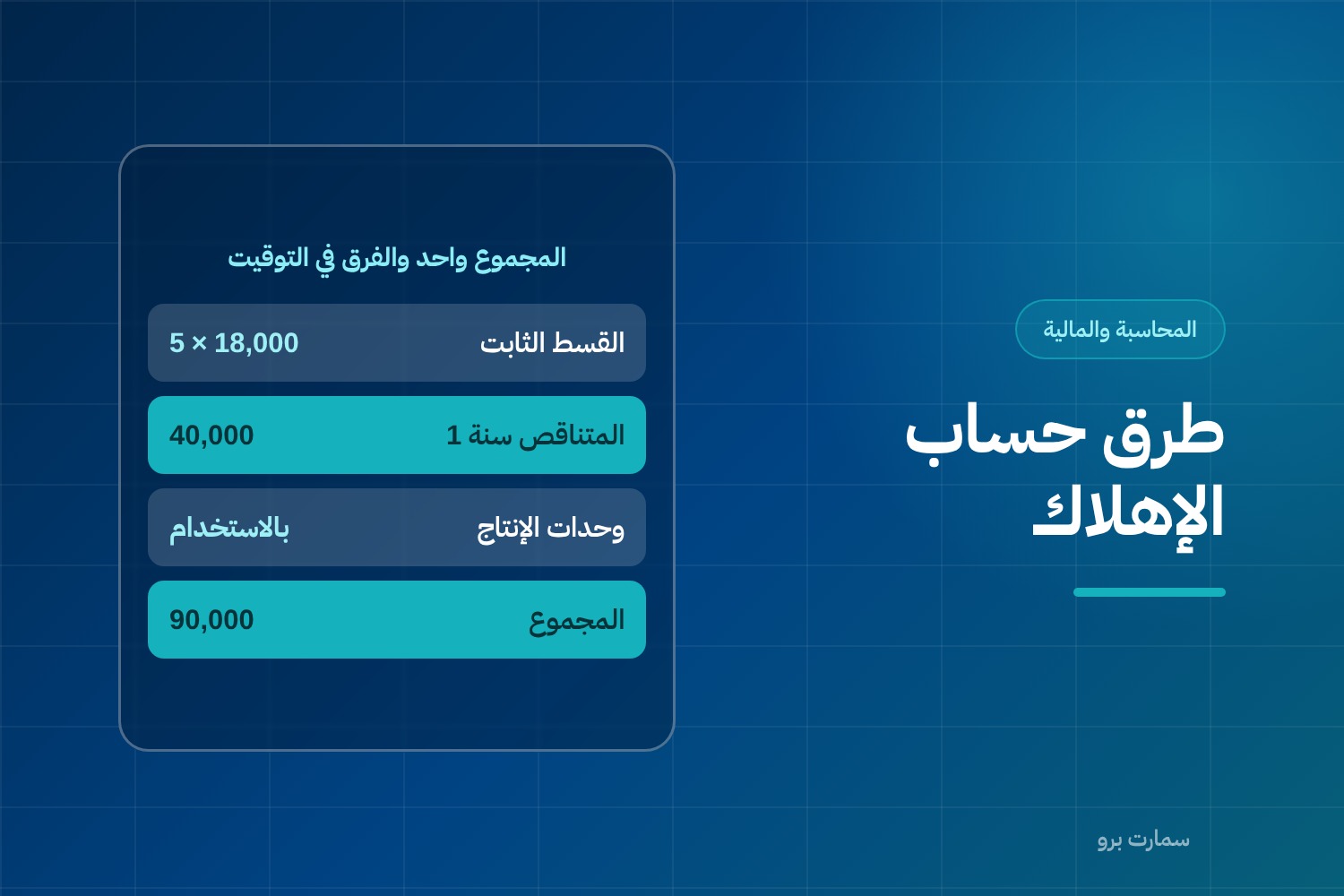
There are three depreciation methods recognised under international standards (IFRS): straight-line, declining balance and units of production. Choosing between them is not an accounting preference. The method must reflect the pattern in which the asset's benefits are consumed, so an asset that wears out through use rather than time should not be depreciated by time.
First, a common mix-up in terminology. Depreciation applies to tangible assets such as buildings, machinery and vehicles. Amortisation applies to intangible assets such as software, licences and trademarks. Depletion applies to natural resources. These are three words for three types of asset, and treating them as synonyms confuses whoever reads your financial statements.
What are the three depreciation methods?
Straight-line spreads the depreciable amount evenly over the useful life. The depreciable amount is the asset's cost minus its residual value, which is what you expect to recover at the end of its life.
Annual charge = (Cost − Residual value) ÷ Useful life
It suits assets whose benefits are consumed evenly over time, such as a building, furniture or leasehold improvements.
Declining balance charges more in the early years:
Annual charge = Carrying amount at start of year × Fixed rate
Note one essential difference. The rate is applied to the carrying amount (cost minus accumulated depreciation), not to the cost. The residual value is not deducted in the calculation. Instead, it acts as a floor the balance cannot go below.
This method suits assets whose benefit is concentrated early in their life, or whose maintenance costs rise with age, such as computers and vehicles.
Units of production links the charge to actual use:
Charge per unit = (Cost − Residual value) ÷ Total expected units Annual charge = Charge per unit × Units in the year
It suits production machinery, or a truck measured in kilometres. Its advantage is that the charge falls automatically in a slow year, because the asset was used less.
How do the methods compare on one example?
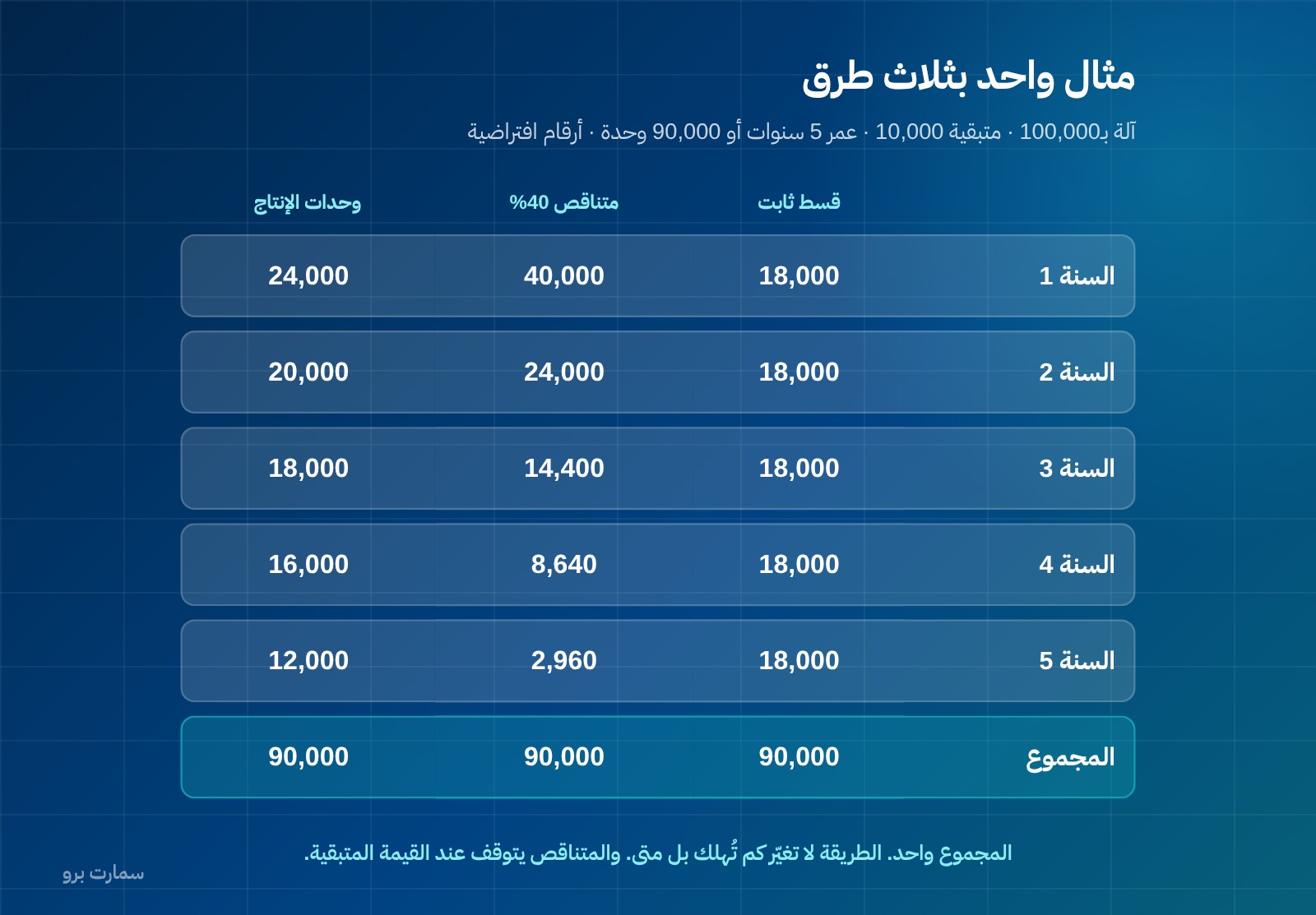
The figures below are hypothetical, for illustration only. A machine costs SAR 100,000, has an expected residual value of SAR 10,000, and a useful life of 5 years or 90,000 production units.
| Year | Straight-line | Declining balance 40% | Units of production |
|---|---|---|---|
| 1 | 18,000 | 40,000 | 24,000 units → 24,000 |
| 2 | 18,000 | 24,000 | 20,000 units → 20,000 |
| 3 | 18,000 | 14,400 | 18,000 units → 18,000 |
| 4 | 18,000 | 8,640 | 16,000 units → 16,000 |
| 5 | 18,000 | 2,960 | 12,000 units → 12,000 |
| Total | 90,000 | 90,000 | 90,000 |
Charge per unit = (100,000 − 10,000) ÷ 90,000 = SAR 1 per unit.
Now the most important point: the total is the same under all three methods. The method does not change how much you depreciate, only when. Depreciation allocates cost across years. It does not estimate the asset's value.
In year 5 under declining balance, the charge is SAR 2,960, not SAR 5,184 (40% of the SAR 12,960 opening carrying amount). The balance stops at the SAR 10,000 residual value and cannot go below it. Many Excel schedules get this wrong.
Which assets are not depreciated?
Land is not depreciated because its useful life is indefinite. If you buy land and a building for a single price, you must split the cost between them. Depreciating land is an error that compounds every year.
Intangible assets with an indefinite useful life, such as some trademarks, are not amortised either. They are tested for impairment every year instead.
Which three figures must be reviewed every year?
The standard requires the useful life, the residual value and the depreciation method to be reviewed at least at the end of every financial year.
Any change is a change in accounting estimate, applied prospectively rather than retrospectively. Past charges are not restated. The remaining carrying amount is spread over the new remaining life.
Most preparers skip this review. Useful lives are entered once at purchase and never revisited. The result is a machine carried at zero while still running, or a car depreciated over five years even though it was sold in year three.
What is the depreciation journal entry and its effect?
The entry is monthly or annual, and it is one of the adjusting entries covered in types of journal entries:
Dr Depreciation expense · Cr Accumulated depreciation
Note that the credit does not go to the asset itself. It goes to a contra account called accumulated depreciation. The original cost stays visible in the books, with the amount depreciated shown beside it, and the difference is the carrying amount. If you reduce the asset directly, you lose sight of its original cost and its age.
Depreciation is a non-cash expense: not a single riyal leaves with it. That is why it is added back in the statement of cash flows when moving from profit to operating cash flow.
Is accounting depreciation the same as tax depreciation?
No, and this matters in practice. The method and useful life you choose for your financial statements do not have to match what the tax authority accepts when calculating the tax base. The difference between them creates a temporary difference that is dealt with through deferred tax.
Choosing a method because it reduces your tax base is a double mistake. It distorts your financial statements, and there is no guarantee it will be accepted for tax purposes.
Quick checklist
- Separate the cost of land from the building for every property.
- Check that the method for each asset class genuinely reflects how its benefits are consumed.
- Confirm that declining balance stops at the residual value and does not go below it.
- Review useful lives and residual values at every year-end, and document each change and its date.
- Make sure your system generates the depreciation entry automatically from the asset register, not from a manual entry that gets forgotten.
- Record the available-for-use date, not the purchase date. Depreciation starts when the asset is ready for its intended use.
The rules for measuring and depreciating these assets sit in IAS 16 Property, Plant and Equipment, part of the IFRS Standards. In SmartPro, the Assets & custody system keeps the asset register and depreciation, and it connects to finance and accounting so entries post without manual work.
Key takeaway: All three depreciation methods depreciate the same total. Pick the one that matches how the asset is actually used, and review life, residual value and method every year.
To see automatic depreciation entries on your own assets, start a free trial of SmartPro.
Article visuals
Frequently asked questions
What depreciation methods are recognised?
There are three. Straight-line spreads the depreciable amount evenly over the useful life. Declining balance applies a fixed rate to the carrying amount, so it charges more in the early years. Units of production links the charge to actual use, and the choice must reflect the pattern in which the asset's benefits are consumed.
What is the difference between depreciation, amortisation and depletion?
Depreciation applies to tangible assets such as buildings, machinery and vehicles. Amortisation applies to intangible assets such as software, licences and trademarks. Depletion applies to natural resources. Using the three terms as synonyms confuses readers of your financial statements.
Does the depreciation method change the total amount depreciated?
No. The total is the same under all three methods. The method changes when the cost is charged, not how much is charged. Depreciation allocates the depreciable amount across years and is not an estimate of the asset's value.
Is land depreciated?
No, because its useful life is indefinite. If you buy land and a building for a single price, you must split the cost between them, because depreciating land is an error that compounds every year. Intangible assets with an indefinite useful life are not amortised either. They are tested for impairment every year.
When should useful life and the depreciation method be reviewed?
Review the useful life, residual value and method at least at the end of every financial year. Any change is a change in accounting estimate, applied prospectively rather than retrospectively. Past charges are not restated. The remaining carrying amount is spread over the new remaining useful life.