
Solved Accounting Exercises: Six Exercises with Saudi Figures and 15% VAT
Six exercises with complete journal entries: a purchase with VAT, a sale, a sales return, a prepaid expense, depreciation and payroll, all in Saudi riyals.
Author:سامي الحيدري
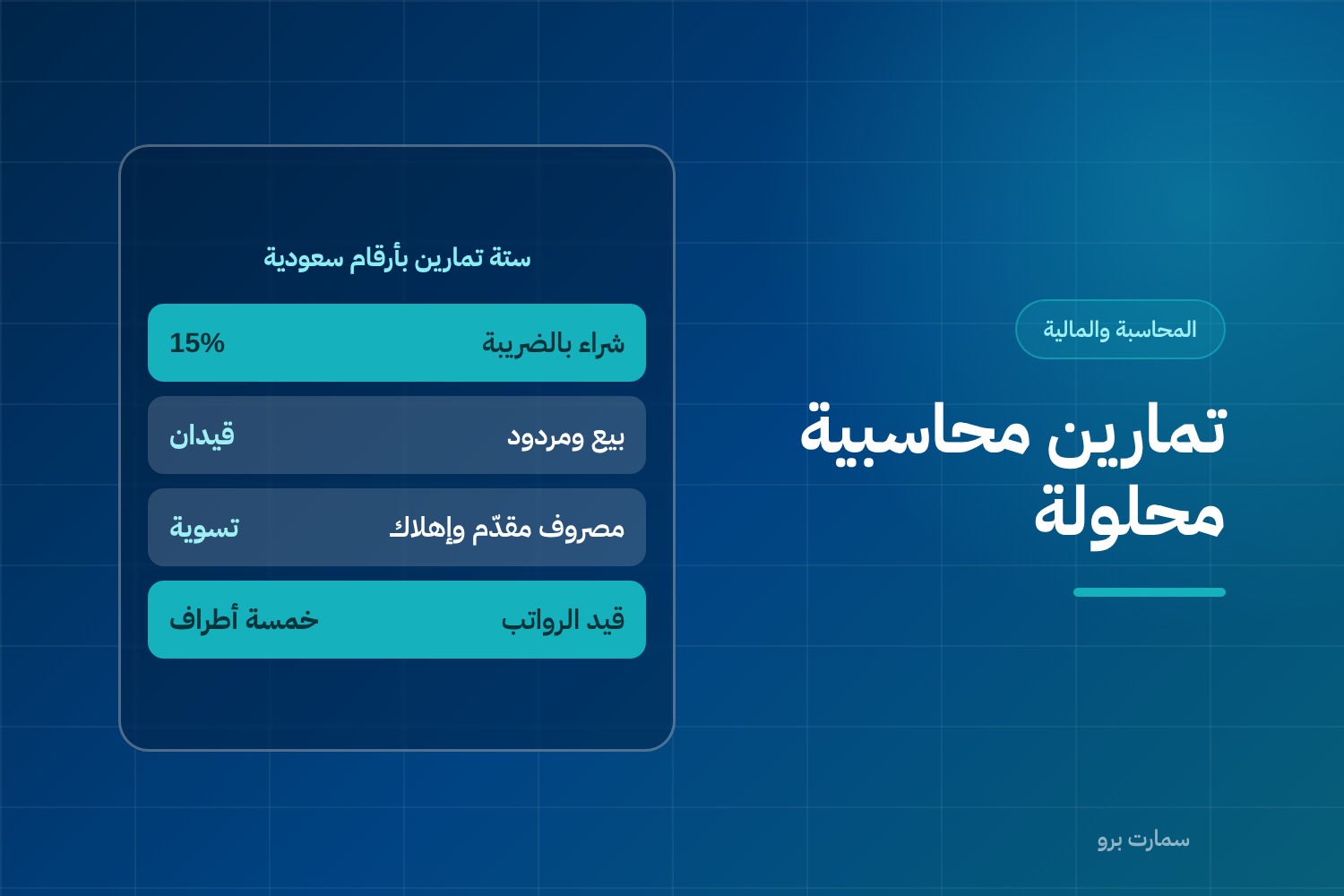
These solved accounting exercises use Saudi figures and 15% VAT instead of examples from textbooks written for another tax environment. The six exercises cover what an accountant actually records: a purchase with VAT, a sale, a sales return, a year-end adjustment, depreciation and payroll. Each one comes with the complete journal entry.
All figures below are hypothetical. They illustrate the method and are not taken from any real business. Cover each solution, work the entry out yourself, then compare.
Exercise 1: How do you record a purchase of goods with VAT?
A business buys goods for SAR 20,000 before VAT, on credit, under a perpetual inventory system. A perpetual system updates the inventory account with every purchase and sale.
Solution:
| Account | Debit | Credit |
|---|---|---|
| Inventory | 20,000 | |
| VAT — input tax | 3,000 | |
| Suppliers (accounts payable) | 23,000 |
The VAT is 20,000 × 15% = 3,000. It does not form part of inventory cost because it is recoverable. It is recorded as a separate asset that is offset against output tax on the VAT return. Adding it to inventory inflates the cost of the goods and loses the right to recover it.
Exercise 2: How do you record a cash sale?
The business sells half of the goods for SAR 16,000 before VAT, in cash. The cost of the goods sold is SAR 10,000.
Solution: two entries, not one.
| Account | Debit | Credit |
|---|---|---|
| Cash | 18,400 | |
| Sales | 16,000 | |
| VAT — output tax | 2,400 |
| Account | Debit | Credit |
|---|---|---|
| Cost of sales | 10,000 | |
| Inventory | 10,000 |
The second entry is what separates perpetual from periodic inventory. Gross profit is 16,000 − 10,000 = SAR 6,000.
Exercise 3: How do you record a sales return?
The customer returns a quarter of the goods bought. The selling price of the returned goods is SAR 4,000 before VAT, and their cost is SAR 2,500.
Solution:
| Account | Debit | Credit |
|---|---|---|
| Sales returns | 4,000 | |
| VAT — output tax | 600 | |
| Cash | 4,600 |
| Account | Debit | Credit |
|---|---|---|
| Inventory | 2,500 | |
| Cost of sales | 2,500 |
A credit note is issued with this return to reverse the effect of the original invoice, because an e-invoice cannot be cancelled or edited in place. The details are in credit notes and debit notes.
Notice the use of a separate "Sales returns" account rather than debiting Sales directly. Gross sales stay visible, and returns appear as their own line that you can measure.
Exercise 4: How do you record a prepaid expense and its adjustment?
The business pays a year's rent of SAR 60,000 on 1 October. What is the payment entry, and what is the adjusting entry on 31 December?
Solution: at payment.
| Account | Debit | Credit |
|---|---|---|
| Prepaid expenses | 60,000 | |
| Bank | 60,000 |
On 31 December, three months have passed: 60,000 × (3 ÷ 12) = 15,000.
| Account | Debit | Credit |
|---|---|---|
| Rent expense | 15,000 | |
| Prepaid expenses | 15,000 |
Only SAR 15,000 appears in the income statement, and SAR 45,000 remains an asset in the statement of financial position. Charging the full SAR 60,000 to the year of payment distorts both statements. This is one of the adjusting entries.
Exercise 5: How do you calculate and record depreciation?
A machine costs SAR 80,000, has a residual value of SAR 5,000 and a useful life of 5 years, using the straight-line method. What is the annual charge and its entry?
Solution: (80,000 − 5,000) ÷ 5 = SAR 15,000 per year.
| Account | Debit | Credit |
|---|---|---|
| Depreciation expense | 15,000 | |
| Accumulated depreciation — machinery | 15,000 |
The credit goes to accumulated depreciation, not to the machine itself, so the original cost stays visible. The carrying amount after two years is 80,000 − 30,000 = SAR 50,000. The other methods are covered in depreciation methods.
Exercise 6: How do you record the payroll entry?
One month's payroll: gross earnings of SAR 100,000, employees' share of social insurance (GOSI) SAR 9,000, employer's share SAR 12,000, and employee advances recovered SAR 3,000.
Solution:
| Account | Debit | Credit |
|---|---|---|
| Salaries and wages expense | 100,000 | |
| Social insurance expense — employer's share | 12,000 | |
| Social insurance payable | 21,000 | |
| Employee advances | 3,000 | |
| Salaries payable | 88,000 |
Check the balance: 112,000 in debits against 112,000 in credits. Net pay transferred is 100,000 − 9,000 − 3,000 = SAR 88,000. Social insurance payable combines both shares: 9,000 + 12,000.
Note that the payroll cost to the business is SAR 112,000, not 100,000. Anyone who records a single entry at the net amount misses this. The details are in the payroll journal entry and the total cost of an employee.
How do you actually get value from solved accounting exercises?
Don't read the solutions. Cover them, read the facts, write the entry by hand, then compare. A mistake you catch yourself sticks; a solution you only read is forgotten.
Then test your system: enter the same facts and see whether it produces the same entries. Many systems post a condensed entry that hides one side, and that only shows up when you compare. In SmartPro, a sale updates stock and accounts by itself, so you can check both the revenue entry and the cost entry against Exercise 2; see Finance & Accounting. The foundation of every entry is in double-entry bookkeeping and types of journal entries.
The recognition and measurement principles in these exercises come from IFRS Accounting Standards, and the VAT rate applied in Saudi Arabia is 15%.
Key takeaway: Recoverable VAT stays out of inventory cost, every sale under perpetual inventory needs two entries, and true payroll cost includes the employer's GOSI share. Work each exercise yourself before checking the solution.
To see these entries generated automatically from real transactions, start a free SmartPro trial or book a demo.
Frequently asked questions
Is VAT included in the cost of inventory?
No, not when it is recoverable. It is recorded in a separate "VAT — input tax" account and offset against output tax on the VAT return. Adding it to inventory cost inflates the cost and loses the right to recover it. If the activity is exempt and has no right to recover input tax, however, the VAT becomes part of the cost.
How many journal entries does a single sale create?
Two under a perpetual inventory system. The first records revenue: debit cash or customers, credit sales and output VAT. The second records cost: debit cost of sales, credit inventory. Under a periodic system only the revenue entry is made, and cost of sales is calculated with a formula at the end of the period.
How is a sales return recorded?
With two reversing entries. The first debits sales returns and output VAT and credits cash or customers. The second debits inventory and credits cost of sales at the cost of the returned goods. A credit note is issued with it to reverse the effect of the original invoice, because an e-invoice cannot be cancelled or edited in place.
Why is the credit in a depreciation entry posted to accumulated depreciation and not to the asset?
Accumulated depreciation is a contra account to the asset, so the original cost stays visible in the books with the depreciated amount shown beside it. The difference between the two is the carrying amount. Reducing the asset directly loses track of its original cost and age.
What is the real payroll cost to a business?
Gross earnings plus the employer's share of social insurance, not the net pay transferred. A gross payroll of SAR 100,000 with an employer's share of SAR 12,000 costs SAR 112,000, not 100,000 or 88,000. Recording a single entry at the net amount hides the employer's share and understates labour cost.