
Deferred Revenue: A Liability, Not Income, and How to Record It Month by Month
Cash received before you deliver is a liability, not profit. When deferred revenue arises, its month-by-month journal entries with an example, and how it differs from a prepaid expense.
Author:سامي الحيدري
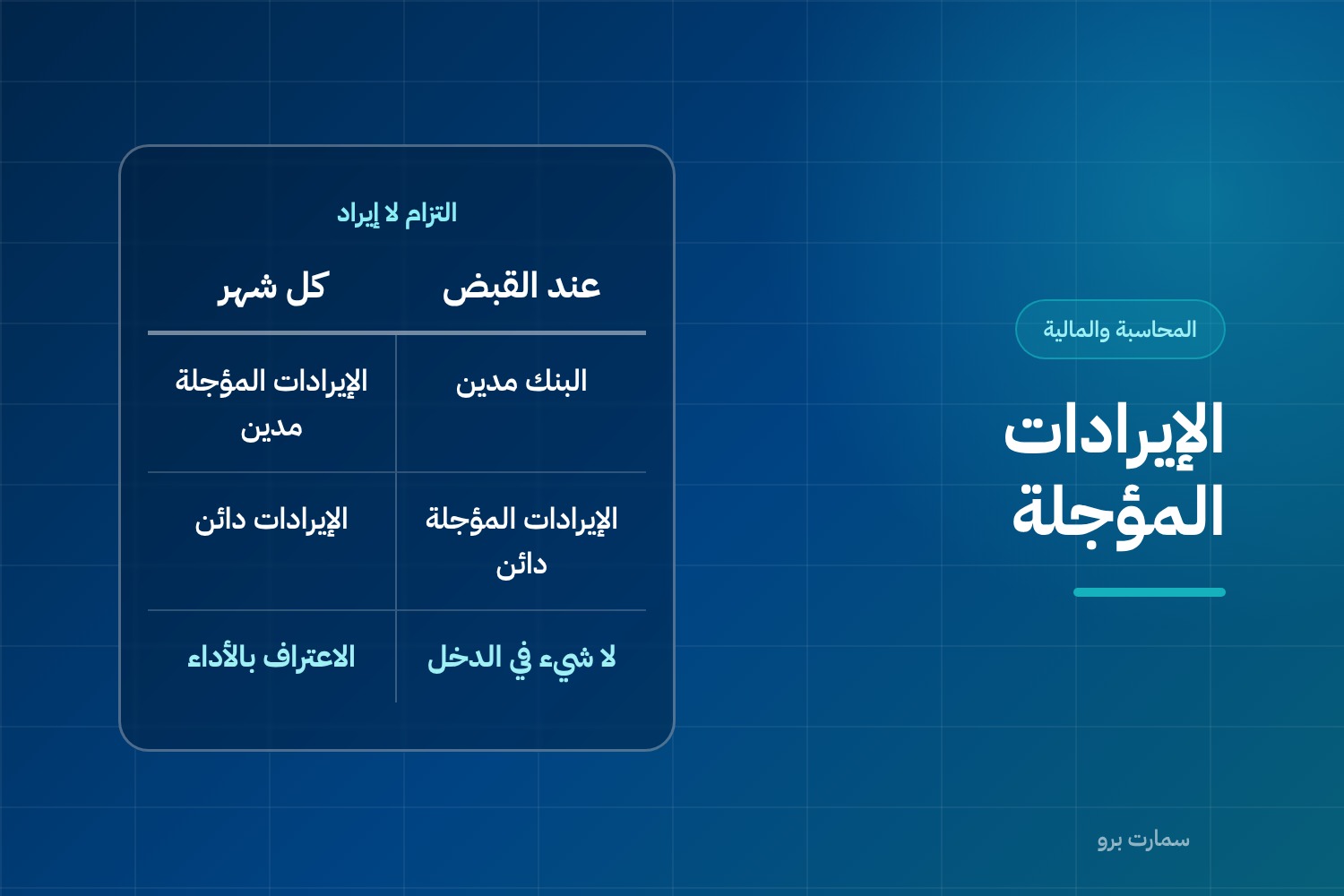
Deferred revenue is not revenue. It is a liability: money you have collected but not yet earned by delivering, so it is a debt you owe, not a profit. Many small businesses post it to revenue on the day they collect. That shows profit that has not been earned, and the following months then carry costs with no revenue to match them.
The clearest picture is an annual subscription of SAR 12,000 collected in January. The full amount is in the bank, but you have delivered only one month. Eleven-twelfths of that amount remain a liability until you deliver them.
When does deferred revenue arise?
Whenever you collect before you perform:
- Advance subscriptions: software, maintenance, memberships, hosting.
- Advance payments on a contract not yet carried out.
- Rent collected in advance for a future period.
- Gift cards and customer credit: cash today, goods later.
- Training or course fees collected before the course runs.
- Extended warranties sold with a product and covering several years.
One rule governs them all: revenue is recognised when the performance obligation is satisfied, not when the cash arrives. A performance obligation is a promise in a contract to deliver a distinct good or service to the customer. This is the core of revenue recognition, and it is what separates the cash basis from the accrual basis.
How do you record deferred revenue, step by step?
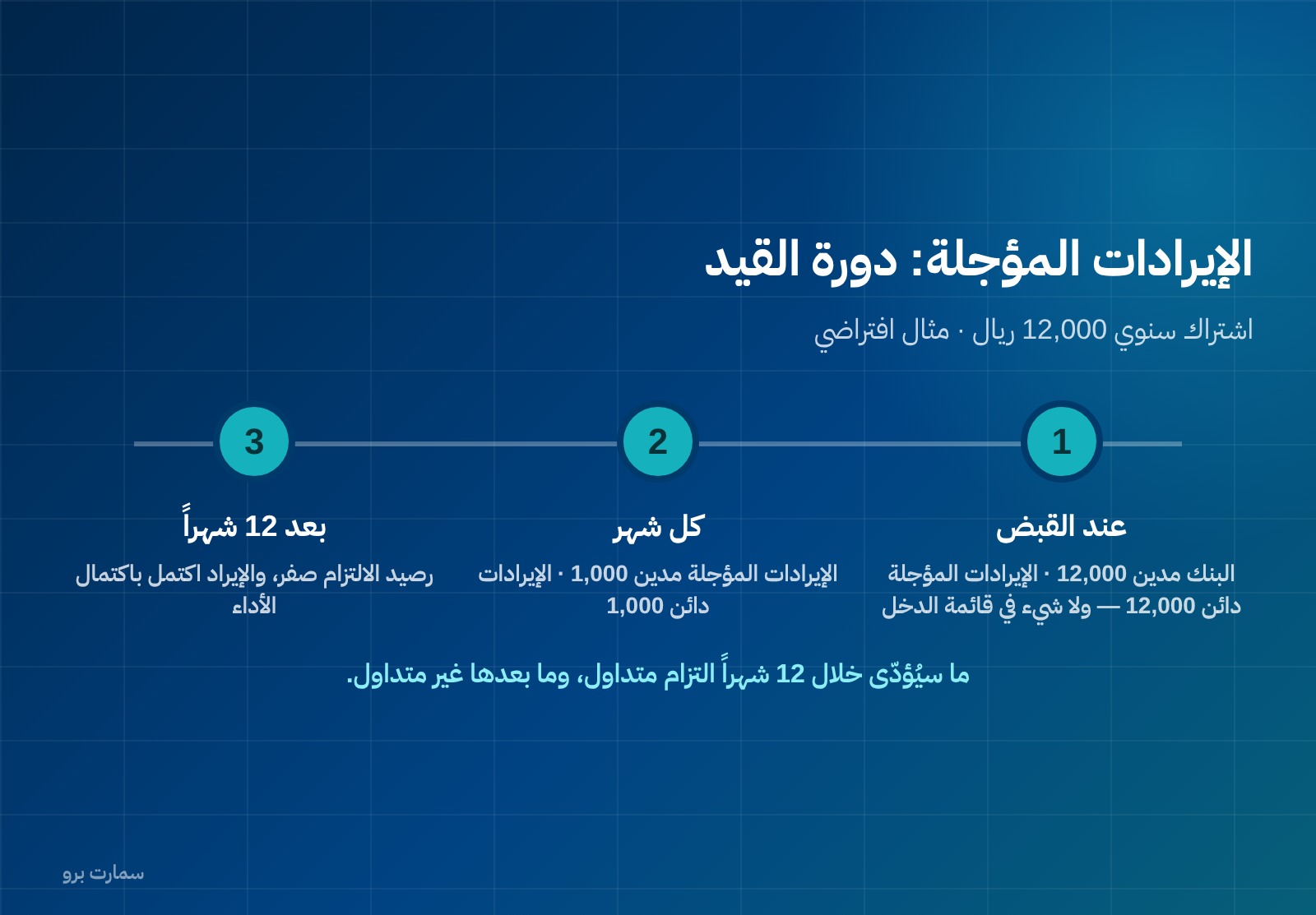
The figures below are hypothetical, to illustrate the method. An annual subscription of SAR 12,000 is collected on 1 January, and the service is delivered evenly over twelve months.
On collection
Debit Cash or Bank 12,000 · Credit Deferred Revenue 12,000
Note that nothing passes through the income statement. The whole movement stays inside the statement of financial position: an asset comes in, and a liability arises.
At the end of each month
Debit Deferred Revenue 1,000 · Credit Revenue 1,000
| Month | Recognised (SAR) | Liability balance (SAR) |
|---|---|---|
| January | 1,000 | 11,000 |
| February | 1,000 | 10,000 |
| March | 1,000 | 9,000 |
| … | … | … |
| December | 1,000 | 0 |
The liability shrinks month after month, revenue builds up, and the balance reaches zero when performance is complete. This is one of the adjusting entries recorded at the end of every period.
Where does deferred revenue appear in the financial statements?
In the statement of financial position, under liabilities, not revenue. If the term is long, it is split:
- The part to be delivered within twelve months → current liability.
- The part beyond that → non-current liability.
So a three-year maintenance contract worth SAR 36,000 is split into SAR 12,000 current and SAR 24,000 non-current. Putting all of it under current liabilities makes your current ratio look worse than it really is. That distorts how your financial ratios read and how a bank assesses your file.
In the statement of cash flows, the collection appears under operating activities when it is received. That is why subscription businesses show cash flow higher than their accounting profit. This is not an error; it is the nature of the model.
What are the two most costly mistakes?
First: recognising everything on collection. The effect is twofold: inflated profit in the period of collection, and later periods carrying the cost of the service with no revenue. The business reads this as a decline in performance when it is really a recording error. For zakat and tax, revenue recognised too early pulls the base into a year it does not belong to.
Second: confusing it with a prepaid expense. Both are "paid in advance", but they are exact opposites:
| Deferred revenue | Prepaid expenses | |
|---|---|---|
| Who paid? | The customer paid you | You paid the supplier |
| Nature | Liability | Asset |
| Where it sits | Liabilities side | Assets side |
| How it is used up | Turns into revenue | Turns into an expense |
What happens on refund or cancellation?
What if the customer cancels after three months? The remaining liability (SAR 9,000 in the example) does not turn into revenue automatically:
- If refunded: debit Deferred Revenue, credit Bank.
- If the customer's right lapses under a contract term: recognise it as revenue when the right lapses, not before.
Gift cards are a special case. Part of them is never used, and it is not correct to recognise that as revenue simply because time has passed. It needs a written policy and a historical pattern to base the estimate on.
Which three situations make it harder to apply?
A contract delivered at an uneven pace. Not every contract is spread evenly across its months. A contract that delivers eighty per cent of its work in the first quarter recognises revenue by percentage of completion, not by the number of months. Straight-line allocation suits subscriptions where the service is delivered steadily, such as hosting or maintenance with periodic visits, not milestone-based contracts.
A non-refundable advance payment. Collecting a non-refundable deposit does not mean recognising revenue. The standard looks at the performance obligation, not at whether the money can be refunded. The deposit remains a liability until you perform, and even if you keep it on cancellation, it is recognised at that point, not earlier.
A subscription with several components. A subscription that bundles a software licence, initial training and annual support is not one obligation but three. The price is allocated across them based on the standalone selling price of each, and each part is recognised when its obligation is met: training when it is delivered, support across the year. Treating them as one block brings revenue forward or pushes it back for no reason.
How can you spot the error in one minute?
Open the income statement and the statement of cash flows for the same period. If revenue equals cash collected from customers exactly, month after month, you are on the cash basis, whatever your accounting policy says.
For a subscription business the two figures should differ: cash jumps in the renewal month, while revenue moves in a straight line. If they match, that is not precision. It is proof that the deferred revenue account is not being used at all.
How does deferred revenue affect VAT?
VAT is generally due on the earliest of three events: payment, supply, or issuing the invoice. So collecting SAR 12,000 in advance with an invoice creates output VAT in the period of collection, even though the accounting revenue is recognised over twelve months.
This is a timing difference between the accounting treatment and the tax treatment. It is legitimate and expected, but it should be deliberate, not a surprise. If you record the liability in your books but forget the tax in your VAT return, you file an incomplete return.
Checklist
- Open your chart of accounts and make sure there is a "Deferred Revenue" account under liabilities, not revenue. Building the chart itself is covered in the chart of accounts guide.
- Review every advance payment you collected this year: has the service actually been delivered?
- Set up an amortisation schedule for every long contract and link it to an automatic monthly entry.
- Separate current from non-current before preparing the financial statements.
- Write a refund and cancellation policy before you need it.
The rules for revenue recognition and the presentation of liabilities are set out in the International Financial Reporting Standards.
Key takeaway: Cash collected before you deliver is a liability, not profit. Record it as deferred revenue, release it to revenue as you perform, and account for VAT in the period you collect.
To see how automated journal entries work in SmartPro's Finance & Accounting, start a free trial.
Article visuals
Frequently asked questions
What is deferred revenue?
Deferred revenue is an amount collected before the matching goods or services have been delivered, so it is recorded as a liability, not as revenue. It arises whenever collection comes before performance: advance subscriptions, advance payments on contracts, rent collected in advance, gift cards, course fees before the course runs, and extended warranties.
How is deferred revenue recorded?
On collection, debit Cash or Bank and credit Deferred Revenue, and nothing passes through the income statement. At the end of each period, debit Deferred Revenue and credit Revenue for the amount delivered. The liability shrinks and revenue builds up until the balance reaches zero when performance is complete.
Where does deferred revenue appear in the financial statements?
It appears in the statement of financial position under liabilities, not revenue. If the term is long, it is split: the part to be delivered within twelve months is a current liability, and the rest is non-current. Putting a three-year contract entirely under current liabilities makes the current ratio look worse than it really is.
What is the difference between deferred revenue and prepaid expenses?
They are exact opposites. Deferred revenue is money the customer paid you; it is a liability on the liabilities side and turns into revenue. A prepaid expense is money you paid a supplier; it is an asset on the assets side and turns into an expense.
How does deferred revenue affect VAT in Saudi Arabia?
VAT is generally due on the earliest of payment, supply, or issuing the invoice. So collecting an amount in advance with an invoice creates output VAT in the period of collection, even if the accounting revenue is recognised over twelve months. This is a legitimate timing difference, but it should be deliberate, not a surprise.