
Saudi VAT Number: Its Format, How to Get and Verify It, and the Confusion with the Distinctive Number
Fifteen digits and a start-and-end rule, the steps to obtain one, ZATCA's free verification service, and a genuine overlap with the distinctive number (TIN).
Author:سامي الحيدري
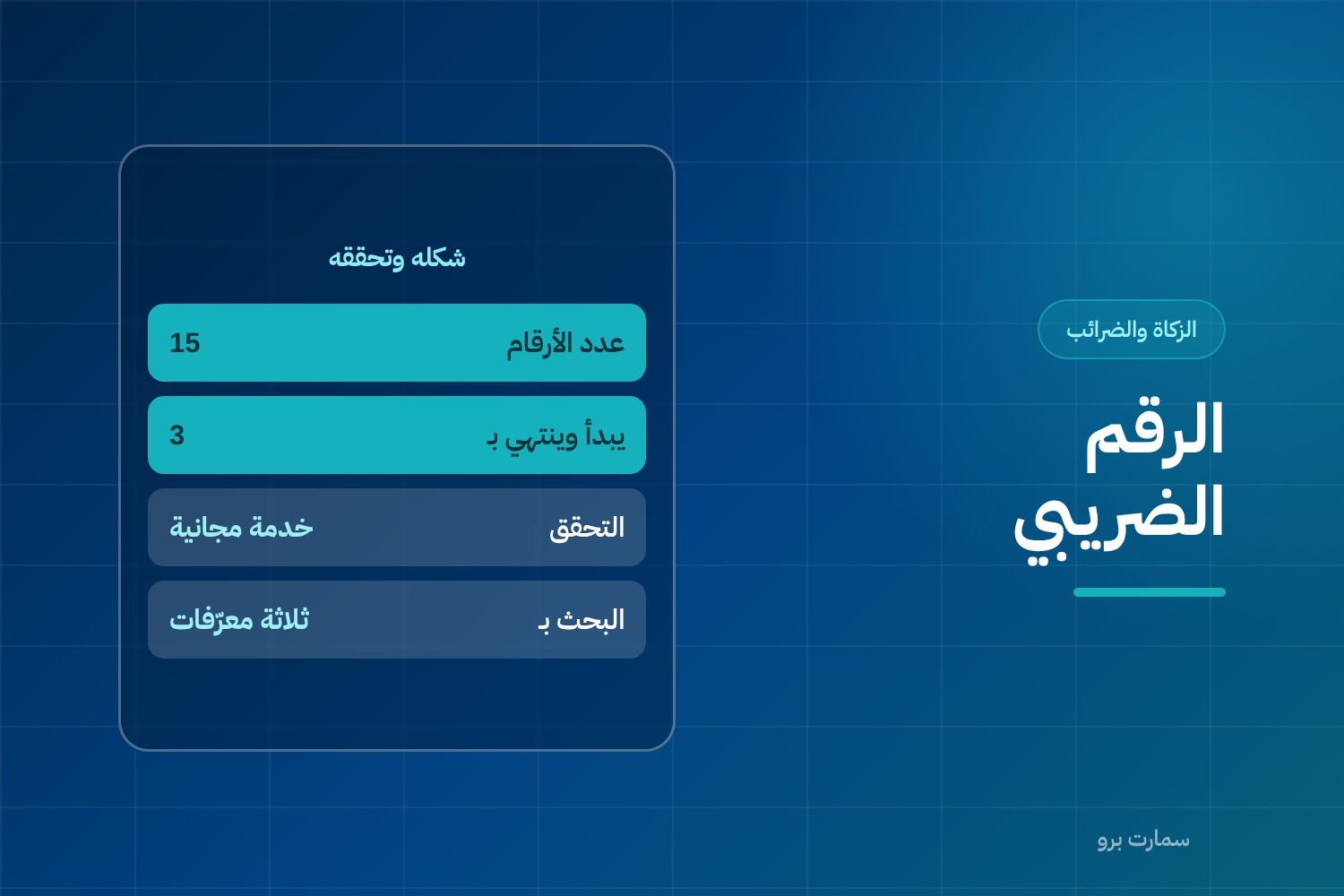
A Saudi VAT number is the number a business receives when it registers for value added tax. It is a mandatory item in the supplier field of a tax invoice and inside the invoice's QR code. Obtaining one is rarely the problem. The confusion is between it, the distinctive number and the commercial registration number, and many sources share that mix-up.
This article untangles them precisely, including one point where ZATCA's own documents are inconsistent.
What does a Saudi VAT number look like?
Fifteen digits, starting and ending with the digit 3.
This rule is set out in the Detailed Technical Guideline for e-invoicing, in the specification for the organisation identifier in the certificate request. It is the only rule ZATCA states as a requirement.
One caveat that few people mention: the Billing and Records Guideline shows an example VAT number that ends in 1, not 3. The example does not match the rule. The safe reading is to keep the "starts and ends with 3" rule within its context, the VAT registration number used in e-invoicing, rather than apply it to every tax number in every context.
If you need certainty in a specific case, the reference is the registration certificate itself, not a general rule.
VAT number vs distinctive number: a genuine overlap
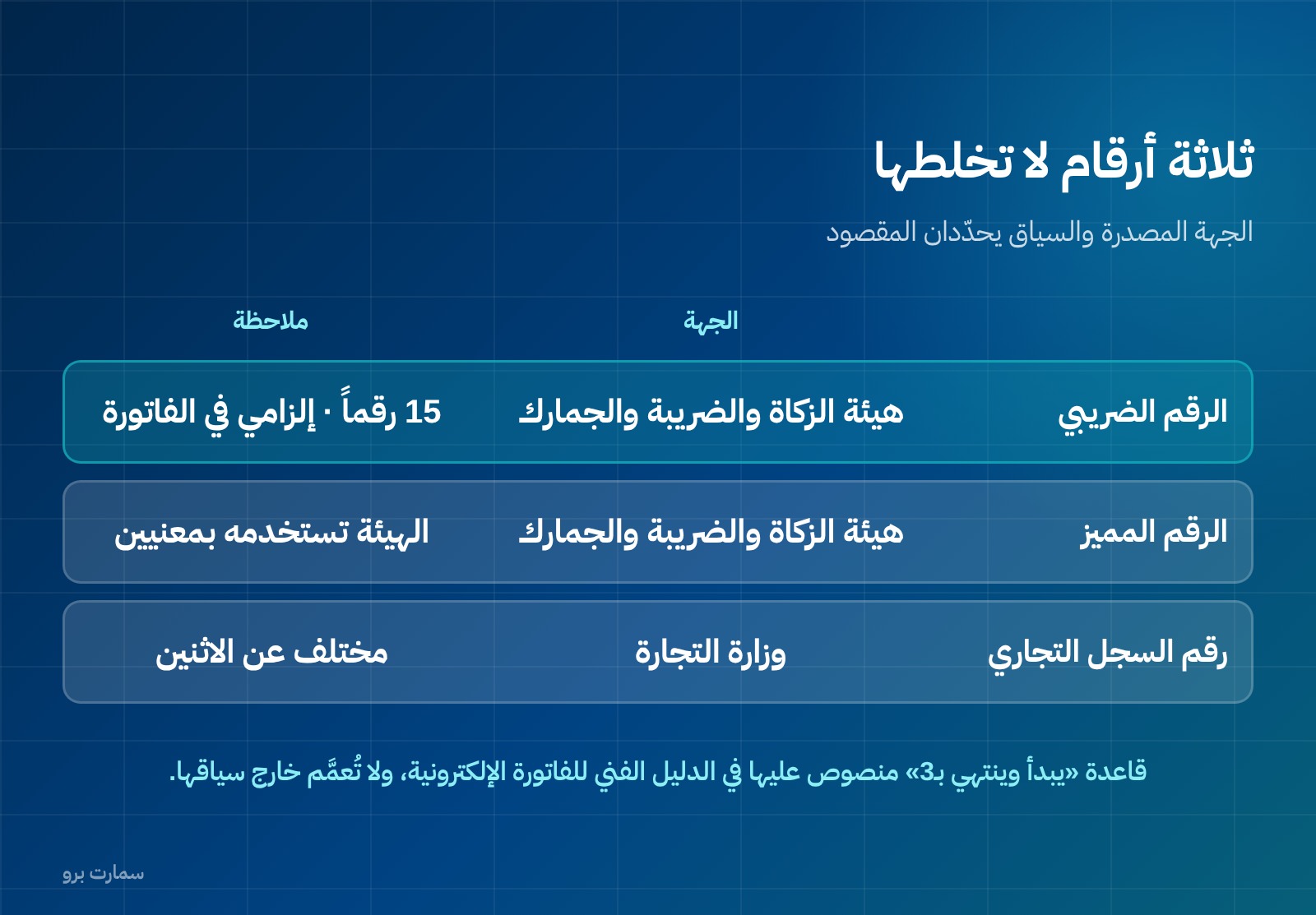
This is what most articles avoid because it is inconvenient: ZATCA uses "distinctive number" in two different senses.
- In the Distinctive Number Guideline, it is a number a business receives when it registers with ZATCA, and it is issued when the Ministry of Commerce issues the commercial registration. It is cancelled only after both the VAT and excise registrations are cancelled and all returns and amounts due are settled. The guideline does not state how many digits it has.
- In the Billing and Records Guideline (section 4-2-3), "distinctive number" is used to mean the supplier's number shown on the VAT registration certificate, in other words the VAT number itself.
So anyone who writes that "the distinctive number is definitely different from the VAT number" contradicts one ZATCA document, and anyone who writes that they are the same contradicts the other. The correct approach is to mention both uses and let the context determine which is meant.
The commercial registration number comes from the Ministry of Commerce, not ZATCA, and is different from both. Note also that the Detailed Technical Guideline refers to the distinctive number (TIN) as having ten digits, in the context of VAT group members.
How do you get a VAT number?
| Step | Detail |
|---|---|
| 1 | Log in to the ZATCA portal |
| 2 | Open the General Services tab |
| 3 | Select the VAT registration service |
| 4 | Complete the registration form |
| 5 | Receive notification by SMS and email |
ZATCA calls the result the "VAT account number".
The registration page for individuals states the thresholds explicitly: registration is mandatory for anyone whose annual revenue exceeds SAR 375,000, and voluntary for revenue between SAR 187,500 and SAR 375,000. The page for businesses refers to reaching the mandatory or voluntary threshold without stating the figures. So the figures above are given in the context of individuals; for your business's position, see the registration cases covered in VAT registration in Saudi Arabia.
You can reprint the registration certificate through a separate service on the portal.
What happens to the number in a VAT group?
This case deserves its own section. When businesses join a single VAT group, each member's number does not disappear, but the group receives its own registration number, which it uses on invoices to external parties.
The Detailed Technical Guideline states that the organisational unit name in the certificate request carries the ten-digit distinctive number of each group member. So there are two numbers in play, not one: the group's number in the supplier field, and the member's number inside the certificate data.
A business that joins a VAT group without setting this up correctly in its system will issue invoices with the wrong number from day one. It is worth a technical review with your system provider before the effective date, not after.
Two questions to ask before you register
Are you required to register, or is it optional? Mandatory registration is tied to exceeding a set threshold, and voluntary registration is available below it, subject to a condition. Voluntary registration is not a cost-free decision: it lets you deduct input VAT, but it also commits you to periodic returns and the full invoicing rules, and by extension to the integration phase of e-invoicing when your wave comes.
Are you ready for what comes after the number? Getting the number is the start of a process, not the end. It is followed by a monthly or quarterly cycle of returns, payment deadlines and late penalties. A business that registers and then does not file its returns has created an obligation it cannot meet, and penalties build up on the silent filer just as they do on the one who files incorrectly. The return cycle is covered in filing a VAT return, and all the deadlines are gathered in the zakat and tax calendar.
How do you verify a supplier's VAT number?
ZATCA provides a "VAT registration verification" service, which is free and open to the public, not only to registered taxpayers.
You can search by any one of three:
- VAT number
- Commercial registration number
- VAT certificate number
This service matters more than it seems. Receiving a tax invoice from an unregistered supplier means the input VAT on it is not deductible, so you have paid 15% you will not recover. Checking before you approve a new supplier's first invoice takes a minute and prevents a loss that repeats every month. The deduction rules are in input VAT deduction.
Where must the number appear?
- In the supplier field of the tax invoice. It is a mandatory item; the other items are detailed in tax invoice requirements.
- Inside the QR code printed on the invoice, detailed in QR code requirements.
- In VAT returns and correspondence with ZATCA.
- On invoices you receive from a supplier, it is the supplier's number, not yours. Entering your own business's number on purchase invoices is a common data-entry error.
Which mistakes keep happening?
- Mixing up your number and your customer's when preparing an invoice, so it goes out with the wrong supplier field.
- Assuming a supplier is registered because their invoice says "tax invoice". The format does not prove registration; verification does.
- Using the number after deregistration. A business that has cancelled its registration may no longer issue tax invoices; details are in VAT deregistration in Saudi Arabia.
- Relying on the "ends with 3" rule to verify a number instead of using ZATCA's service. The rule does not prove the number is actually registered or that the registration is still active.
- Entering it with spaces or dashes, so it is rejected by the system or in the e-invoice file.
A short checklist
- Make sure your number in the system matches the registration certificate, digit by digit.
- Make supplier VAT number verification a mandatory step in your new-supplier approval process.
- Review a sample of your purchase invoices: do they carry the supplier's number or yours?
- Keep a copy of the registration certificate where whoever issues invoices can reach it.
Reference for procedures and services: Zakat, Tax and Customs Authority (ZATCA).
Article visuals
Frequently asked questions
How many digits does a Saudi VAT number have, and what does it look like?
Fifteen digits, starting and ending with the digit 3. This rule is set out in ZATCA's Detailed Technical Guideline for e-invoicing, in the organisation identifier specification. One caveat: the Billing and Records Guideline shows an example ending in 1, so the rule should be kept within its e-invoicing context rather than generalised.
How do I get a VAT number in Saudi Arabia?
Log in to the ZATCA portal, open the General Services tab, select the VAT registration service and complete the registration form. You are then notified by SMS and email. ZATCA calls the result the VAT account number.
How do I verify a supplier's VAT number?
Use the VAT registration verification service on the ZATCA portal, which is free and open to the public. You can search by VAT number, commercial registration number or VAT certificate number. Verification matters because an invoice from an unregistered supplier means input VAT you cannot deduct.
What is the difference between the VAT number and the distinctive number?
ZATCA uses "distinctive number" in two senses. In the Distinctive Number Guideline, it is a number a business receives when it registers with ZATCA, issued alongside the commercial registration; in the Billing and Records Guideline, it means the supplier's number on the VAT registration certificate, which is the VAT number itself. The correct approach is to mention both uses and let the context decide. The commercial registration number comes from the Ministry of Commerce and differs from both.
What are the VAT registration thresholds in Saudi Arabia?
ZATCA's registration page for individuals states that registration is mandatory for annual revenue above SAR 375,000 and voluntary for revenue between SAR 187,500 and SAR 375,000. The page for businesses refers to reaching the threshold without stating the figures.