
IAS 7: The Statement of Cash Flows
What IAS 7 requires of the statement of cash flows: the three-way classification, cash equivalents, the direct and indirect methods, and the changes coming in 2027.
Author:سامي الحيدري
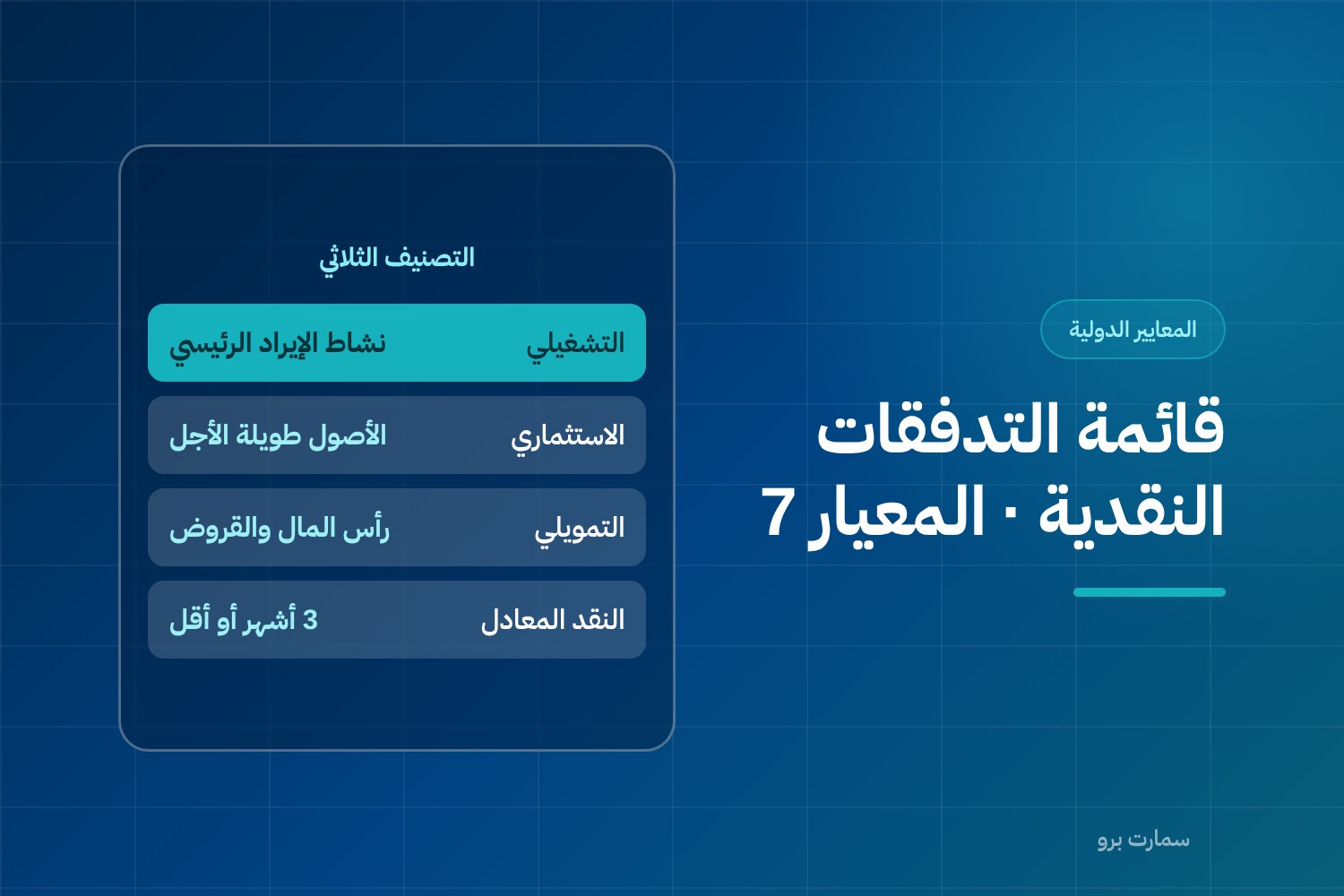
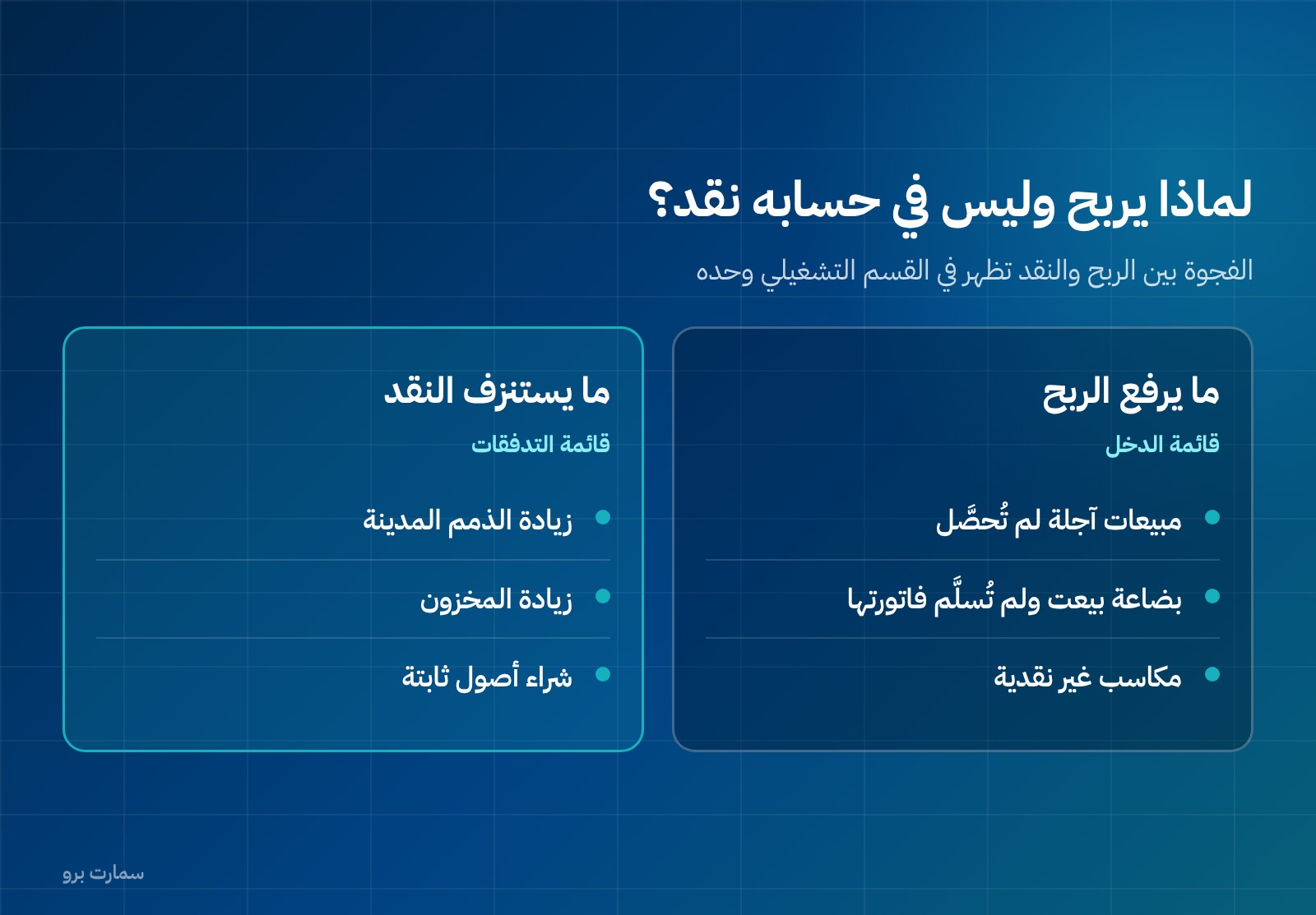
IAS 7 is the standard that governs the statement of cash flows. It answers a question that puzzles many business owners: how can a company be profitable on paper and still have no cash in the bank? The other primary statements report profit and financial position. Only this one reports cash: where it came from and where it went.
The standard applies to every entity without exception, whatever its activity, including financial institutions. The statement is an integral part of the financial statements for every period presented. It is not an optional extra added when needed.
What is the three-way classification under IAS 7?
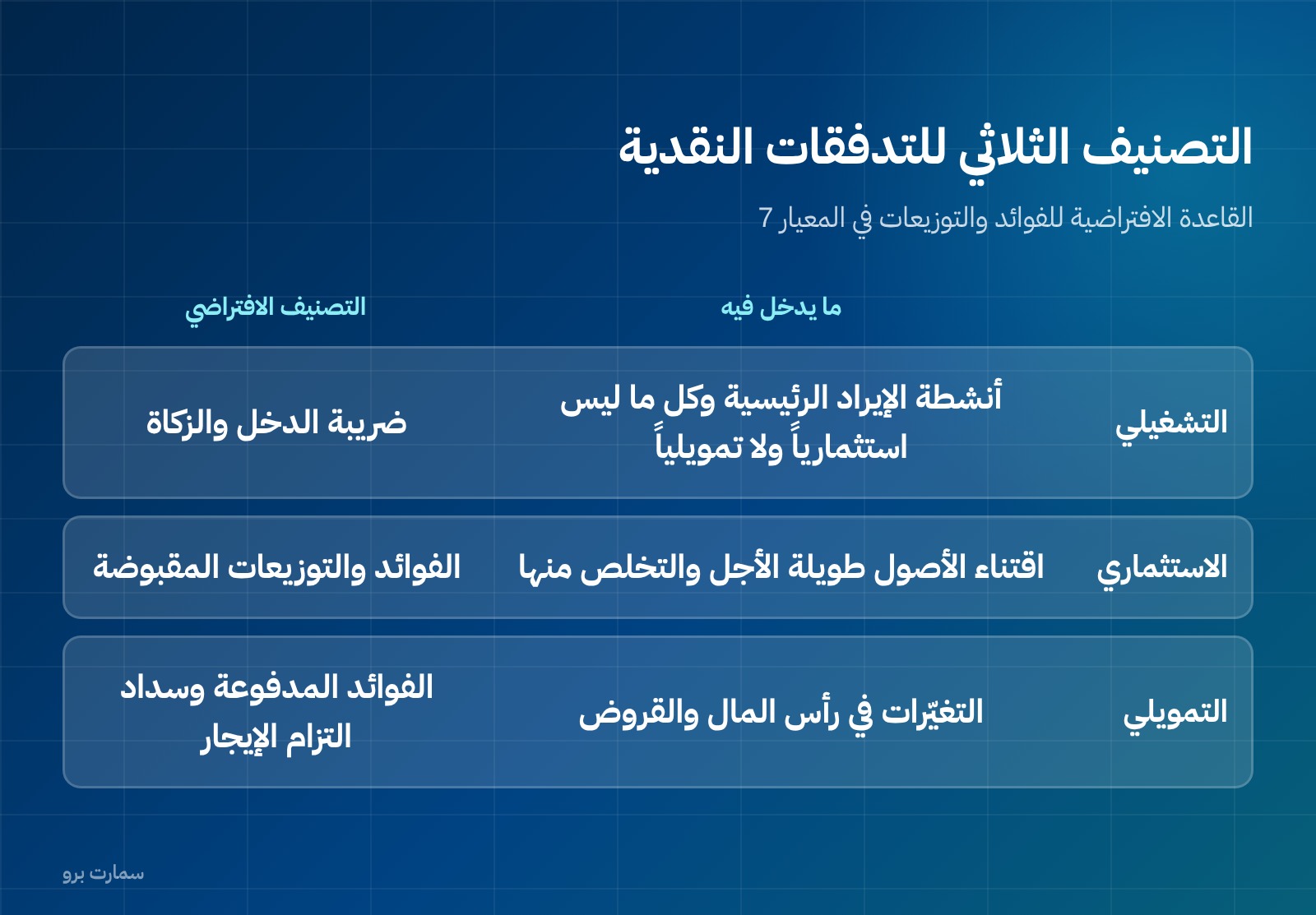
Every cash movement is classified into one of three categories. A classification error distorts the picture even when the total is correct:
| Activity | What it includes |
|---|---|
| Operating | The principal revenue-producing activities, and everything that is not investing or financing |
| Investing | Acquiring and disposing of long-term assets, and investments that are not cash equivalents |
| Financing | Changes in the size and composition of contributed equity, and borrowings |
The default rule in the text: interest paid is financing, while interest and dividends received are investing. Entities whose main business is investing in assets or providing finance to customers have a specific treatment. A lessee's payments on the lease liability are financing, and dividends paid are financing too.
What counts as cash and cash equivalents?
Cash comprises cash on hand and demand deposits. Cash equivalents are short-term, highly liquid investments that are readily convertible to known amounts of cash and subject to an insignificant risk of changes in value, normally with a maturity of three months or less from the date of acquisition.
A one-year deposit is therefore not a cash equivalent, however safe it is. Mixing it into the balance makes your liquidity look larger than it really is.
Direct or indirect method: what is the difference?
For the operating section you have two options. The direct method shows the major classes of gross cash receipts and payments: how much you actually collected from customers and how much you paid suppliers. The indirect method starts from operating profit or loss and adjusts it for non-cash items and working capital movements.
The standard encourages the direct method, but most entities choose the indirect method because it is easier to extract from the books.
The starting point of the indirect method has changed. Following the amendments made by IFRS 18, it is now operating profit or loss, not net profit as before.
Should cash flows be shown gross or net?
The general rule for investing and financing activities is to present cash flows gross: inflows and outflows shown separately. Netting is allowed in only two narrow cases: amounts received or paid on behalf of customers, and items with quick turnover, large amounts and short maturities.
A company that borrowed SAR 10 million and repaid SAR 9 million does not present a single net SAR 1 million.
Which disclosures are most often forgotten?
- Components of cash and cash equivalents, reconciled to the amounts in the statement of financial position, together with the policy for determining those components.
- Changes in liabilities arising from financing activities: a reconciliation from opening to closing balance, split into financing cash flows, the effect of obtaining or losing control, foreign exchange effects, fair value changes and other changes.
- Supplier finance arrangements: their terms, the carrying amounts at the start and end of the period, and the range of payment due dates compared with comparable trade payables. This disclosure is recent, effective from 2024, and many entities overlook it.
- Non-cash transactions, such as acquiring an asset through a lease liability: these are disclosed, not presented within cash flows.
How are foreign currency cash flows translated?
Foreign currency cash flows are translated at the exchange rate on the date of each cash flow, and a foreign subsidiary's cash flows at the rates on the dates of those flows. An approximate weighted average rate may be used, but the period-end rate may not be used for a subsidiary's cash flows.
Unrealised exchange differences are not cash flows at all. For more detail, see our guide to IAS 21 and foreign exchange.
Where do income tax and zakat go?
Tax payments are presented separately and classified as operating activities, unless they can be specifically identified with an investing or financing activity. If they are allocated across more than one category, the total amount paid must be disclosed.
What changes in 2027?
The IFRS 18 amendments touch this standard in two places: the starting point of the indirect method, as noted above, and the requirements for classifying interest and dividend cash flows. IFRS 18 is effective for periods beginning on or after 1 January 2027, with early application permitted.
If you are building your accounting system today, it makes sense to build it on the new classification from the start.
Example: the gap between profit and cash
The figures below are hypothetical, to illustrate the method. A business closed its year with a profit of SAR 400,000, yet its cash fell by SAR 60,000. The operating section explains the gap:
| Item | Amount (SAR) |
|---|---|
| Operating profit | 400,000 |
| Add: depreciation (non-cash item) | 120,000 |
| Less: increase in trade receivables | (310,000) |
| Less: increase in inventory | (180,000) |
| Add: increase in trade payables | 90,000 |
| Net cash from operating activities | 120,000 |
Then SAR 180,000 went out on equipment purchases under investing activities, leaving a net change of minus SAR 60,000. The business genuinely made a profit, but that profit went into receivables not yet collected and stock sitting in the warehouse. This is exactly what the cash flow statement reveals and the income statement does not. For more on reading it, see why profit doesn't equal cash.
What are three common preparation mistakes?
- Including long-term deposits in cash equivalents, which makes liquidity look larger than it is.
- Including non-cash transactions in cash flows, such as acquiring an asset against a lease liability. The correct treatment is disclosure in the notes.
- Changing the classification of interest from year to year. The standard requires consistency from period to period.
How does IAS 7 connect with other standards?
It overlaps with IAS 23 on borrowing costs for capitalised interest, which is included in interest paid; with IFRS 16 on leases for classifying lease liability payments; and with IAS 8 on accounting policies when the classification policy changes. The full official text is published on the IFRS Foundation's website at ifrs.org.
What is the standard's official name in Saudi Arabia?
The approved Arabic title is «المعيار الدولي للمحاسبة 7: قائمة التدفقات النقدية» (International Accounting Standard 7: Statement of Cash Flows). SOCPA adopted it with a Saudi modification: zakat was added alongside income tax in paragraphs 14 and 35, because zakat is an expense for Saudi companies. Zakat payments are therefore presented separately and classified as operating activities under the same rule.
Source: Saudi Organization for Chartered and Professional Accountants (SOCPA), the document adopting IFRS for application in the Kingdom, updated on 04/07/1447 AH.
Key takeaway: IAS 7 makes you explain every riyal of cash movement in three consistent categories, with cash equivalents limited to roughly three months' maturity and zakat shown separately under operating activities. Plan for the IFRS 18 changes now, before periods starting 1 January 2027.
SmartPro's accounting turns every sale, receipt and payment into a journal entry automatically, so the figures behind your cash flow statement stay current; start a free trial to see it with your own data.
Article visuals
Frequently asked questions
What does IAS 7 cover?
IAS 7 governs how the statement of cash flows is prepared and presented. It covers classifying cash flows as operating, investing or financing, the definition of cash and cash equivalents, and the accompanying disclosures. It applies to every entity, whatever its activity.
What is the difference between the direct and indirect methods?
The direct method shows the major classes of gross cash receipts and payments, such as cash collected from customers and paid to suppliers. The indirect method starts from operating profit or loss and adjusts it for non-cash items and working capital movements. IAS 7 encourages the direct method.
What is meant by cash and cash equivalents?
Cash is cash on hand and demand deposits. Cash equivalents are short-term, highly liquid investments readily convertible to known amounts of cash with an insignificant risk of changes in value. They normally mature within three months or less from the date of acquisition.
Where are interest paid and interest received classified?
By default, interest paid is classified under financing activities, while interest and dividends received are classified under investing activities. Entities whose main business is investing or providing finance to customers have a specific treatment. Whatever the classification, it must be applied consistently from period to period.
Are cash flows presented gross or net?
The general rule is gross presentation for investing and financing activities, with inflows and outflows shown separately. Netting is permitted only for amounts received or paid on behalf of customers, and for items with quick turnover, large amounts and short maturities.