
E-Invoicing Integration Waves 1 to 25: The Full Table of Thresholds and Dates
Every Phase 2 integration wave in one table, with each wave's threshold, the revenue years tested and ZATCA's date. It also explains why “with effect from” and “before” are not the same thing.
Author:سامي الحيدري
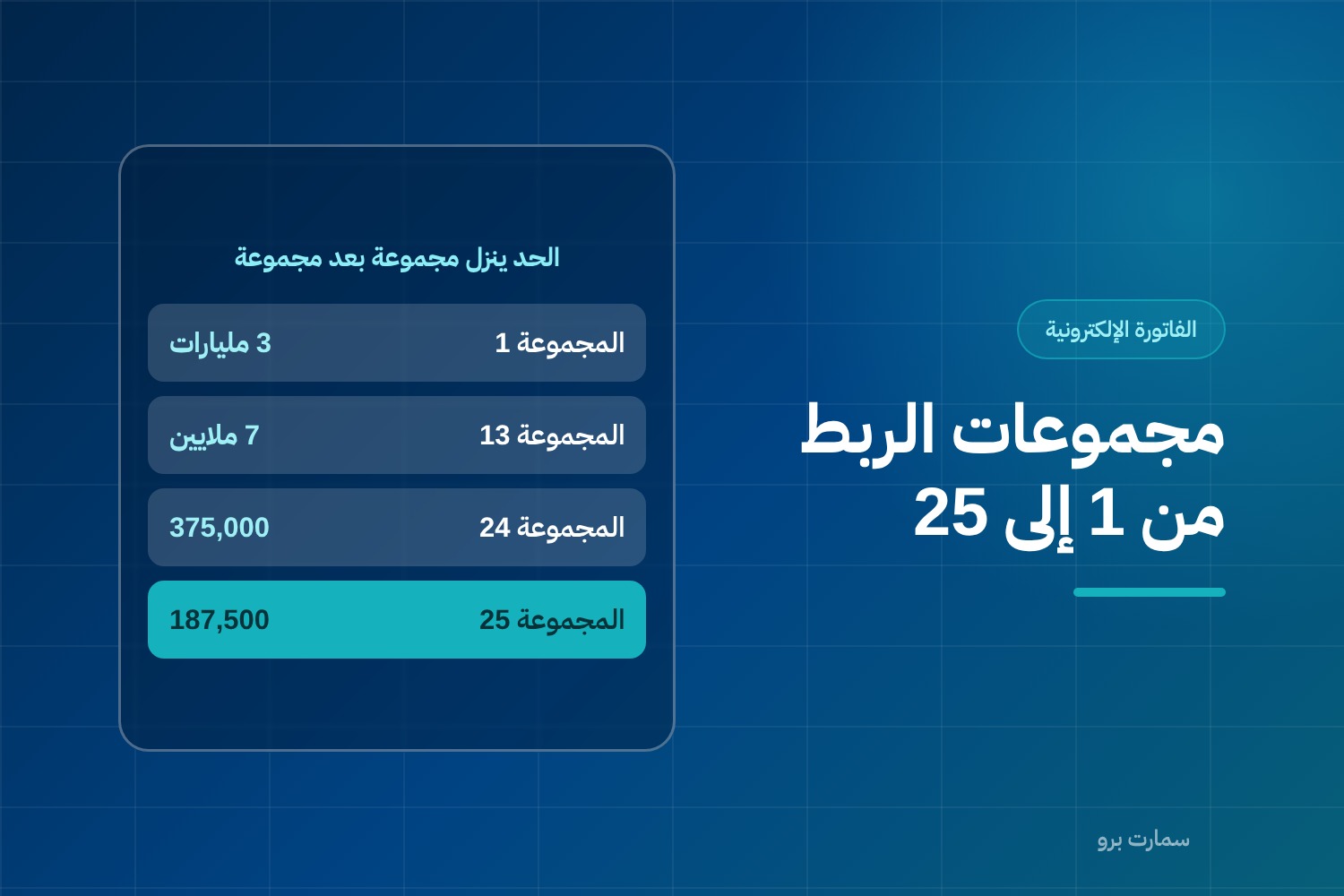
There are 25 e-invoicing integration waves to date, from a SAR 3 billion threshold in the first to SAR 187,500 in the twenty-fifth. What confuses most businesses is not the criterion itself. Most published material stops at an old wave, or mixes up the “start date” with the “deadline”, and ZATCA's wording treats those as two different things.
This page puts every wave in one table, updated in November 2026, using ZATCA's own wording rather than a paraphrase. An integration wave is a group of VAT-registered businesses that ZATCA requires to connect their invoicing systems to the Fatoora platform under Phase 2 of e-invoicing.
What are all the e-invoicing integration waves?
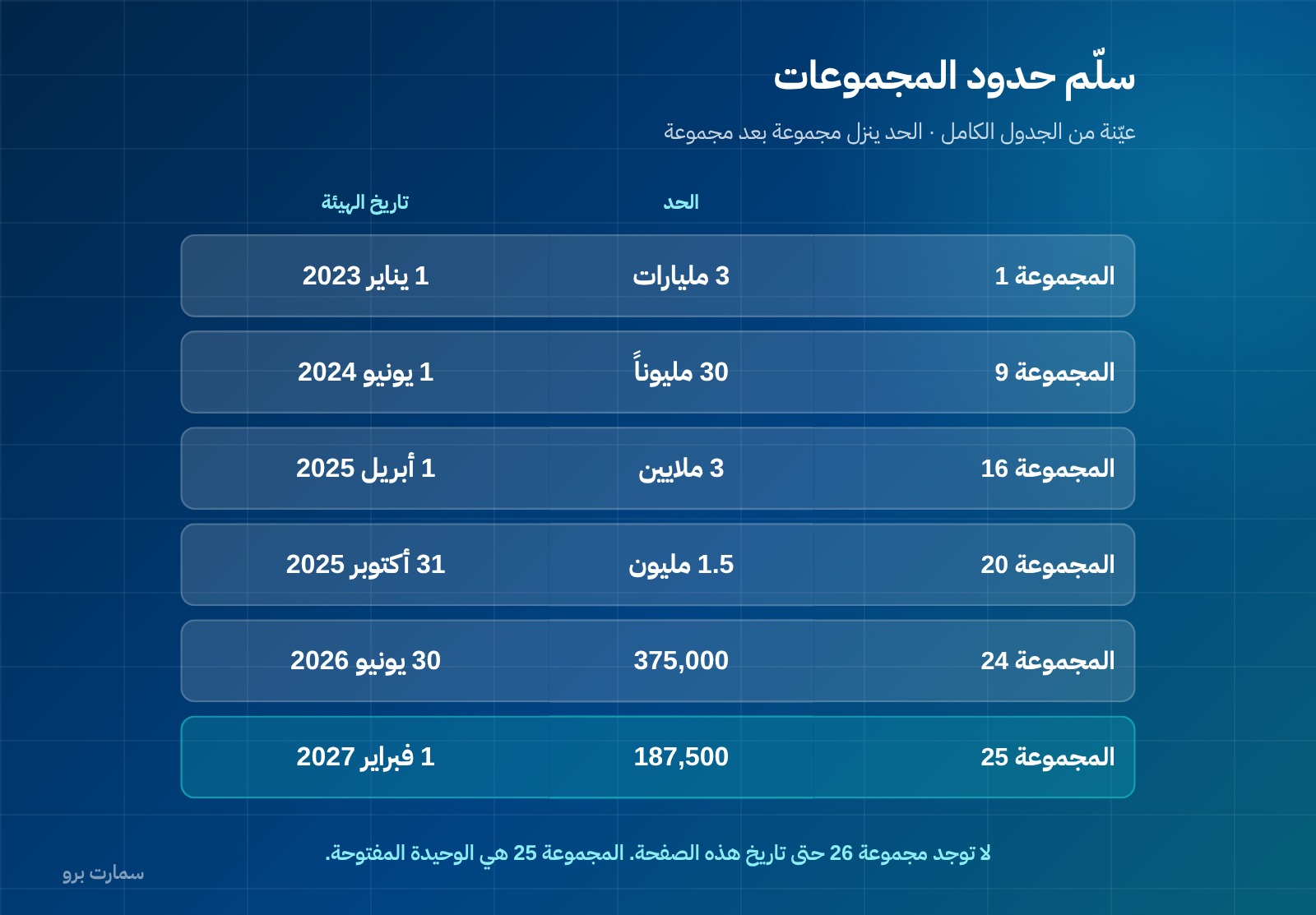
| Wave | Announced | Threshold (taxable revenue exceeding) | Years tested | ZATCA date |
|---|---|---|---|---|
| 1 | — | SAR 3 billion | 2021 | 1 January 2023 |
| 2 | 23 December 2022 | SAR 500 million | 2021 | 1 July 2023 |
| 3 | 24 March 2023 | SAR 250 million | 2021 or 2022 | 1 October 2023 |
| 4 | 28 April 2023 | SAR 150 million | 2021 or 2022 | 1 November 2023 |
| 5 | 26 May 2023 | SAR 100 million | 2021 or 2022 | 1 December 2023 |
| 6 | 16 June 2023 | SAR 70 million | 2021 or 2022 | 1 January 2024 |
| 7 | 28 July 2023 | SAR 50 million | 2021 or 2022 | 1 February 2024 |
| 8 | 18 August 2023 | SAR 40 million | 2021 or 2022 | 1 March 2024 |
| 9 | 17 November 2023 | SAR 30 million | 2021 or 2022 | 1 June 2024 |
| 10 | 29 March 2024 | SAR 25 million | 2022 or 2023 | 1 October 2024 |
| 11 | 26 April 2024 | SAR 15 million | 2022 or 2023 | 1 November 2024 |
| 12 | 24 May 2024 | SAR 10 million | 2022 or 2023 | 1 December 2024 |
| 13 | 28 June 2024 | SAR 7 million | 2022 or 2023 | 1 January 2025 |
| 14 | 26 July 2024 | SAR 5 million | 2022 or 2023 | 1 February 2025 |
| 15 | 30 August 2024 | SAR 4 million | 2022 or 2023 | 1 March 2025 |
| 16 | 27 September 2024 | SAR 3 million | 2022 or 2023 | 1 April 2025 |
| 17 | 1 November 2024 | SAR 2.5 million | 2022 or 2023 | 31 July 2025 |
| 18 | 29 November 2024 | SAR 2 million | 2022 or 2023 | 31 August 2025 |
| 19 | 27 December 2024 | SAR 1.75 million | 2022 or 2023 | 30 September 2025 |
| 20 | 31 January 2025 | SAR 1.5 million | 2022 or 2023 | 31 October 2025 |
| 21 | 28 February 2025 | SAR 1.25 million | 2022, 2023 or 2024 | 30 November 2025 |
| 22 | 21 March 2025 | SAR 1 million | 2022, 2023 or 2024 | 31 December 2025 |
| 23 | 27 June 2025 | SAR 750,000 | 2022, 2023 or 2024 | 31 March 2026 |
| 24 | 26 September 2025 | SAR 375,000 | 2022, 2023 or 2024 | 30 June 2026 |
| 25 | 24 July 2026 | SAR 187,500 | 2022, 2023, 2024 or 2025 | 1 February 2027 |
There is no Wave 26 as of the date of this page. Wave 25 is the latest wave and the only one still open.
Does “with effect from” mean the same as “before”?
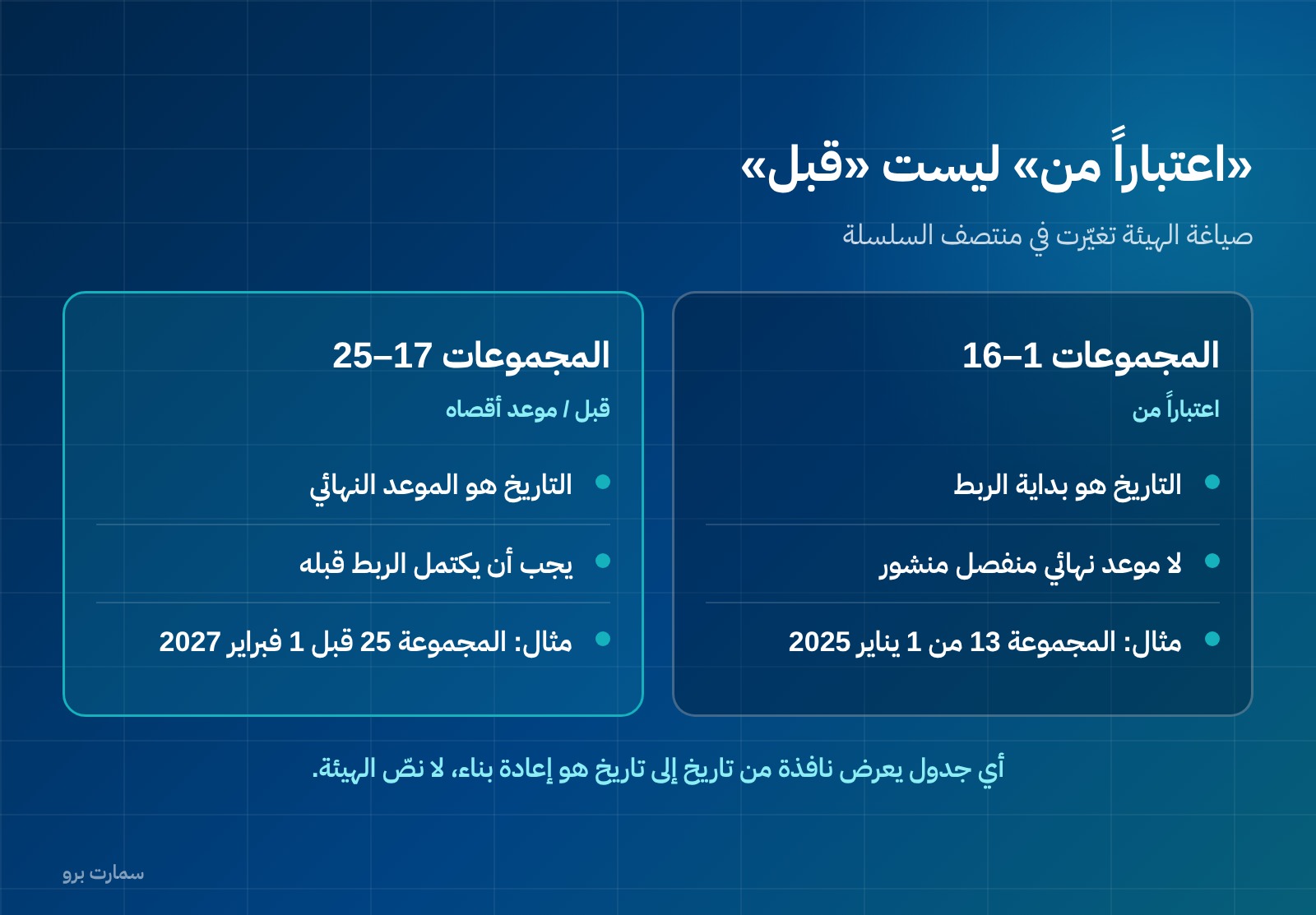
No. This structural detail is missing from most published material. ZATCA's announcements give a single date for each wave, not a window with two ends. The wording of that date also changed partway through the series:
- Waves 1 to 16: the wording is “with effect from”. This is the date on which integration starts for that wave.
- Waves 17 to 25: the wording is “before” or “no later than”. This is a deadline, and integration must be complete before it.
Any table that shows you a “from date to date” window for each wave is therefore a third-party reconstruction, not ZATCA's text. If you fall in one of the later waves, the date that matters to you is a deadline, not a starting point, and the gap between the two can be months.
Which revenue years does ZATCA test?
This is the second most common mistake businesses make. The criterion does not test last year's revenue. It tests a specific set of years, and that set has changed four times:
- Waves 1 and 2: 2021 only.
- Waves 3 to 9: 2021 or 2022.
- Waves 10 to 20: 2022 or 2023.
- Waves 21 to 24: 2022, 2023 or 2024.
- Wave 25: 2022, 2023, 2024 or 2025.
Adding 2025 in the latest wave brought in a whole group that used to fall outside the criterion: businesses that started trading or grew during 2025. If you checked your position before July 2026, you need to check it again.
How do I find which wave my business is in?
You can work it out in three steps.
- Pull your taxable revenue for each year from 2021 to 2025 from the VAT returns you filed, not from your books. The filed return is the reference.
- Take your highest year, not the current year and not an average. Exceeding the threshold in a single year within the tested years is enough to bring you in.
- Work down the table from the highest threshold to the lowest. The first row whose threshold you exceed is your wave, provided your year is one of the years tested for that wave.
Here is a worked example. A business's highest revenue was SAR 900,000 in 2023. That is above the Wave 23 threshold (SAR 750,000) and below the Wave 22 threshold (SAR 1 million), so it is in Wave 23 and its date was 31 March 2026. If its highest revenue had been SAR 250,000, it would fall in Wave 25, with a date of 1 February 2027.
ZATCA notifies each targeted business directly at least six months before its integration date. Treat that notice as confirmation, not discovery. The table is public, and you can do the calculation today.
What has not changed since 2023?
Here is some reassurance if you are preparing now. The E-Invoicing Regulation and the Controls, Requirements and Technical Specifications have not changed since 19 May 2023. The data dictionary and the XML implementation standard carry the same date.
New waves bring new taxpayers into the same format, not a new one. In practice, a system that is already integrated and proven with businesses in earlier waves needs no new development for you, only account setup. That gives you a direct question to ask any vendor: how many businesses have you actually integrated, and in which waves?
What does integration actually involve?
Phase 2 is not simply issuing an electronic invoice. That was Phase 1, and every business has been subject to it since December 2021. Phase 2 requires three things together:
- connecting your system to the Fatoora platform
- issuing invoices in XML, or as a PDF/A-3 file with the XML embedded
- adding the extra fields, including the cryptographic stamp and previous invoice hash
The path an invoice takes depends on its type. A standard (B2B) tax invoice goes through ZATCA before you deliver it to the buyer. A simplified (B2C) invoice is sent to ZATCA after it is issued, within a set time limit. This is the difference between clearance and reporting, and it shapes how your sales process works.
The detailed onboarding steps are in how to onboard on the Fatoora platform. The details of the wave that is currently open are in e-invoicing Wave 25. Missing your date is a separate violation, covered in e-invoicing penalties.
Is there any row to treat with caution?
Yes, Wave 1. The page announcing its criterion is no longer on ZATCA's website, so I have not given it an announcement date. The criterion itself still appears on two live ZATCA pages: SAR 3 billion of 2021 revenue, with integration from 1 January 2023.
The two pages word it differently. One says revenue “not less than” the threshold and the other says revenue “exceeding” it. This table follows the second wording.
This page is updated whenever ZATCA announces a new wave. Source: the Zakat, Tax and Customs Authority (ZATCA) website.
Key takeaway: Find your wave from the highest taxable revenue on your filed returns within the tested years, not from last year's figure. For Waves 17 to 25, ZATCA's date is a deadline to finish integration, not a start date.
SmartPro already issues ZATCA (Fatoora) Phase 2 e-invoices, so you can start a free trial or book a demo to see it working on your own sales.
Article visuals
Frequently asked questions
How many e-invoicing integration waves has ZATCA announced so far?
ZATCA has announced 25 waves. They run from Wave 1, with a SAR 3 billion threshold on 2021 revenue, to Wave 25, with a SAR 187,500 threshold and a date of 1 February 2027. There is no Wave 26 as of November 2026.
How do I find out which integration wave my business falls into?
Pull your taxable revenue for each year from the VAT returns you filed. Take your highest year, not the current year or an average, then work down the wave table from the highest threshold to the lowest. The first row whose threshold you exceed is your wave, provided that year is one of the years tested for it.
What is the difference between “with effect from” and “before” in ZATCA's announcements?
ZATCA gives a single date for each wave, not a window with two ends. Waves 1 to 16 use “with effect from”, which is the date integration starts. Waves 17 to 25 use “before” or “no later than”, which is a deadline. Any table showing a from-to window for each wave is a reconstruction, not ZATCA's text.
Does ZATCA test last year's revenue for e-invoicing integration?
No. The criterion tests a specific set of years, and that set has changed four times. Waves 1 and 2 test 2021 only, Waves 3 to 9 test 2021 or 2022, and Waves 10 to 20 test 2022 or 2023. Waves 21 to 24 test 2022 to 2024, and Wave 25 adds 2025, so it tests four years.
Have the e-invoice specifications changed with the new waves?
No. The latest version of the Controls, Requirements and Technical Specifications is dated 19 May 2023, and the data dictionary and XML implementation standard carry the same date. New waves bring new taxpayers into the same format. A system already integrated and proven in earlier waves needs account setup, not new development.