
Hedge Accounting: What Remains of IAS 39 and Why
IAS 39 has not been withdrawn. All that remains of it is hedge accounting, available as an accounting policy choice for entities that apply IFRS 9. Here is what remains, and why.
Author:سامي الحيدري
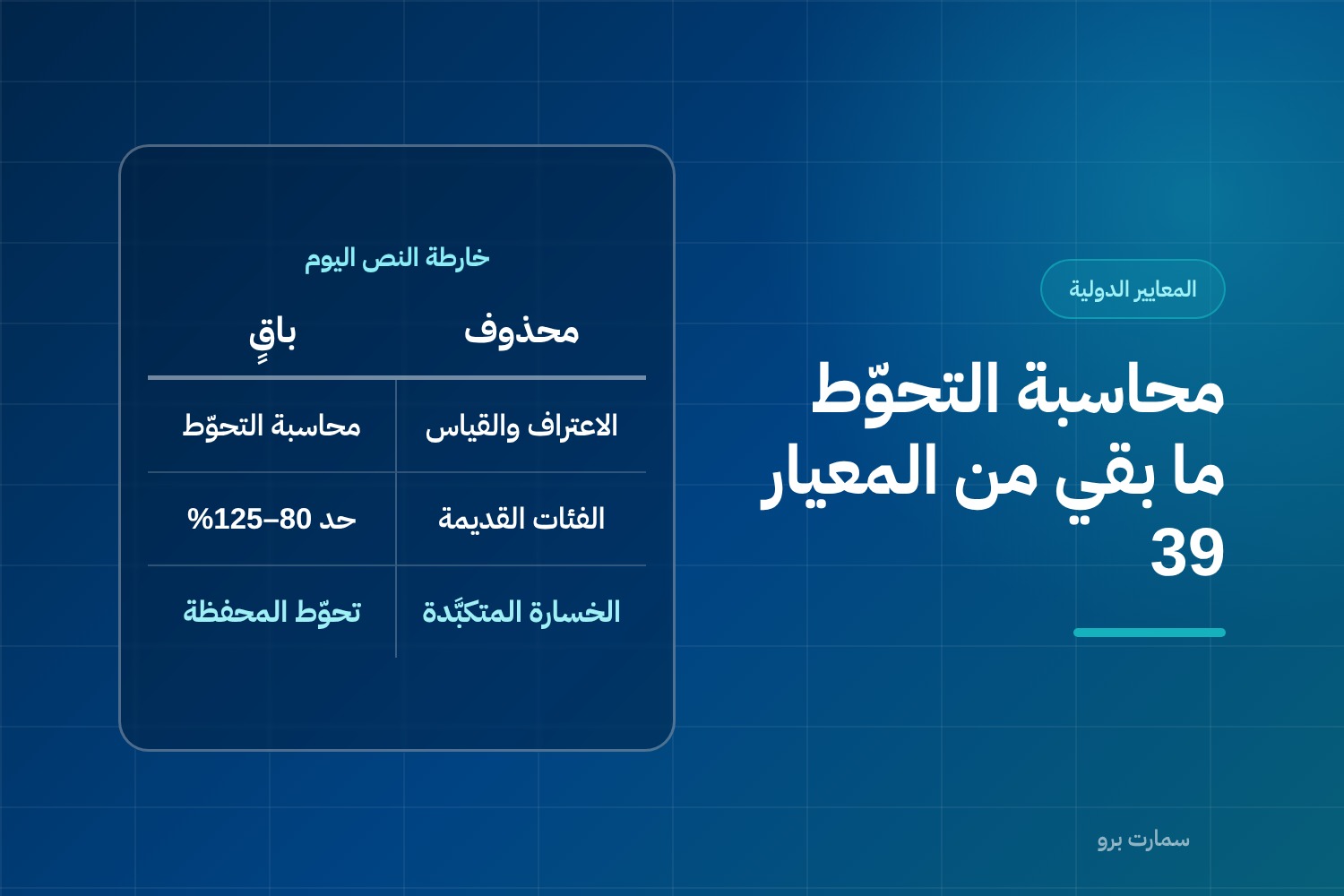
IAS 39 is probably the most misreported standard in both Arabic and English, because most of what gets quoted about it describes text that no longer exists. What actually remains of IAS 39 today is hedge accounting alone, available as an accounting policy choice for entities that apply IFRS 9.
What was deleted and what remains?
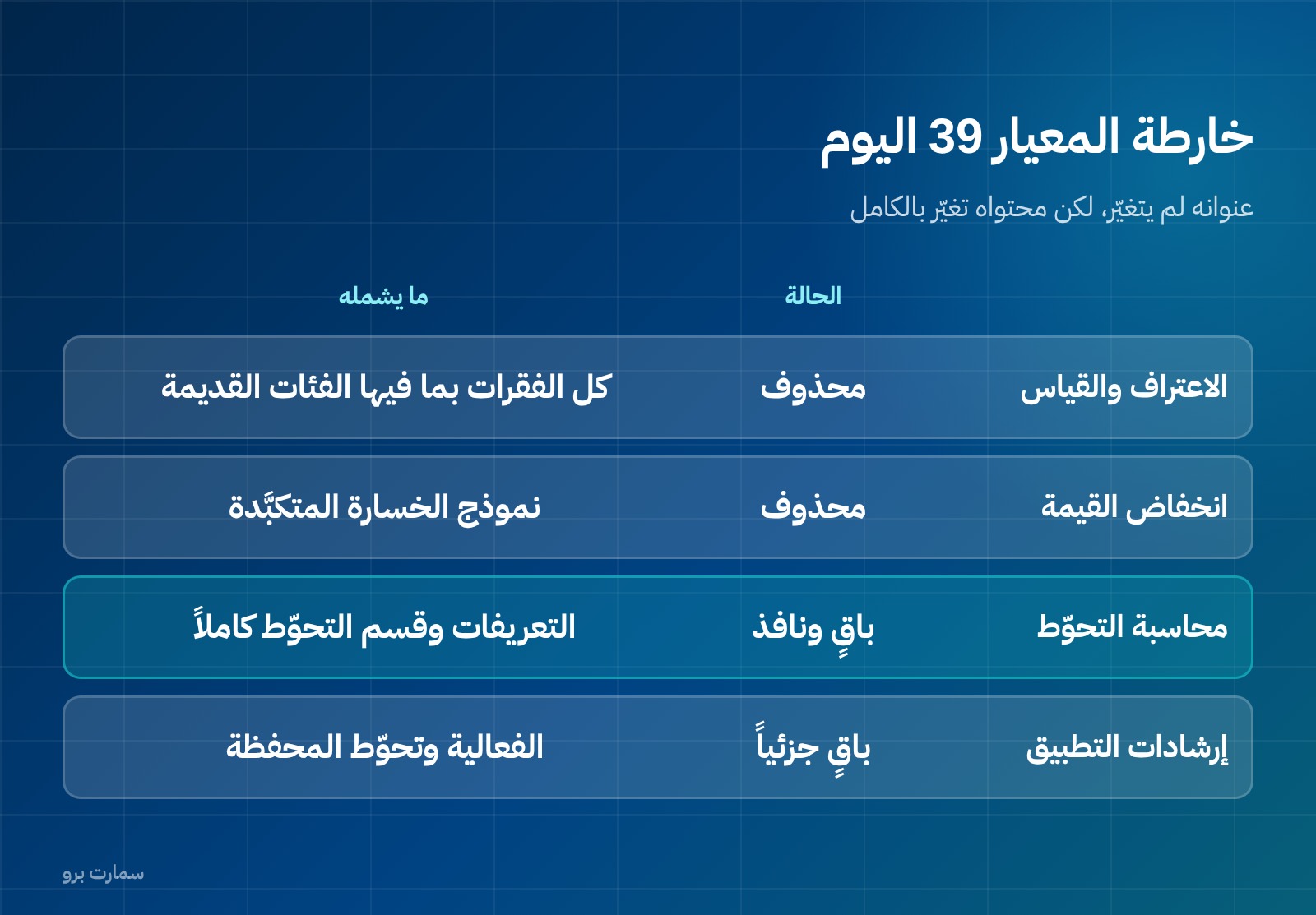
The standard is still titled "Financial Instruments: Recognition and Measurement", even though it no longer contains any recognition or measurement requirements. Here is the precise map:
| Status | Content |
|---|---|
| Deleted | The objective paragraph, the scope paragraphs, and all requirements on recognition, classification, measurement, impairment, embedded derivatives and derecognition |
| Deleted | The old categories: held-to-maturity, loans and receivables, and available-for-sale |
| Deleted | The incurred loss impairment model |
| Remains | The hedge accounting definitions, the entire hedging section, the interest rate benchmark reform paragraphs, and the application guidance on effectiveness and portfolio hedges |
So anyone writing today about "the IAS 39 categories" should present them explicitly as history that predates IFRS 9, not as current treatment.
Has IAS 39 been withdrawn?
Many describe IAS 39 as "withdrawn" or "no longer in force". The official position is the opposite: IAS 39 is still in force, and IFRS 9 replaces it only subject to two things: the accounting policy choice to continue applying the hedge accounting requirements of IAS 39, and the temporary exemption for certain insurers.
Why would an entity choose to stay on IAS 39?
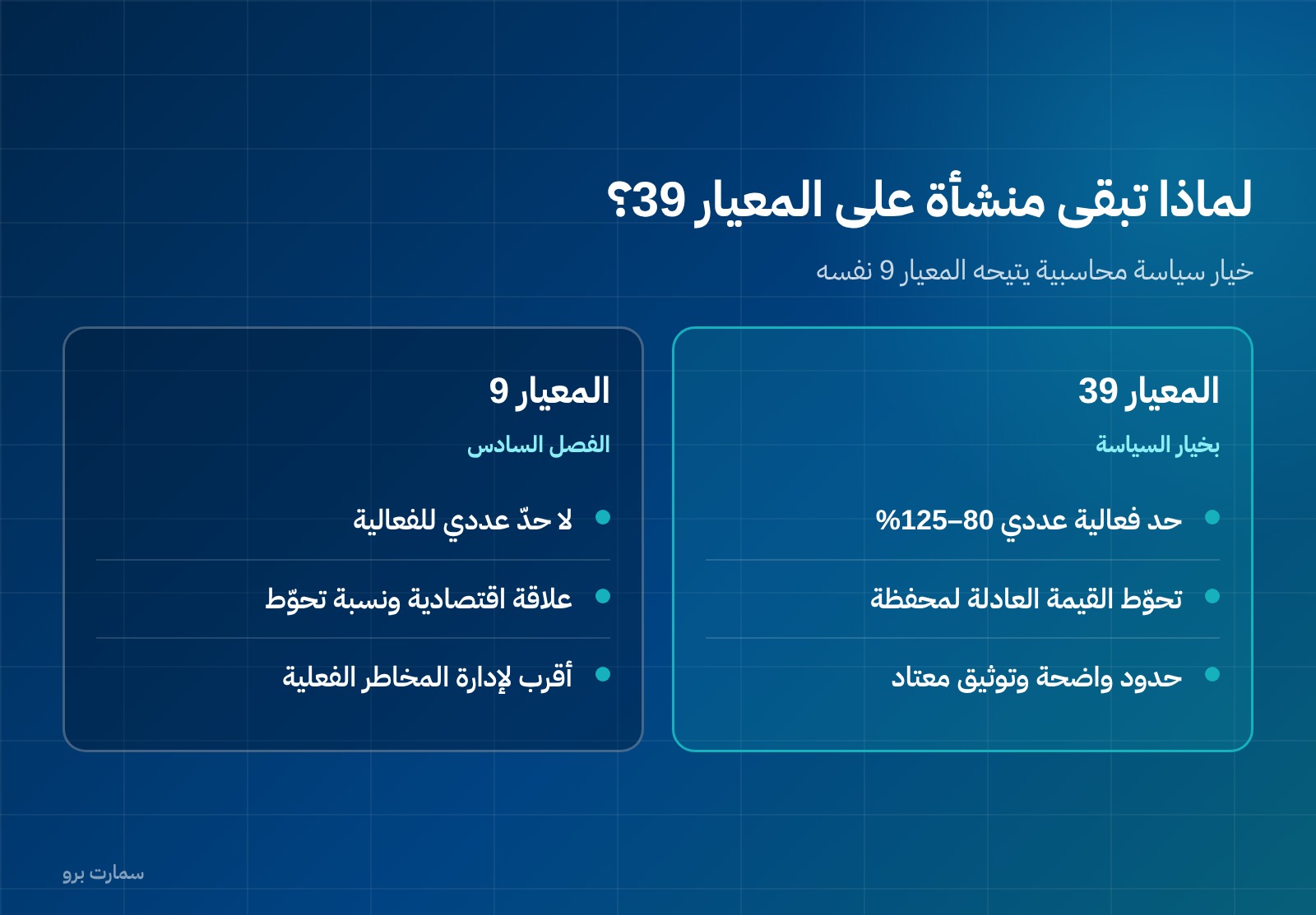
The best-known practical reason is the 80–125% effectiveness range. The IAS 39 application guidance sets a numerical test for hedge effectiveness, whereas Chapter 6 of IFRS 9 has no equivalent numerical threshold. IFRS 9 instead bases effectiveness on an economic relationship and a hedge ratio consistent with actual risk management.
Some entities, especially those with mature hedging relationships documented against the numerical test, prefer to keep a standard with clear limits rather than move to a judgement that requires fresh analysis and documentation.
The second reason is the fair value hedge of a portfolio. The text allows an entity, in a fair value hedge of the interest rate exposure of a portion of a portfolio of financial assets or liabilities, to apply IAS 39 instead of IFRS 9. An entity that applies IFRS 9 and has not chosen to continue with IAS 39 must apply Chapter 6 of IFRS 9.
What are the three types of hedging relationship?
- Fair value hedge: a hedge of the exposure to changes in the fair value of a recognised asset or liability, or of an unrecognised firm commitment.
- Cash flow hedge: a hedge of the exposure to variability in cash flows attributable to a recognised asset or liability, or to a highly probable forecast transaction.
- Hedge of a net investment in a foreign operation, as defined in IAS 21 on functional currency and exchange differences.
What qualifies as a hedging instrument and a hedged item?
A hedging instrument is usually a derivative. A non-derivative financial asset or financial liability may be designated as a hedging instrument only for foreign currency risk. Designation is generally of the instrument in its entirety, with limited exceptions.
A hedged item can be a recognised asset or liability, an unrecognised firm commitment, a highly probable forecast transaction, or a net investment in a foreign operation.
What does this mean for a Saudi business?
Most non-financial Saudi businesses do not need hedge accounting at all. They transact in riyals pegged to the US dollar, borrow at local rates, and have limited currency exposure. Hedge accounting is optional, not mandatory: an entity that does not apply it records its derivatives at fair value through profit or loss and accepts the resulting volatility.
But a business that imports in a currency other than the dollar, borrows in a foreign currency, or is tied to long-term commodity contracts may find that volatility in its income statement distorts the picture of its performance. Hedge accounting then becomes a tool for aligning the timing of gains and losses, at a heavy documentation cost: documenting the relationship and risk management objectives at inception, testing effectiveness, and the disclosures required by IFRS 7.
What conditions must a hedging relationship meet?
Hedge accounting is not a decision you make after a loss has happened. A hedging relationship requires documentation at inception that identifies the hedging instrument, the hedged item, the nature of the risk being hedged, and how effectiveness will be assessed. Without this upfront documentation, the special accounting does not apply, however real the economic hedge may be.
How does each type affect the financial statements?
| Type | Where the hedging instrument's effect goes |
|---|---|
| Fair value hedge | Profit or loss, offset by an adjustment to the carrying amount of the hedged item |
| Cash flow hedge | The effective portion goes to other comprehensive income, and is reclassified to profit or loss when the hedged item affects it |
| Net investment hedge | Other comprehensive income, within translation differences |
The real benefit of hedge accounting shows in the second type. Without it, changes in the derivative's value hit the income statement immediately while the hedged item has not yet had any effect, producing volatility that does not reflect the economics of the transaction.
Practical summary
- Do not describe IAS 39 as withdrawn; it is in force for what remains in it.
- Do not attribute the old categories or the incurred loss model to it as current treatment; both have been deleted.
- Do not present the 80–125% range as a general IFRS rule; it is a test specific to IAS 39, available only through an accounting policy choice.
The official text is on ifrs.org, and the current treatment of recognition and measurement is in IFRS 9.
What is the status of IAS 39 in Saudi Arabia?
One point deserves attention: IAS 39 is not listed in the endorsement document issued by the Saudi Organization for Chartered and Professional Accountants (SOCPA). The list of endorsed standards goes straight from IAS 38 to IAS 40, and the document contains no section on it.
Its absence is simply that, an absence: the document contains no text that explicitly rejects or excludes it. So an entity that needs to apply IAS 39 hedge accounting, under the accounting policy choice that IFRS 9 allows, would do well to confirm the position with SOCPA or its auditor before relying on it, rather than assuming either that it is available or that it is prohibited.
Reference: Saudi Organization for Chartered and Professional Accountants.
Key takeaway: IAS 39 is still in force, but only its hedge accounting survives, as an optional policy choice under IFRS 9; in Saudi Arabia, confirm its status with SOCPA or your auditor before relying on it.
If you want journal entries, cost centres and financial statements kept in order for your auditor, explore SmartPro Finance & Accounting or book a demo.
Article visuals
Frequently asked questions
Has IAS 39 been withdrawn?
No. IAS 39 is still in force for what remains in it. IFRS 9 replaces it only subject to the accounting policy choice to continue applying IAS 39 hedge accounting, and a temporary exemption for certain insurers.
What remains of IAS 39?
Only hedge accounting: its definitions, the entire hedging section, the interest rate benchmark reform paragraphs, and the application guidance on effectiveness and on the fair value hedge of a portfolio. Recognition, measurement and impairment have all been deleted.
Why would an entity stay on IAS 39 hedge accounting?
The best-known reason is the 80–125% effectiveness range set out in its application guidance, since Chapter 6 of IFRS 9 has no equivalent numerical threshold. Another reason is the option for a fair value hedge of a portfolio's interest rate exposure.
Is hedge accounting mandatory?
No, hedge accounting is optional. An entity that does not apply it records its derivatives at fair value through profit or loss and accepts the resulting volatility in its income statement.
What are the types of hedging relationship?
There are three: the fair value hedge, the cash flow hedge, and the hedge of a net investment in a foreign operation.