
Accounting Saudization: 44 Professions, from 40% Towards a 70% Target in Five Phases
The first phase sets 40% for businesses employing five or more accountants, with a 70% target over five years. A contract not documented in Qiwa does not count.
Author:سامي الحيدري
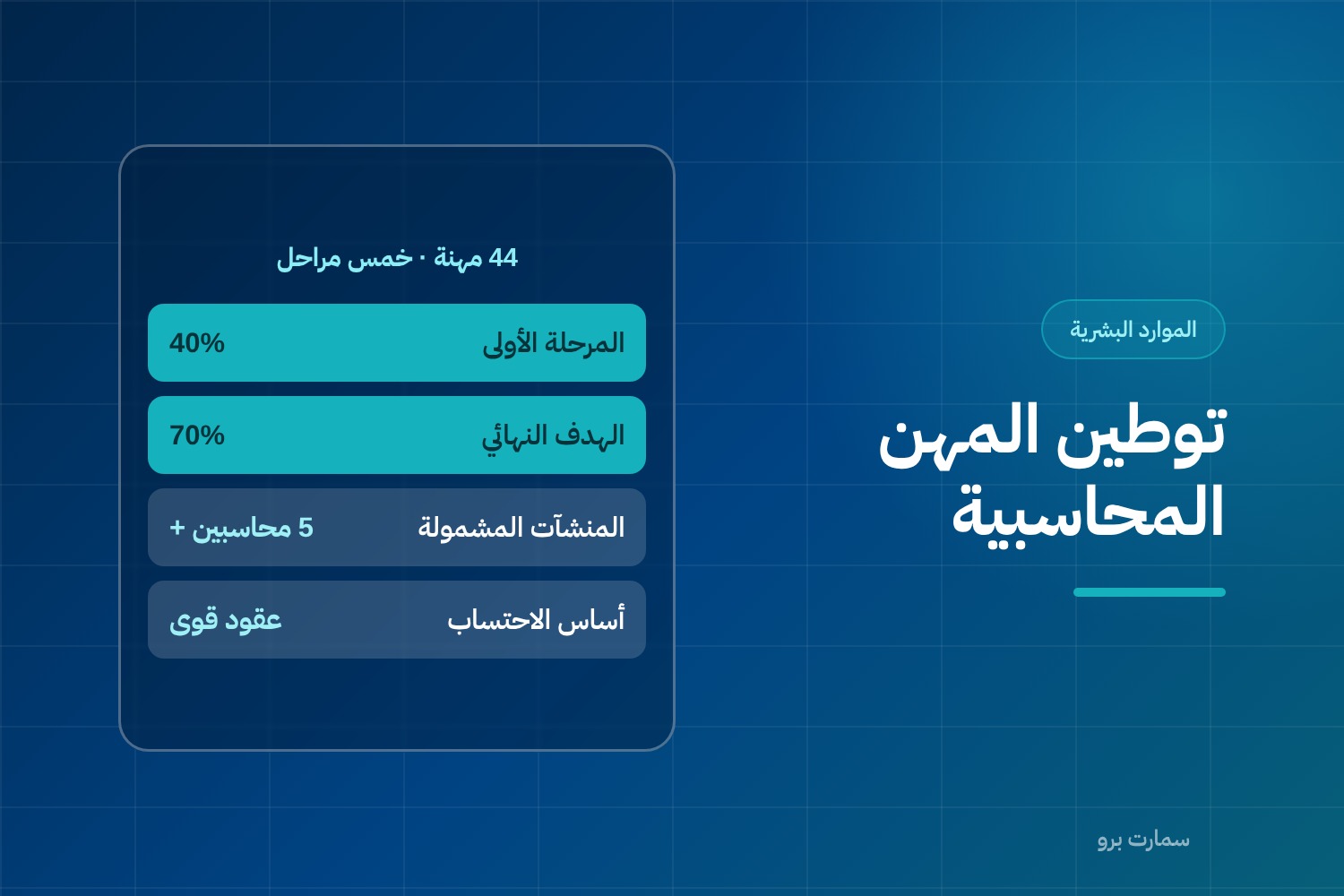
Accounting Saudization took effect on 27 October 2025 under a decision by the Ministry of Human Resources and Social Development (HRSD), issued with the Ministry of Commerce. It covers 44 accounting professions at 40% in its first phase. The decision runs in five gradual phases over five years, with a final target of 70%. Anyone planning a finance team today is planning on a rising ladder, not a fixed ratio.
The businesses covered are those employing five or more accountants in the targeted accounting professions. Fewer than that is outside the scope in this phase.
Who does accounting Saudization apply to?
The ratio is measured on the accounting professions in the business, not on total headcount. A factory with 200 workers and six accountants has its ratio calculated on the six.
Published examples of the targeted professions include chief financial officer, accounts manager and certified public accountant. The list covers 44 professions under the Saudi Standard Classification of Occupations, the national list that assigns each job title an official occupation. So the job title you enter in the Qiwa platform is what gets classified, not what you call the role internally.
This is where many businesses slip. An employee who actually works as an accountant but is registered as an "administrative officer" may not count in the numerator, while an employee registered as an accountant who does a different job counts in the denominator. The title in Qiwa is the reference.
Where does accounting Saudization sit among the 2026 decisions?
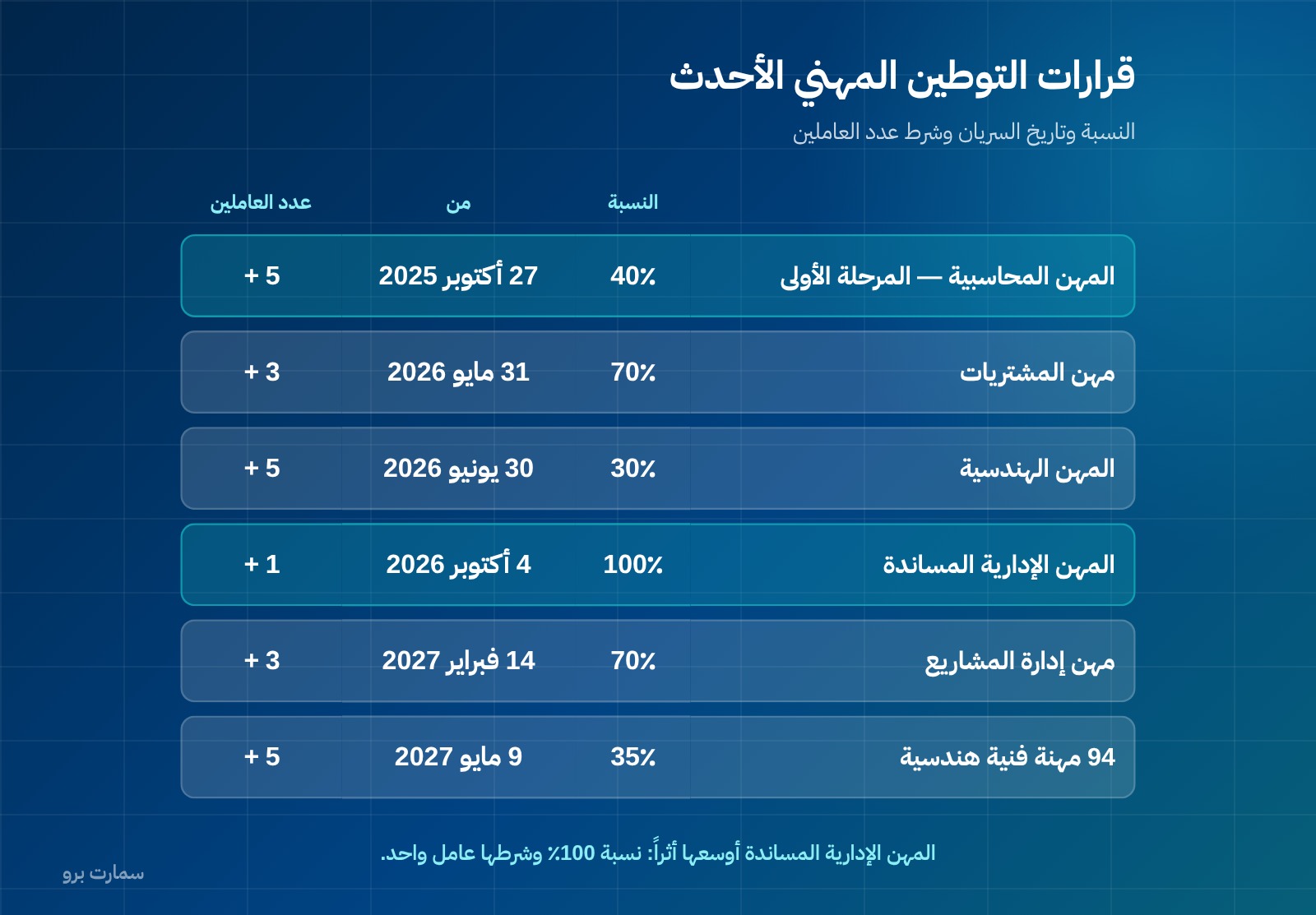
The accounting decision is not alone. The wave that has moved through the market in 2026 is broader:
| Decision | Ratio | From | Headcount threshold |
|---|---|---|---|
| Accounting professions, phase one | 40% | 27 October 2025 | 5 or more accountants |
| Procurement professions | 70% | 31 May 2026 | 3 or more workers |
| Engineering professions | 30% | 30 June 2026 | 5 or more workers |
| Administrative support professions | 100% | 4 October 2026 | 1 or more workers |
| Project management professions | 70% | 14 February 2027 | 3 or more workers |
| 94 technical engineering professions | 35% | 9 May 2027 | 5 or more workers |
Look at the headcount column: administrative support professions apply from a single worker. Any business with one secretary, data-entry clerk or translator is covered at 100%. That is wider in impact than the accounting decision, and it touches almost every business.
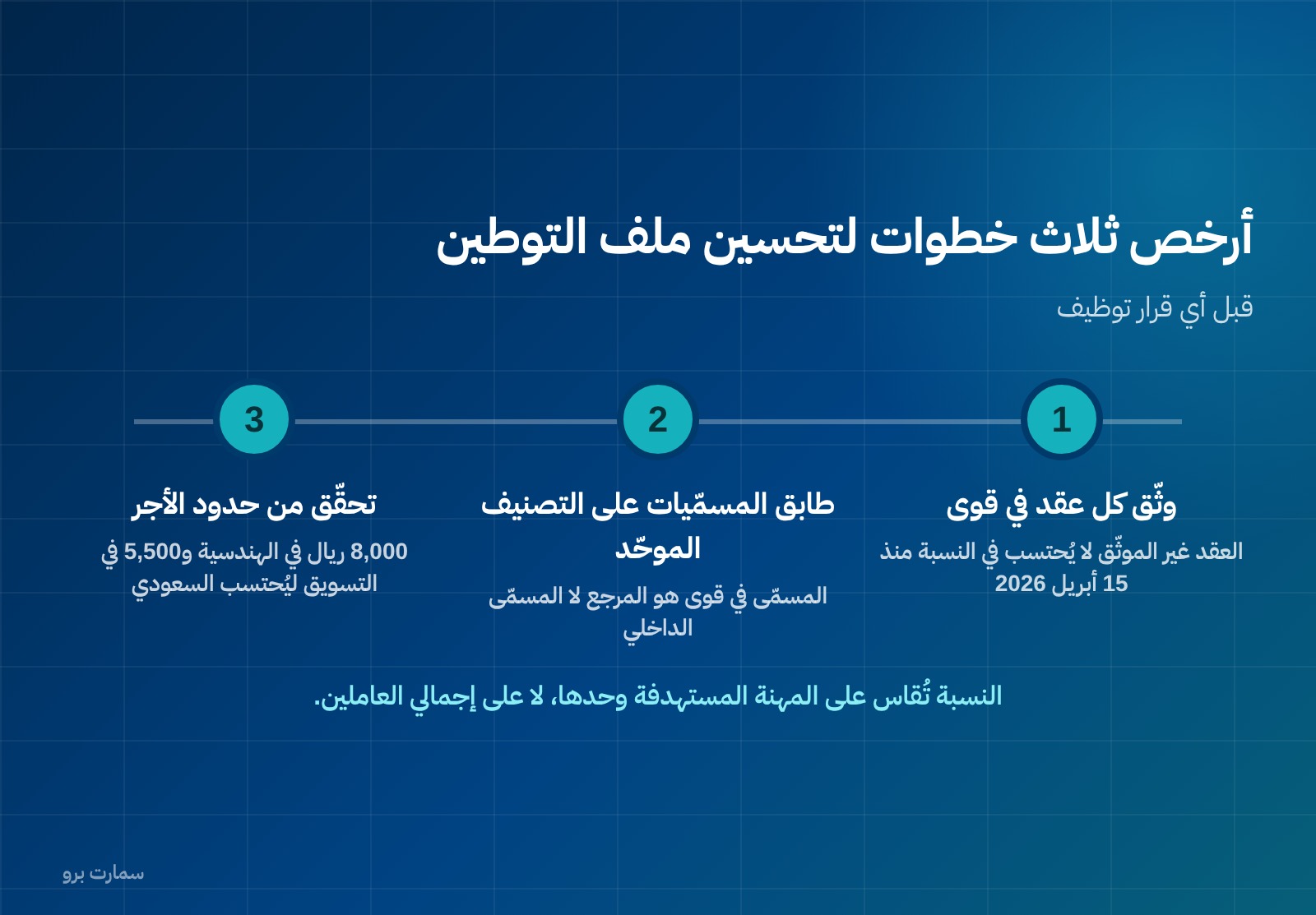
Some decisions also carry a wage condition before a Saudi employee counts: a minimum of SAR 8,000 for engineering professions, and a minimum of SAR 5,500 for marketing professions. A Saudi employee paid below the threshold in those professions does not count towards the ratio, even while on the job.
Why can your ratio drop for no visible reason?
From 15 April 2026, Saudization ratios in Nitaqat are calculated on the basis of employment contracts documented electronically through Qiwa. Nitaqat is the HRSD programme that grades each business by its Saudization ratio. The change was announced on 15 March 2026, based on Council of Ministers Resolution No. 195.
The practical effect is direct and harsh: a Saudi employee whose contract is not documented in Qiwa does not count in your ratio. They are at work, their salary goes through the Wage Protection System, and their GOSI contribution is paid, yet they do not appear in the numerator.
A business with six accountants, three of them Saudi, sits at 50%. It may show only 33% if one of those contracts is undocumented. The gap is not in hiring but in documentation, and fixing it takes a day of admin work, not a recruitment drive.
How does Developed Nitaqat raise the required ratio automatically?
On 22 January 2026, the procedural guide for the "Developed Nitaqat" programme was issued by ministerial decision. It restructures the programme: activities are merged, the Saudization plan is fixed, and ratios are linked to headcount. There are five bands: Red, Low Green, Medium Green, High Green and Platinum.
Band limits come from a formula based on total headcount and constants that vary by activity and band. The guide includes separate constant columns for 2026, 2027 and 2028. That means the ratio required of you rises automatically year after year, without any new decision being announced.
A business settled in Medium Green this year may drop next year with the same number of employees and the same number of Saudis. The numbers moved, not you.
What are the three common mistakes in reading the ratio?
First: calculating the ratio on total headcount. This confuses finance managers more than anything else. Profession-specific decisions are measured on the targeted profession alone. A business with an excellent overall Nitaqat ratio may be non-compliant in accounting professions, and vice versa. Your Saudization file is no longer one number but an overall figure plus a set of profession-level figures under each decision.
Second: assuming the ratio is measured per branch. The project management decision states explicitly that measurement is at entity level, meaning the business with all its branches, not each branch separately. Businesses with several branches need to read each decision on this specific point, because how Saudis are distributed across branches can improve one figure and damage another.
Third: treating the decision as a one-off event. Only one of the five phases has published details. A business at exactly 40% today is on the line, not safe. If one Saudi employee leaves a team of five, the ratio falls from 40% to 20% in a day. In a small team, a margin is not a luxury; it is what separates compliance from a violation.
How does this affect building your finance team?
The announced direction changes the order of decisions. Businesses that used remote accountants or outside accounting offices now face two questions: who counts towards the ratio and who does not, and whether the work is an accounting profession registered in Qiwa or a contracted service.
This raises the value of something else: a system that reduces the number of hands the accounting cycle needs. A team of four accountants working on a system that generates journal entries and returns automatically, such as SmartPro Finance & Accounting, may do the work of six working on spreadsheets. The smaller team is easier to bring to the ratio and cheaper to get there. This is not an argument against hiring, only an observation that the decision's impact on your business depends partly on how many hands your system needs.
What should you do this month?
- Export the list of job titles from Qiwa and match each title to the Saudi Standard Classification of Occupations. Do not rely on internal titles.
- Check that every Saudi employee's contract is documented in Qiwa. This is the cheapest improvement in the whole file.
- Calculate your ratio on accounting professions alone, not on total headcount.
- Review administrative support professions in your business. Their ratio is 100% from a single worker, and they are the most overlooked.
- Check wages in professions with a minimum wage condition before counting on an employee.
- Plan for phase two. The decision has five phases reaching 70%. Details of the later phases are not yet published, but the direction is announced.
The cost of one employee is not the salary alone: it includes GOSI, benefits and leave, as set out in the total cost of an employee. If you are building a cost model for your finance team over the next two years, build it on a rising ratio rather than a fixed one, and link it to payroll as described in the payroll run cycle. Keeping employee files and payroll in one place, as in SmartPro Human Resources, makes those checks quicker.
The decisions and their texts are published by the Ministry of Human Resources and Social Development at hrsd.gov.sa, and that is where to check them, because ratios and professions are updated by successive decisions.
Key takeaway: Accounting Saudization starts at 40% for businesses with five or more accountants and rises towards 70%, measured only on Qiwa-documented contracts and official job titles. Fix documentation and titles first, then plan for a rising ratio.
To see how a connected accounting system can keep your finance team lean, start a free SmartPro trial or book a demo.
Article visuals
Frequently asked questions
What is the current accounting Saudization ratio?
Phase one is 40%, effective from 27 October 2025, and covers 44 accounting professions under a decision made in partnership with the Ministry of Commerce. It applies to businesses employing five or more accountants in the targeted professions. The decision runs in five gradual phases over five years towards a 70% target.
How is the accounting Saudization ratio calculated?
It is calculated on the accounting professions in the business, not on total headcount. A business with 200 workers and six accountants has its ratio calculated on those six. The classification reference is the job title on the Qiwa platform under the Saudi Standard Classification of Occupations, not the internal title.
Why does my Saudi employee not count towards the Saudization ratio?
From 15 April 2026, Nitaqat ratios are calculated on employment contracts documented electronically through Qiwa. A Saudi employee whose contract is not documented does not count in the numerator, even if they are working and paid through the Wage Protection System. The fix is to document the contract on Qiwa.
Is there a minimum wage for a Saudi employee to count?
In some decisions, yes. Engineering professions require a minimum of SAR 8,000 and marketing professions SAR 5,500 for a Saudi employee to count towards the ratio, so anyone paid below the threshold in those professions does not count. No wage condition has been published for the accounting decision in its first phase.
Which other Saudization decisions affect small businesses?
The widest is administrative support professions at 100% from 4 October 2026, applying from a single worker, so it covers any business with a secretary, data entry clerk or translator. Others include procurement at 70% from 31 May 2026, engineering at 30% from 30 June 2026, and project management at 70% from 14 February 2027.