
Government Grants: When Are They Recognised and How Are They Presented?
How government grants are accounted for under IAS 20: the reasonable assurance condition, the income approach, and the difference between grants related to assets and grants related to income.
Author:سامي الحيدري

Under IAS 20, government grants are recognised only when there is reasonable assurance that the business will comply with the attached conditions and that the grant will be received. They are then taken to profit or loss systematically over the periods in which the related costs they compensate are recognised, not when the cash arrives.
Many businesses in Saudi Arabia receive government support in different forms: employment support, industrial land or concessional financing. The accounting question that keeps coming up is: when does this support become income in my income statement? The answer lies in International Accounting Standard 20, whose full title is "Accounting for Government Grants and Disclosure of Government Assistance".
Government grants are defined as assistance by government in the form of transfers of resources to an entity in return for past or future compliance with certain conditions relating to its operating activities. "Government" here includes government, government agencies and similar bodies, whether local, national or international.
A note on the wording of the standard
The standard does not contain a separate objective paragraph at all. Any reference that quotes "the objective of IAS 20" in quotation marks is reproducing a writer's wording, not the text of the standard. The governing principle is drawn from the recognition and matching paragraphs.
What falls outside the scope of IAS 20?
| Excluded | Where it is dealt with instead |
|---|---|
| Assistance provided as benefits determined when calculating taxable profit | IAS 12 |
| Government participation in the ownership of the entity | Outside the scope |
| Grants covered by the agriculture standard | IAS 41 |
| Special problems of financial statements reflecting the effects of changing prices | Outside the scope |
The first exclusion matters commercially: tax exemptions and tax incentives are not government grants under this standard. Tax holidays, accelerated tax depreciation and reduced tax rates are all dealt with under deferred tax, not here.
When can government grants be recognised? Reasonable assurance
A grant, including a non-monetary grant at fair value, is not recognised until there is reasonable assurance of two things together:
- That the entity will comply with the conditions attached to it.
- That the grant will be received.
The standard adds a direct warning: receipt of a grant does not of itself provide conclusive evidence that the conditions have been or will be fulfilled. If the support money has landed in your bank account but conditions are still outstanding, you are looking at a liability, not income.
Is a grant income or capital? The income approach
The standard settles the old debate: grants are recognised in profit or loss on a systematic basis over the periods in which the entity recognises as expenses the related costs the grants are intended to compensate.
This means recognition on a receipts basis is generally not acceptable, because it departs from the accrual basis. It is acceptable only when no basis exists for allocating the grant to periods other than the one in which it was received.
What are the three matching patterns?
- Grant related to a depreciable asset: recognised in profit or loss over the same periods and in the same proportions as the depreciation charged on that asset.
- Grant related to a non-depreciable asset that requires certain obligations to be fulfilled: recognised over the periods that bear the cost of meeting those obligations. The example in the standard is land granted on condition that a building is erected on it.
- Grant that becomes receivable as compensation for expenses or losses already incurred, or for immediate financial support with no future related costs: recognised in profit or loss in the period in which it becomes receivable.
How are non-monetary grants measured?
When a grant takes the form of a non-monetary asset, such as land or other resources, the usual treatment is to account for both the grant and the asset at the fair value of the non-monetary asset. The alternative sometimes followed is to record both the asset and the grant at a nominal amount.
A worked timing example
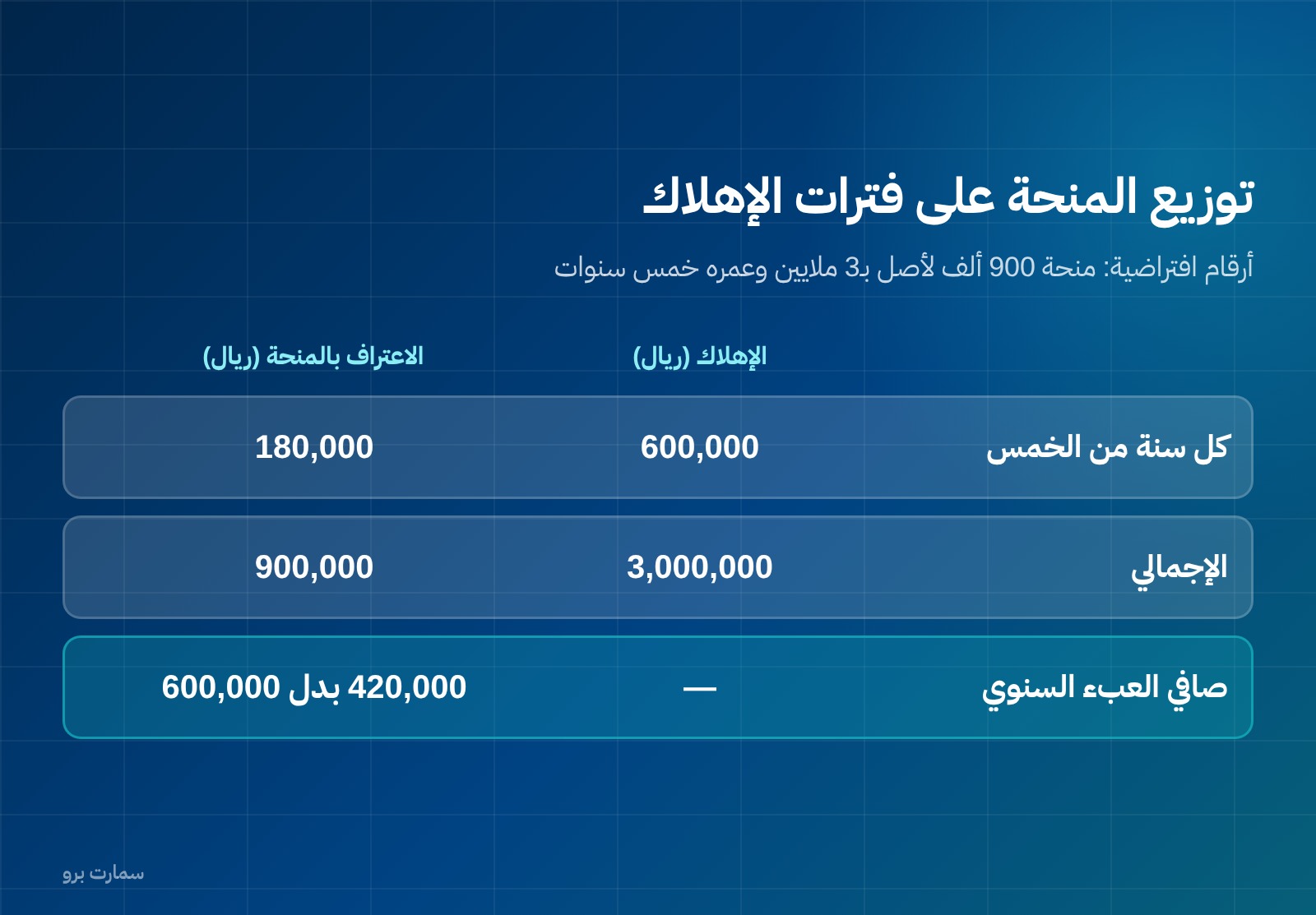
The figures below are hypothetical, to illustrate the method. A business receives a grant of SAR 900,000 towards a production line costing SAR 3,000,000, with a useful life of five years:
| Year | Depreciation (SAR) | Grant recognised (SAR) |
|---|---|---|
| 1 | 600,000 | 180,000 |
| 2 | 600,000 | 180,000 |
| 3 | 600,000 | 180,000 |
| 4 | 600,000 | 180,000 |
| 5 | 600,000 | 180,000 |
| Total | 3,000,000 | 900,000 |
The SAR 900,000 is not booked as income in the year it is received. It is spread over the years in which depreciation is charged. As a result, the net charge to the income statement is SAR 420,000 a year instead of SAR 600,000.
How are forgivable loans treated?
A forgivable loan, meaning a loan where the lender undertakes to waive repayment under certain prescribed conditions, is treated as a government grant when there is reasonable assurance that the entity will meet the terms for forgiveness. Until then, it stays a liability in your books.
What must be disclosed?
Disclose the accounting policy adopted and the methods of presentation, the nature and extent of grants recognised, and unfulfilled conditions and other contingencies attaching to government assistance that has been recognised. You must also disclose other forms of government assistance that do not meet the definition of a grant.
What are the two ways to present asset grants?
A grant related to an asset can be presented in two acceptable ways. The choice is an accounting policy that you disclose and apply consistently:
- Deferred income: the grant is shown as a liability in the statement of financial position, and an amount is released to profit or loss each year in the same proportions as depreciation.
- Deduction from the asset's cost: the grant is deducted from the carrying amount of the asset, so annual depreciation falls by the same amount.
The effect on net profit is the same under both methods, but the effect on total assets and total liabilities differs, and so does the effect on ratios such as return on assets and the debt ratio. See financial ratios.
What happens if the conditions are breached?
If a grant becomes repayable, it is treated as a change in accounting estimate. The repayment is first set against any unamortised deferred income balance, and any excess is recognised as an expense immediately in profit or loss. If the grant was deducted from the asset's cost, the carrying amount is increased by the repayment, and the cumulative additional depreciation that would have been charged without the grant is recognised immediately.
A point worth checking
The standard is effective for periods beginning on or after 1 January 1984, and it was originally issued in April 1983. Many references cite 2001, which is the date the International Accounting Standards Board adopted the standard, not its effective date.
The official text is on ifrs.org. For the full picture, see our guide to IFRS in Saudi Arabia.
What is the standard's official title in Saudi Arabia?
The approved Arabic title of this standard translates as: "International Accounting Standard 20: Accounting for Government Grants and Disclosure of Government Assistance". The Saudi Organization for Chartered and Professional Accountants (SOCPA) endorsed it without any modification for application in the Kingdom.
Reference: Saudi Organization for Chartered and Professional Accountants, the document endorsing IFRS for application in the Kingdom, updated on 4/7/1447 AH.
Key takeaway: A government grant is recognised only once compliance and receipt are reasonably assured, and it is then matched against the costs it compensates rather than booked as income on receipt.
To see how SmartPro's finance and accounting system keeps your journal entries and depreciation organised, start a free trial.
Article visuals

Frequently asked questions
When are government grants recognised?
They are not recognised until there is reasonable assurance of two things together: that the entity will comply with the conditions attached to the grant, and that the grant will be received. Receipt of the money does not of itself provide conclusive evidence that the conditions have been met.
Is a grant recorded as income as soon as it is received?
No. It is recognised in profit or loss on a systematic basis over the periods in which the entity recognises the costs the grant is intended to compensate. Recognition on a receipts basis is generally not acceptable.
Are tax exemptions government grants?
No. Assistance provided as benefits determined when calculating taxable profit, such as tax holidays, accelerated tax depreciation and reduced tax rates, is excluded from the scope of IAS 20. It is dealt with under the income taxes standard, IAS 12.
How is a grant related to an asset treated?
If the asset is depreciable, the grant is recognised in profit or loss over the same periods and in the same proportions as the depreciation. If the asset is non-depreciable and requires obligations to be fulfilled, the grant is recognised over the periods that bear the cost of meeting those obligations.
How is a forgivable loan treated?
A forgivable loan is treated as a government grant when there is reasonable assurance that the entity will meet the terms for forgiveness. Until then, it remains a liability in the books.