
Classifying Financial Instruments: Liability or Equity?
How IAS 32 decides whether a financial instrument is a liability or equity, what the substance-over-form rule means, and how compound instruments are split.
Author:سامي الحيدري
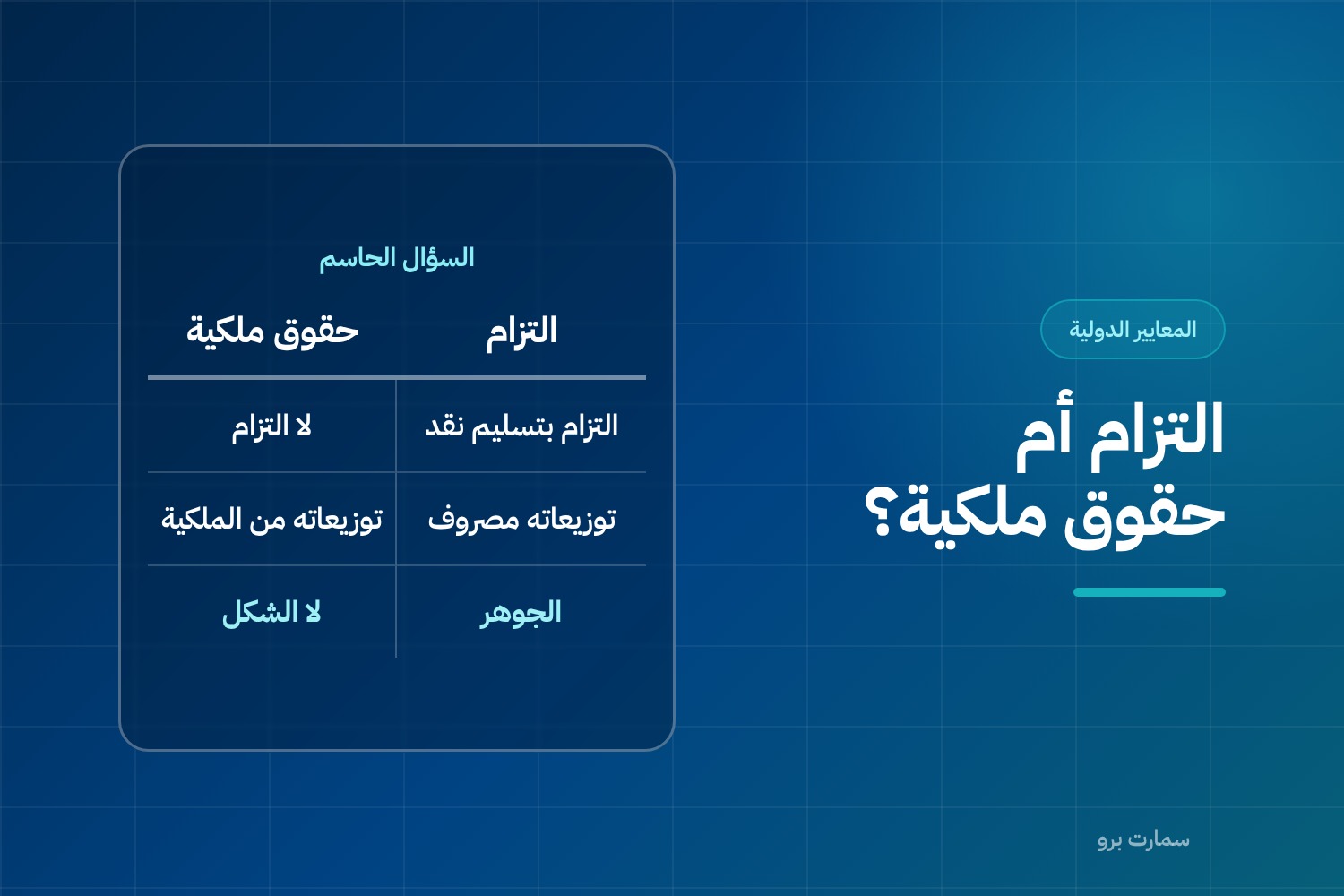
One question decides where a financial instrument sits on your balance sheet: do you have a contractual obligation to deliver cash? If yes, it is a liability, whatever it is called. If no, it is equity. This is the core of IAS 32, the standard that governs the classification of financial instruments and their presentation.
The standard classifies an instrument from the issuer's perspective, together with the related interest, dividends, losses and gains. It complements IFRS 9, which covers recognition and measurement, and IFRS 7, which covers disclosure.
What does substance over form mean here?
The text is explicit: the substance of a financial instrument, not its legal form, governs its classification. Two of the best-known applications of this rule:
- Mandatorily redeemable preference shares are financial liabilities, not equity, even though they are called "shares".
- Their dividends are recorded as an expense in the income statement, exactly like interest on a bond.
Miss this point and you present a liability inside equity. Your gearing then looks lower than it really is, and financing decisions get built on the wrong number.
How do you test whether an instrument is a liability or equity?
An instrument is classified as equity only if both of these conditions are met:
- It contains no contractual obligation to deliver cash or another financial asset, or to exchange assets or liabilities under conditions that are potentially unfavourable.
- If it will or may be settled in the issuer's own equity instruments, it is either a non-derivative with no obligation to deliver a variable number of shares, or a derivative settled only by exchanging a fixed amount of cash for a fixed number of shares.
The second condition is known as the "fixed-for-fixed" rule, and it knocks out many instruments that their issuers assume are equity.
An entity that has no unconditional right to avoid delivering cash has a financial liability. In fact, a contract containing an obligation to buy the entity's own shares for cash gives rise to a financial liability at the present value of the redemption amount, reclassified out of equity. This applies even when the obligation depends on the counterparty exercising its right.
How are compound instruments split?
A bond convertible into shares is a single instrument carrying two components: debt and a conversion option. A compound instrument is one that contains both a liability and an equity element. The standard requires the two to be separated and presented separately, using a residual method:
| Step | Action |
|---|---|
| 1 | Measure the liability component first, at the fair value of a similar liability with no conversion feature |
| 2 | Allocate the remainder (the fair value of the instrument as a whole minus the liability component) to equity |
The parts add up to the whole, so no gain or loss arises on initial recognition. And a change in the likelihood of conversion does not trigger reclassification of the two components.
Transaction costs on a compound instrument are allocated to the two components in proportion to the proceeds.
How are treasury shares treated?
Treasury shares are the entity's own equity instruments that it has bought back. They are deducted from equity. No gain or loss is recognised in profit or loss on their purchase, sale, issue or cancellation; the consideration is recognised directly in equity. The amount of treasury shares held is disclosed separately, together with related party disclosures if they were reacquired from related parties.
Where do interest and dividends go?
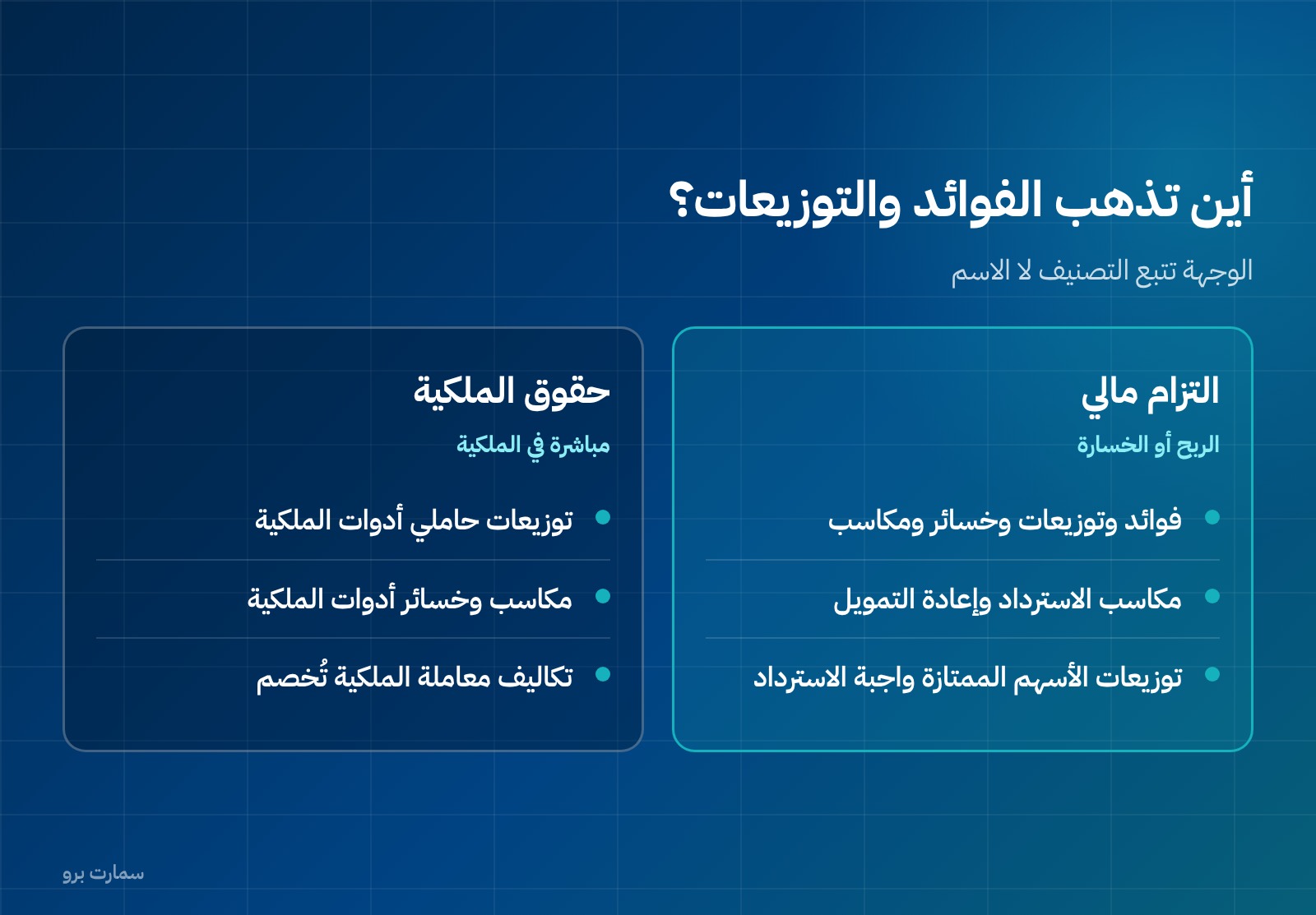
The rule follows the classification, not the name:
| Item | Where it goes |
|---|---|
| Interest, dividends, losses and gains on a financial liability | Profit or loss |
| Distributions to holders of equity instruments | Directly in equity |
| Gains and losses on redeeming or refinancing a liability | Profit or loss |
| Transaction costs of an equity transaction | Deducted from equity |
Transaction costs of an equity transaction that is abandoned are expensed, so they do not stay parked in equity.
When can financial assets and liabilities be offset?
Offsetting means presenting a financial asset and a financial liability as a single net amount. It is allowed when, and only when, both of these conditions are met:
- The entity currently has a legally enforceable right to set off the recognised amounts.
- It intends either to settle on a net basis, or to realise the asset and settle the liability simultaneously.
The right alone is not enough, and the intention alone is not enough. A master netting arrangement does not by itself justify offsetting unless both conditions are met. Offsetting is usually inappropriate for synthetic instruments, for instruments with the same risk exposure held with different counterparties, and for collateral pledged against non-recourse liabilities.
Worked example: splitting a convertible bond
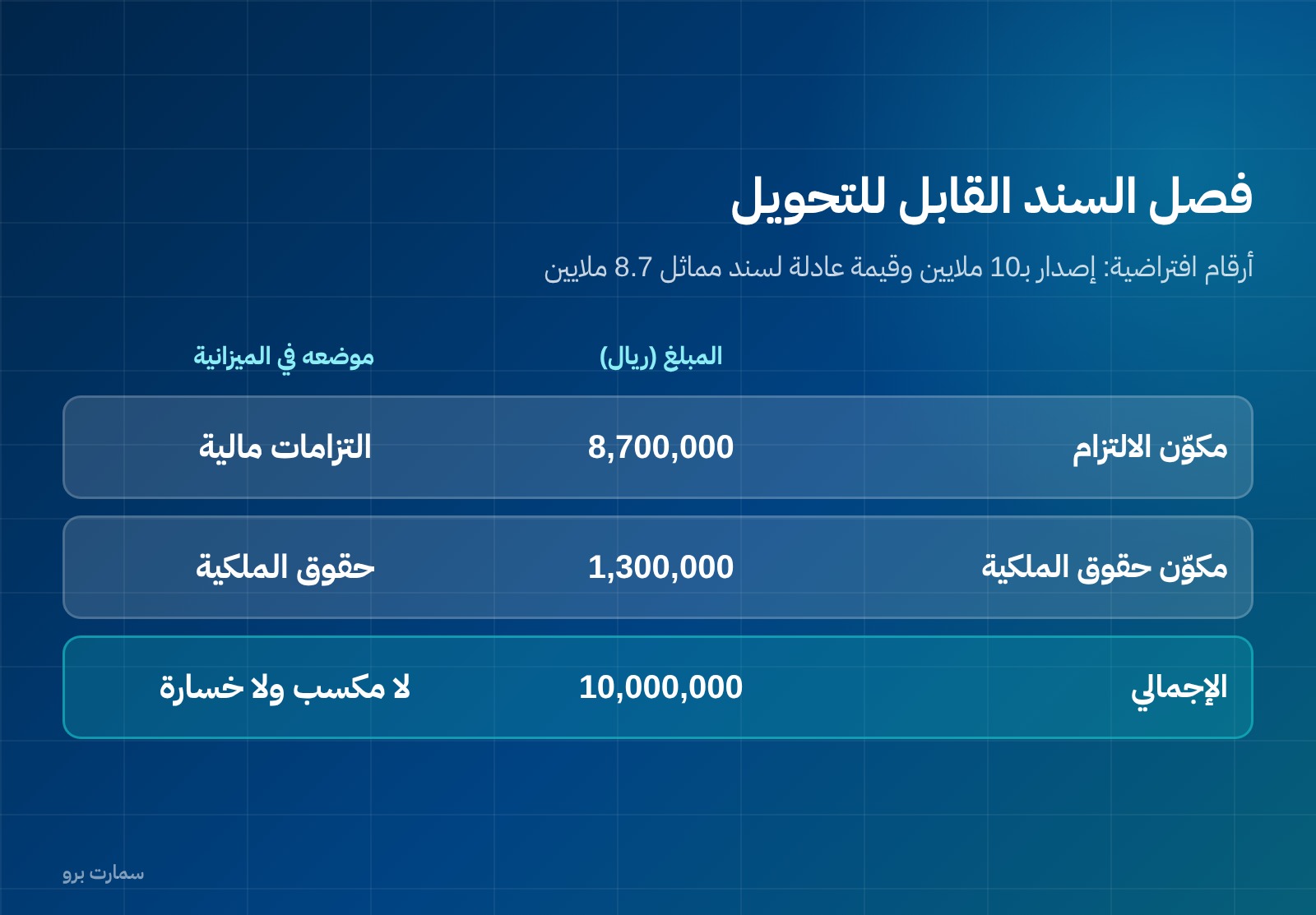
The figures below are hypothetical, to illustrate the method. An entity issues convertible bonds with a face value of SAR 10,000,000. The fair value of a similar bond without a conversion feature is estimated at SAR 8,700,000:
| Component | Amount (SAR) | Balance sheet position |
|---|---|---|
| Liability component | 8,700,000 | Financial liabilities |
| Equity component (residual) | 1,300,000 | Equity |
| Total | 10,000,000 |
The issue discount of SAR 1,300,000 is then amortised over the life of the bond using the effective interest rate, so the finance cost shown is higher than the coupon paid in cash. An entity that does not split the components understates its finance cost for the whole life of the instrument.
Which four items should you review before closing?
- Preference shares: is there a redemption obligation or a mandatory cumulative dividend? If so, they are a liability.
- Written put options on the entity's own shares: they create a liability at the present value of the redemption amount, even if not yet exercised.
- Partners' current accounts: are they repayable on demand, or a permanent contribution? The answer changes the classification.
- Opposing balances with a single counterparty: does offsetting meet both conditions, or has a net amount been presented without a legally enforceable right?
What does this mean in practice?
A classification error does not change your balance sheet total, but it changes every ratio built on it: debt to equity, return on equity and interest cover. Presenting a liability within equity makes the business look less leveraged and more profitable at the same time. See financial ratios to trace how the effect flows through.
The standard has been effective since 1 January 2005. One of its amendments with the most precise date is "Classification of Rights Issues", effective from 1 February 2010. That is an effective date other than January, and many references wrongly round it. The official text is on ifrs.org; see also our guide to IFRS in Saudi Arabia.
What is the official title adopted in Saudi Arabia?
The approved Arabic title of this standard is «المعيار الدولي للمحاسبة 32: الأدوات المالية: العرض», corresponding to IAS 32 Financial Instruments: Presentation. SOCPA adopted it with a Saudi modification: added disclosures for Shariah-compliant financing structures such as murabaha, tawarruq and sukuk. Classifying sukuk between liability and equity is one of the most delicate practical questions Saudi businesses face, and it is settled by the same rule: is there a contractual obligation to deliver cash?
Reference: Saudi Organization for Chartered and Professional Accountants (SOCPA), the document endorsing IFRS for application in the Kingdom, updated on 1447/07/04 AH.
Key takeaway: Under IAS 32, an instrument is a liability whenever the issuer cannot avoid delivering cash, whatever its name. Split compound instruments, and offset only when both conditions are met.
To keep liabilities, equity and finance costs posted correctly from day one, explore SmartPro Finance & Accounting or start a free trial.
Article visuals
Frequently asked questions
What separates a liability from equity?
The existence of a contractual obligation to deliver cash or another financial asset. An instrument is classified as equity only if it has no such obligation and, when settled in the issuer's own shares, meets the "fixed-for-fixed" condition.
Why are mandatorily redeemable preference shares a liability?
Because substance, not legal form, governs classification. An obligation to redeem them for cash makes them a financial liability, and their dividends are recorded as an expense in the income statement rather than as a distribution from equity.
How is a convertible bond accounted for?
It must be split into two components. The liability component is measured first at the fair value of a similar liability with no conversion feature, and the remainder is allocated to equity. No gain or loss arises on initial recognition.
When can a financial asset and a financial liability be offset?
Only when two conditions are met together: a currently legally enforceable right of set-off, and an intention to settle on a net basis or to realise the asset and settle the liability simultaneously. The right alone or the intention alone is not enough.
How are treasury shares treated?
They are deducted from equity. No gain or loss is recognised in profit or loss on their purchase, sale or cancellation; the consideration is recognised directly in equity instead.