
Interim Financial Reporting: Minimum Content and Measurement
What IAS 34 requires as the minimum content of interim financial reports, the year-to-date measurement rule, and the periods you must present.
Author:سامي الحيدري

Interim financial reports are financial statements published for a period shorter than the financial year, such as a quarter or a half-year. IAS 34 sets their minimum content and the recognition and measurement principles that apply to them.
The first point to clear up: the standard does not require any entity to publish an interim report, and it does not set how often or how soon. Those matters are left to regulators and markets. The standard applies when an entity is required, or chooses, to publish an interim report in line with IFRS. It encourages publicly traded entities to publish at least a half-yearly report within 60 days of the end of the period.
Is partial compliance with IAS 34 allowed?
No. If an interim report is described as complying with IFRS, it must comply with every requirement of IAS 34, and that compliance must be disclosed. There is no such thing as partial compliance.
Each report, annual or interim, is assessed on its own to determine whether it conforms to the standards.
What is the minimum content of interim financial reports?
| # | Component |
|---|---|
| 1 | A condensed statement (or statements) of financial performance |
| 2 | A condensed statement of financial position |
| 3 | A condensed statement of changes in equity |
| 4 | A condensed statement of cash flows |
| 5 | Selected explanatory notes |
An entity may publish a complete set of financial statements, or more than the minimum. A complete set in an interim report follows IFRS 18.
What must the condensed statements include?
They include, at a minimum, every heading and subtotal shown in the most recent annual financial statements, plus any additional line items or notes whose omission would make the condensed statements misleading. Basic and diluted earnings per share are presented if the entity falls within the scope of that standard. The interim statements are consolidated if the most recent annual statements were consolidated.
What should interim notes contain: an update, not a repeat
This is where many preparers go wrong. Interim notes explain the events and transactions that are significant to understanding the changes since the last annual reporting period, and they update the information in the most recent annual report rather than repeat it.
Items required when significant include: a statement that the same accounting policies and methods are followed, or a description of the changes; seasonality; unusual items; changes in estimates; issues and repurchases of debt and equity; dividends; segment information where the operating segments standard applies; events after the interim period; and changes in the composition of the entity. This information is normally presented on a year-to-date basis.
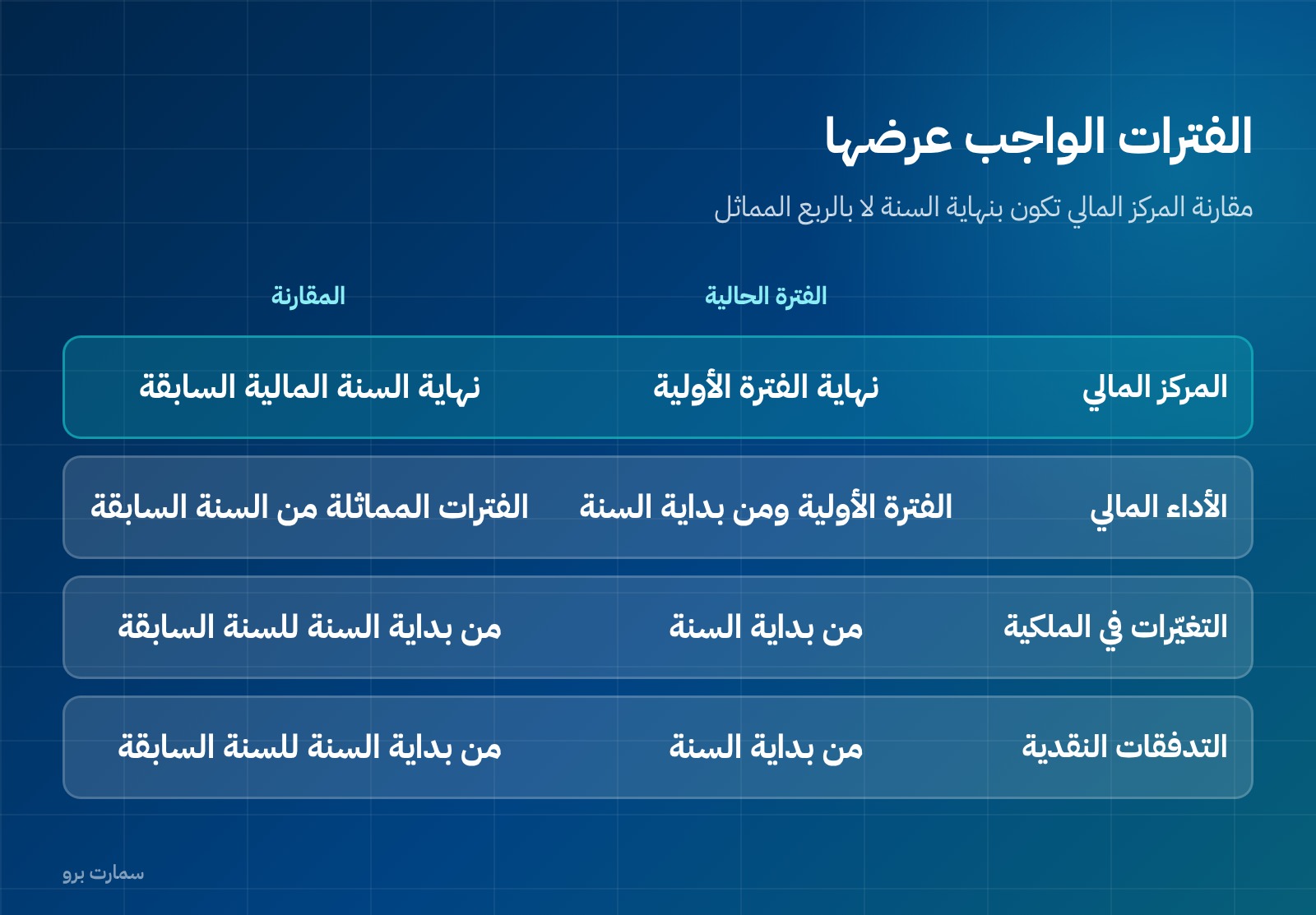
Which periods must an interim report present?
| Statement | Current period | Comparative |
|---|---|---|
| Financial position | End of the current interim period | End of the immediately preceding financial year |
| Financial performance | The current interim period and year to date | The comparable interim periods of the prior year |
| Changes in equity | Year to date | Year to date for the prior year |
| Cash flows | Year to date | Year to date for the prior year |
Note that the statement of financial position is compared with the end of the prior year, not with the same quarter last year. This is a common preparation error.
Highly seasonal entities are encouraged to add information for the twelve months ending on the interim date, with comparatives.
How is materiality judged in an interim report?
Materiality is assessed in relation to the interim period's data, not the annual data. In practice, an item that is not material for the year may be material for a single quarter. The standard also notes that interim measurements rely more heavily on estimates than annual ones.
How does year-to-date measurement work?
This is the central principle. The same accounting policies used in the annual financial statements are applied, and measurements are made on a year-to-date basis, so that the frequency of reporting does not affect the measurement of annual results.
Several practical rules follow:
- A change in estimate made in an earlier interim period of the same year is reflected in a later period without retrospectively adjusting the earlier interim figures.
- Costs that would not meet the definition of an asset at year end are not deferred at an interim date.
- Income tax expense is recognised using the best estimate of the weighted average annual effective tax rate.
- Seasonal, cyclical or occasional revenue is neither anticipated nor deferred at an interim date unless anticipation or deferral would also be appropriate at year end. Examples include dividends, royalties and government grants. The same rule applies to costs incurred unevenly during the year.
So a business that spends on a marketing campaign in the first quarter and benefits from it all year cannot spread the cost across the quarters, because it does not meet the definition of an asset at year end.
What are the three most common preparation errors?
- Comparing the statement of financial position with the same quarter of the prior year instead of the end of the prior year.
- Repeating the annual report's notes in full instead of updating them for what has changed, producing a heavy report with no new information.
- Calculating tax on the quarter's profit alone instead of using the weighted average annual effective rate, which makes tax expense swing between quarters for no economic reason.
Why does this matter to a business that is not required to report?
Many Saudi businesses prepare quarterly reports for their banks or investors without any regulatory obligation. Those reports are read, and financing decisions are built on them. Applying the logic of this standard, even without claiming full compliance, makes them more reliable: year-to-date measurement, the weighted average annual tax rate, and no deferral of costs that fail the asset definition. See notes to the financial statements for how to structure the notes.
How is a change in accounting policy handled?
It is reflected by restating the earlier interim periods of the current year, and the comparable interim periods of prior years that will be restated in the annual statements under IAS 8. If that is impracticable, the new policy is applied prospectively from the earliest practicable date. The end result: one policy applies to each class of transactions throughout the financial year.
The official text is on ifrs.org.
What is the official name of the standard in Saudi Arabia?
The approved Arabic name of this standard is «المعيار الدولي للمحاسبة 34: التقرير المالي الأولي» (IAS 34: Interim Financial Reporting). SOCPA endorsed it without any modification for application in the Kingdom.
Reference: Saudi Organization for Chartered and Professional Accountants (SOCPA), the document endorsing IFRS for application in the Kingdom, updated on 04/07/1447 AH.
Article visuals

Frequently asked questions
Does IAS 34 require entities to publish interim reports?
No. IAS 34 does not specify who must publish interim reports, how often, or how soon after the period ends. It applies only when an entity is required, or chooses, to publish an interim report in line with IFRS.
What is the minimum content of an interim financial report?
Under IAS 34, the minimum is a condensed statement of financial performance, a condensed statement of financial position, a condensed statement of changes in equity, a condensed statement of cash flows, and selected explanatory notes. An entity may publish a complete set or more than this minimum.
Which period is the interim statement of financial position compared with?
It is compared with the end of the immediately preceding financial year, not with the comparable interim period of the prior year. This differs from the other statements, which are compared with the comparable interim periods.
How is tax expense calculated in an interim report?
Income tax expense is recognised using the best estimate of the weighted average annual effective tax rate. The tax is not calculated on the interim period's profit in isolation, which avoids unexplained swings in tax expense between quarters.
Can uneven costs be spread across the quarters?
No, unless deferring or anticipating them would also be appropriate at year end. Costs that do not meet the definition of an asset at year end are not deferred at an interim date.