
Insurance Contracts: The General Measurement Model and the Contractual Service Margin
How IFRS 17 measures insurance contracts: fulfilment cash flows, the contractual service margin, the simplified premium allocation approach and the one-year rule.
Author:سامي الحيدري
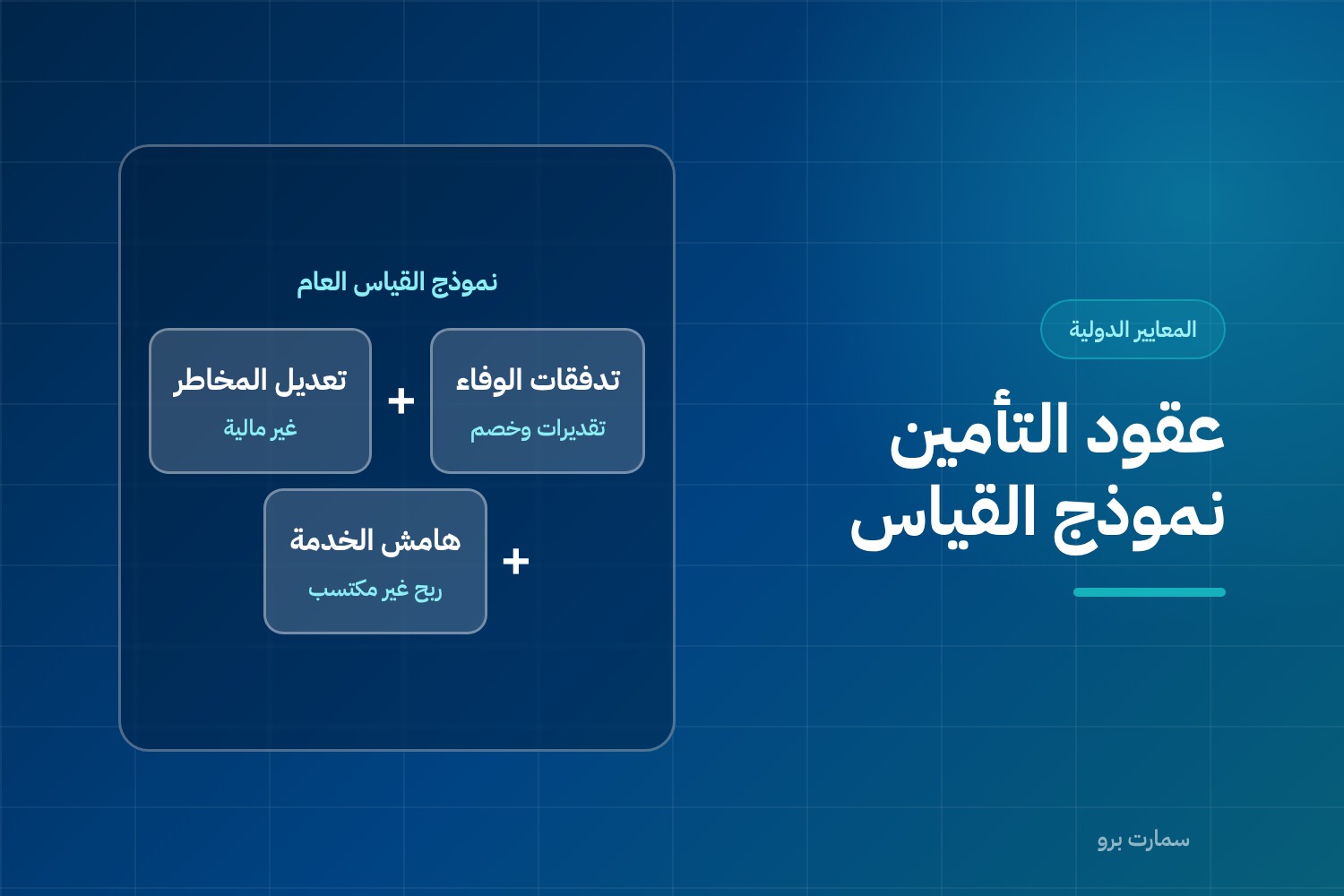
IFRS 17 is the biggest change to accounting for insurance contracts in decades. It applies to periods beginning on or after 1 January 2023, after its original 2021 effective date was deferred by two years.
Its goal is to set the principles for recognising, measuring, presenting and disclosing insurance contracts, so that financial statements faithfully represent their effect on financial position, performance and cash flows.
Which insurance contracts does the standard cover?
It applies to insurance contracts issued, including reinsurance contracts; reinsurance contracts held; and investment contracts with discretionary participation features, provided the entity also issues insurance contracts.
An insurance contract is a contract under which the issuer accepts significant insurance risk from the policyholder.
The most important exclusions are:
- Warranties provided by manufacturers, dealers and retailers, which fall under IFRS 15.
- Employers' assets and liabilities under employee benefit plans.
- Contracts in which the entity is the policyholder, except reinsurance contracts held. A company that buys an insurance policy on its warehouse does not apply this standard.
- Financial guarantee contracts, unless the issuer has previously stated explicitly that it regards them as insurance contracts and has used insurance accounting.
What is the level of aggregation and the one-year rule?
Aggregation comes before measurement. The entity identifies portfolios of contracts subject to similar risks and managed together, then divides each portfolio into at least three groups:
- Contracts that are onerous at initial recognition.
- Contracts that have no significant possibility of becoming onerous subsequently.
- The remaining contracts.
The rule that forced insurers to rebuild their systems: a single group may not include contracts issued more than one year apart. Groups are fixed at initial recognition and are not reassessed.
How does the general measurement model work?
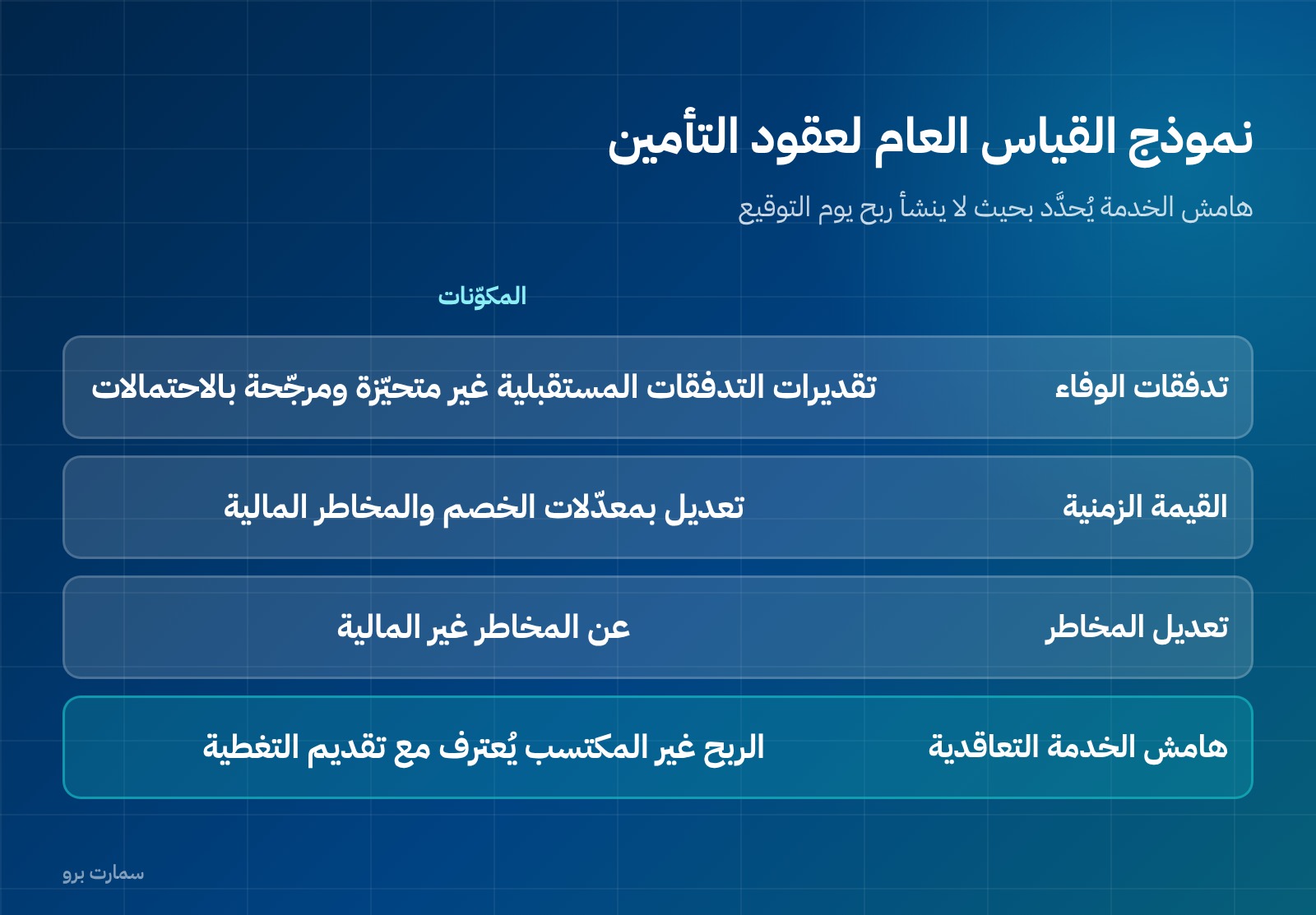
A group is measured as the total of two elements:
| Element | Components |
|---|---|
| Fulfilment cash flows | Estimates of future cash flows + an adjustment for the time value of money and financial risks (discount rates) + a risk adjustment for non-financial risk |
| Contractual service margin | The unearned profit the entity will recognise as it provides services under the contract in the future |
Estimates must be unbiased, probability-weighted, from the entity's perspective, and current. They do not include the entity's own non-performance risk.
The contractual service margin is set so that no income or expense arises at initial recognition, except for onerous groups. This is the central idea of the standard: no profit on the day the policy is signed, but profit earned gradually as coverage is provided.
How are insurance contracts measured subsequently?
The carrying amount at each reporting date = liability for remaining coverage (fulfilment cash flows for future service + the contractual service margin) + liability for incurred claims (fulfilment cash flows for past service).
The contractual service margin is rolled forward with specific adjustments: new contracts, interest accretion, changes in fulfilment cash flows relating to future service, currency exchange differences, and the amount recognised as insurance revenue for services provided in the period.
What happens with onerous groups?
When a group is onerous at initial recognition, the loss is recognised immediately in profit or loss. The same applies later when unfavourable changes exceed the remaining contractual service margin.
A loss component is established within the liability for remaining coverage. Subsequent changes are allocated between it and the rest of the liability, and it is reduced to zero by the end of the coverage period.
When can the simplified premium allocation approach be used?
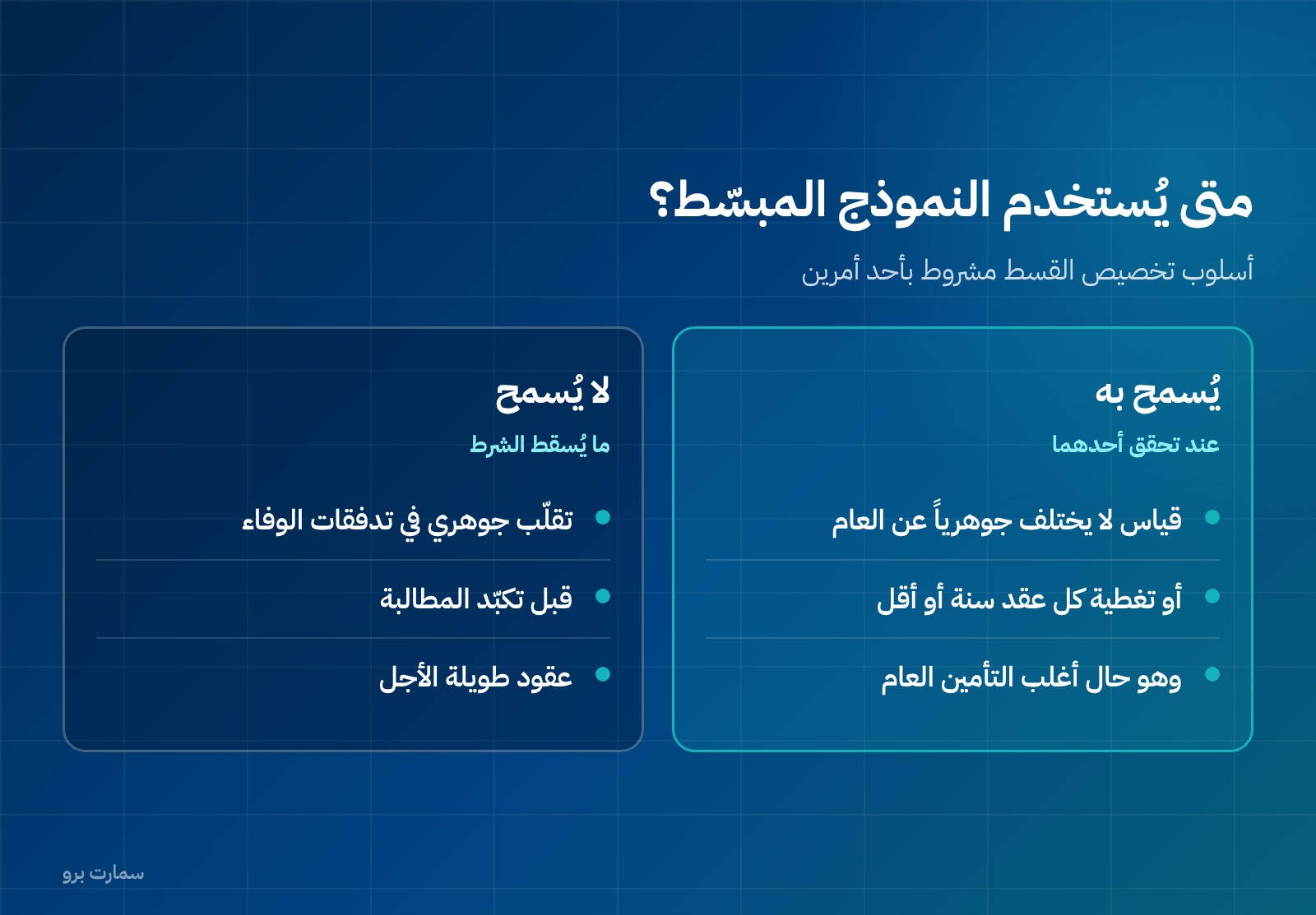
It is permitted if, and only if, one of two conditions is met at inception:
- The entity reasonably expects that the simplification will produce a measurement of the liability for remaining coverage that would not differ materially from the general model.
- Or the coverage period of each contract in the group is one year or less.
The first condition is not met if significant variability in the fulfilment cash flows is expected before a claim is incurred.
Under this approach, insurance acquisition cash flows may be expensed as incurred if the coverage period is one year or less, and cash flows expected to be paid or received within one year or less do not need to be discounted. In practice, this is the model used for most short-term general insurance contracts.
How are insurance contracts presented in the financial statements?
- In the statement of financial position: portfolios in an asset position are presented separately from portfolios in a liability position, and separately for insurance contracts issued and reinsurance contracts held.
- In financial performance: amounts are split into the insurance service result (insurance revenue and insurance service expenses) and insurance finance income or expenses.
- Insurance service expenses include incurred claims excluding repayments of investment components.
- The entity has an accounting policy choice: include all insurance finance income and expenses in profit or loss, or disaggregate them, with a systematic allocation in profit or loss and the difference in other comprehensive income.
What are the transition options?
There are three routes: full retrospective application, and where that is impracticable, the modified retrospective approach or the fair value approach. The contractual service margin and insurance revenue must be disclosed separately by transition approach.
Why did all of this change?
Before this standard, almost every country accounted for insurance contracts in its own way, which made it impossible to compare one insurer with another across borders. The previous standard allowed existing practices to continue as an interim first phase.
The most important change in IFRS 17 is conceptual rather than technical: the premium collected is not revenue. When a customer pays a full year's premium upfront, the insurer has not yet earned anything. Revenue is recognised as coverage is provided, month by month, just like revenue from any service delivered over time.
As a result, revenue figures in insurers' financial statements after 2023 cannot be compared directly with their figures before it.
What does this mean outside the insurance sector?
Most businesses do not apply this standard. But two points matter to companies that are not insurers:
- Extended warranty contracts sold by some retailers may carry significant insurance risk, so classifying them requires professional judgement.
- Reading insurers' financial statements has changed fundamentally since 2023: revenue is no longer the premiums collected, and the contractual service margin has become the most important indicator of future profitability.
The official text is on ifrs.org. See also our complete guide to IFRS in Saudi Arabia.
What is the official name adopted in Saudi Arabia?
The official Arabic name of this standard is «المعيار الدولي للتقرير المالي 17: عقود التأمين» (IFRS 17: Insurance Contracts). SOCPA adopted it with a Saudi modification: paragraph 133 was added, covering disclosures for cooperative insurance (takaful), the model used in the Kingdom. Saudi insurers' financial statements therefore carry an additional disclosure that does not exist in the international text.
Reference: Saudi Organization for Chartered and Professional Accountants (SOCPA), the document endorsing IFRS for application in the Kingdom, updated on 04/07/1447 AH.
Key takeaway: IFRS 17 treats insurance profit as something earned over the coverage period, held in the contractual service margin rather than booked when the premium is collected. Most non-insurers only need it to classify extended warranties and to read insurers' accounts correctly.
If you want your own accounts, VAT and financial statements produced from one connected system, start a free SmartPro trial.
Article visuals
Frequently asked questions
When did IFRS 17 become effective?
IFRS 17 applies to annual periods beginning on or after 1 January 2023, after its original effective date of 1 January 2021 was deferred by two years. Early application is permitted for entities that also apply IFRS 9.
What is the contractual service margin?
The contractual service margin is the unearned profit an entity will recognise as it provides services under insurance contracts in the future. It is set at initial recognition so that no income or expense arises, except for onerous groups, where the loss is recognised immediately.
What is the one-year rule for grouping insurance contracts?
Under IFRS 17, a single group may not include contracts issued more than one year apart. Groups are fixed at initial recognition and are not reassessed afterwards.
When can the simplified premium allocation approach be used?
The premium allocation approach can be used if the entity reasonably expects it to produce a measurement that does not differ materially from the general model, or if the coverage period of each contract in the group is one year or less. It is the approach used in practice for most short-term general insurance contracts.
Does a business apply IFRS 17 to insurance policies it buys?
No. Contracts in which the entity is the policyholder are excluded from IFRS 17, except reinsurance contracts held. A company that buys a policy on its warehouse does not apply this standard.