
Share-Based Payments: Measurement and Vesting Conditions
How share-based payments are accounted for under IFRS 2: the three types, the grant date, and the true-up rule for vesting conditions.
Author:سامي الحيدري
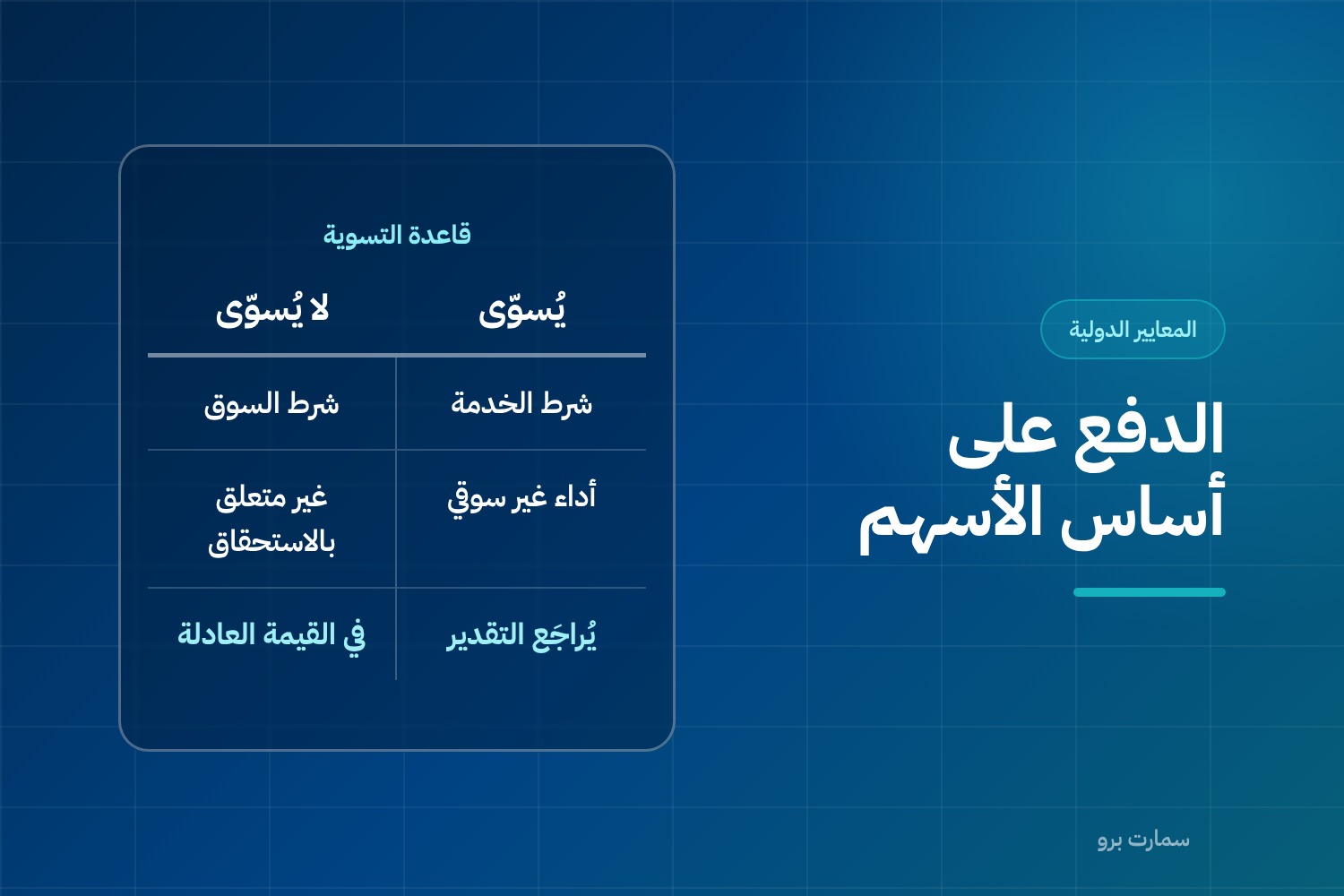
When you grant employees share options instead of a pay rise, it can look as though you have taken on no cash cost and therefore no expense. IFRS 2 says the exact opposite: share-based payments are transactions with a real cost that must appear in your income statement and your statement of financial position.
The standard applies to all such transactions, whether or not the entity can identify the specific goods or services received. It extends to transactions between entities in the same group, and it covers goods such as inventory and property, plant and equipment, not just services.
What are the three types of share-based payments?
| Type | How it is settled | Other side of the entry |
|---|---|---|
| Equity-settled | Shares or options | Increase in equity |
| Cash-settled | Cash linked to the share price | Liability |
| With a choice of settlement | The entity or the supplier can choose cash or shares | Depends on which party holds the choice |
When does IFRS 2 not apply?
- Transactions with a party acting solely in its capacity as a holder of the entity's equity instruments.
- Goods or net assets acquired in a business combination, in a combination of entities under common control, or contributed to form a joint venture. But note: equity instruments granted to employees of the acquiree in exchange for continued service do fall within scope.
- Contracts within the scope of IAS 32 or IFRS 9.
How are share-based payments recognised and measured?
Goods or services are recognised when they are received or acquired, with a matching increase in equity for equity-settled transactions, or a liability for cash-settled ones. Anything that does not qualify for recognition as an asset is recognised as an expense.
Measurement follows two different rules:
- With non-employees: measured at the fair value of the goods or services received. This fair value is presumed to be reliably estimable, a presumption that can be rebutted only in rare cases.
- With employees: measured at the fair value of the equity instruments granted, at grant date. The amount is not remeasured later for changes in fair value.
If the instruments vest immediately, the full amount is recognised at grant date. Otherwise it is recognised over the vesting period as the services are rendered.
How does the true-up rule work for vesting conditions?
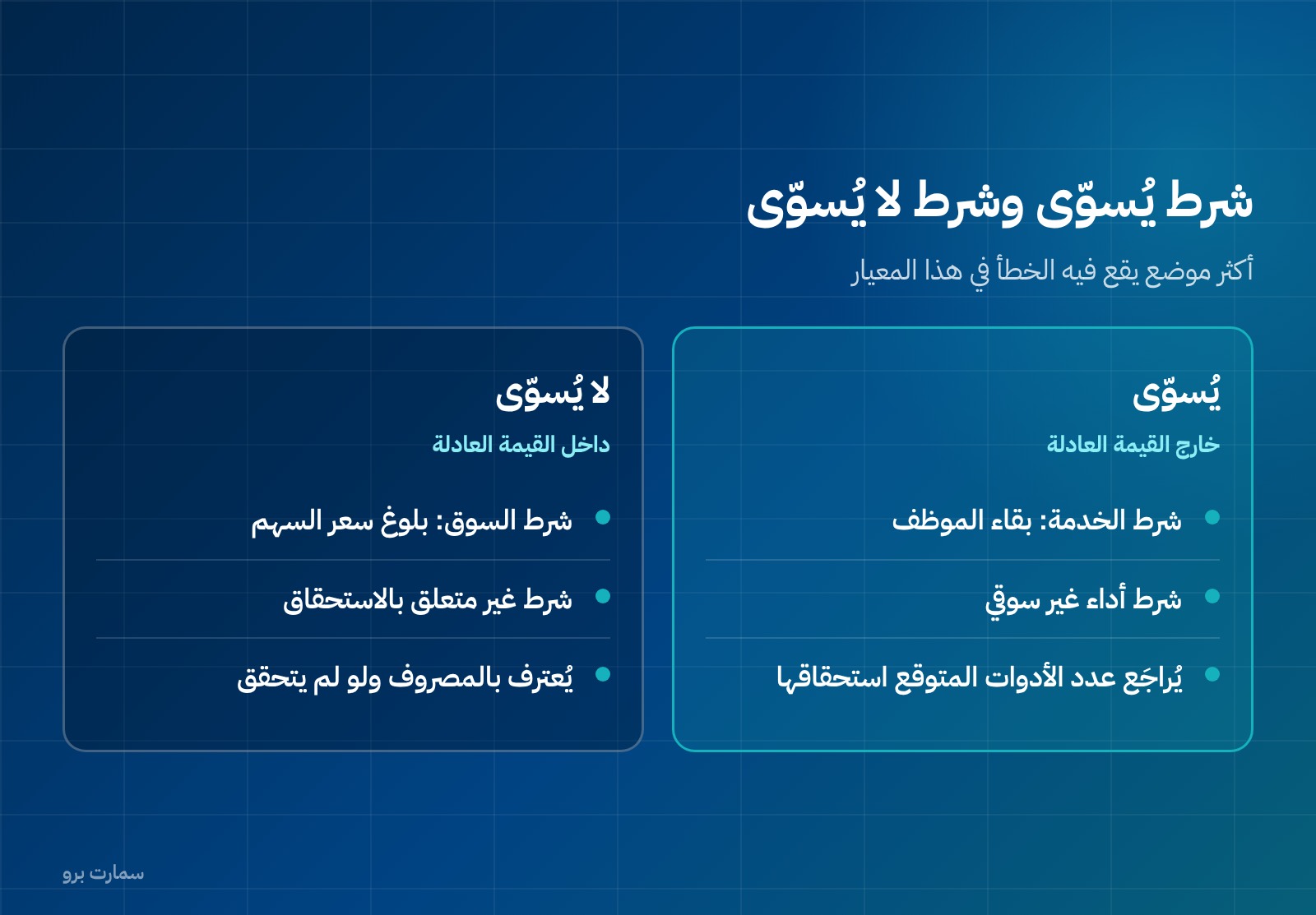
This is the point most often explained wrongly. The rule distinguishes between two kinds of conditions:
Service conditions and non-market performance conditions are not included in the grant-date fair value. Instead, they are handled by estimating the number of instruments expected to vest, revising that estimate, and truing up the result to the number that actually vests.
Market conditions and non-vesting conditions are included in the grant-date fair value and are not trued up.
In practice: if the condition is the share price reaching a set level, which is a market condition, the expense is recognised as long as the employee has provided the service, even if the share never reaches that price. If the condition is that the employee stays three years and they leave in year two, the expense already recognised is reversed, because it is a service condition.
What does the true-up look like in a worked example?
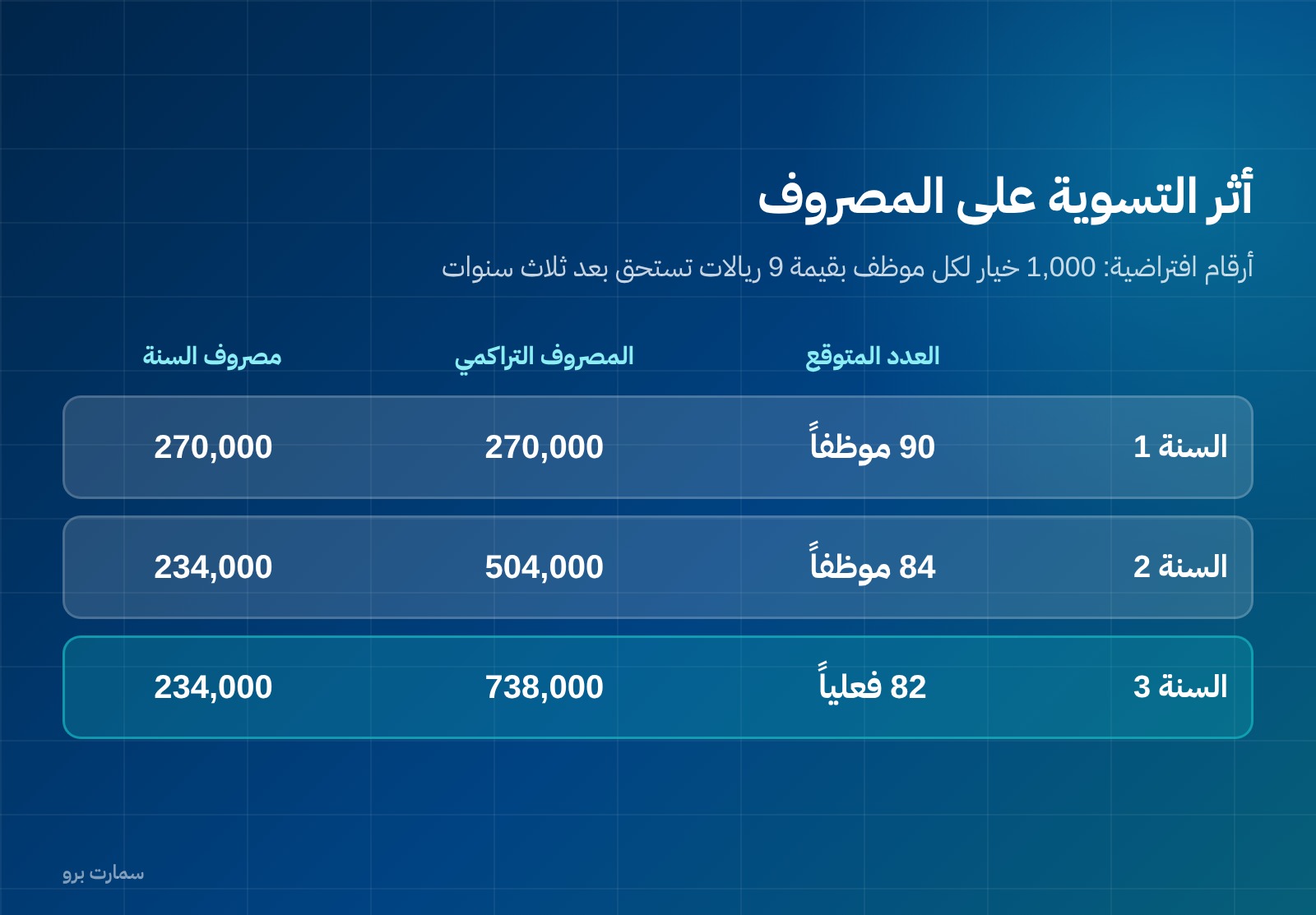
The figures below are hypothetical, to illustrate the method. A company grants 100 employees 1,000 options each, with a grant-date fair value of SAR 9 per option, vesting after three years of service. It initially estimates that 90 employees will stay:
| Year | Expected to stay | Cumulative expense (SAR) | Expense for the year (SAR) |
|---|---|---|---|
| 1 | 90 | 90 × 1,000 × 9 × 1/3 = 270,000 | 270,000 |
| 2 | 84 | 84 × 1,000 × 9 × 2/3 = 504,000 | 234,000 |
| 3 | 82 (actual) | 82 × 1,000 × 9 = 738,000 | 234,000 |
Notice that the cumulative expense ends up based on the actual number. That is the true-up. Had the condition been a market condition, the figure would not have changed when the condition was not met.
What if fair value cannot be measured reliably?
In the rare cases where fair value cannot be estimated reliably, the transaction is measured at intrinsic value, the difference between the share price and the exercise price. It is then remeasured at each reporting date and at the date of final settlement.
Is IFRS 2 fair value the same as IFRS 13 fair value?
The standard states explicitly that "fair value" in IFRS 2 is defined differently from IFRS 13****, so it is measured under IFRS 2 itself, not IFRS 13. Many references say the opposite, so check this carefully when reviewing your working papers.
How are share-based payments within a group treated?
When a parent grants its shares to employees of a subsidiary, a transaction between group entities arises. The standard addresses it directly: the entity that receives the services recognises them, and the entity that settles the transaction recognises the settlement. In the consolidated financial statements, the transaction appears as equity-settled.
This is a common situation in Saudi groups that run a central incentive plan at the holding company while the employees work in the operating companies.
How do share-based payments affect equity and tax?
The expense recognised is matched by an increase in equity, not a cash outflow. So the cash effect is zero, but the effect on profit is real, and so is the effect on profitability ratios. The tax treatment may also differ from the accounting treatment, creating a temporary difference that is handled under deferred tax.
It is important to disclose the number of options outstanding, their exercise prices and the weighted average remaining contractual life, because readers of the financial statements need to know how much their holding could be diluted.
What should your system keep on record?
A share option plan needs a register that holds: the grant date and its fair value, the vesting conditions classified as service, non-market performance or market, the number of instruments per employee, and leaver movements. Without that register, calculating the annual expense becomes a manual judgement call that is hard to defend in front of your auditor.
The official text is on ifrs.org.
What is the official title adopted in Saudi Arabia?
The approved Arabic title of this standard is «المعيار الدولي للتقرير المالي 2: الدفع على أساس الأسهم» (IFRS 2 Share-based Payment). SOCPA adopted it as issued, with a note that an entity's ability to issue capital in exchange for goods or services requires a legal basis, which is a matter outside the scope of accounting standards.
Reference: Saudi Organization for Chartered and Professional Accountants (SOCPA), the document endorsing IFRS for application in the Kingdom, updated on 1447/07/04 AH.
Article visuals
Frequently asked questions
What does IFRS 2 cover?
IFRS 2 covers transactions in which an entity receives goods or services in exchange for its equity instruments or for cash linked to its share price. It requires these transactions to be recognised in the financial statements, including the expense for share options granted to employees.
How are grants to employees measured under IFRS 2?
Grants to employees are measured at the fair value of the equity instruments granted, at grant date, and are not remeasured later for changes in fair value. Transactions with non-employees, by contrast, are measured at the fair value of the goods or services received.
What is the difference between a market condition and a service condition?
A market condition, such as the share price reaching a set level, is included in the grant-date fair value and is not trued up, so the expense is recognised even if the condition is never met. A service condition is handled through an estimate of the number of instruments expected to vest, which is trued up to the number that actually vests.
When is the share-based payment expense recognised?
If the instruments vest immediately, the expense is recognised in full at grant date. Otherwise it is recognised over the vesting period as the services are rendered, with a matching increase in equity or a liability depending on how the transaction is settled.
Is fair value under IFRS 2 the same as under IFRS 13?
No. IFRS 2 states explicitly that its definition of fair value differs from the one in IFRS 13. Share-based payments are therefore measured under IFRS 2 itself, not under IFRS 13.