
Fair Value: The Definition and the Three Levels of Measurement
How IFRS 13 defines fair value, what the principal market and highest and best use mean, and how the three levels of the fair value hierarchy work.
Author:سامي الحيدري
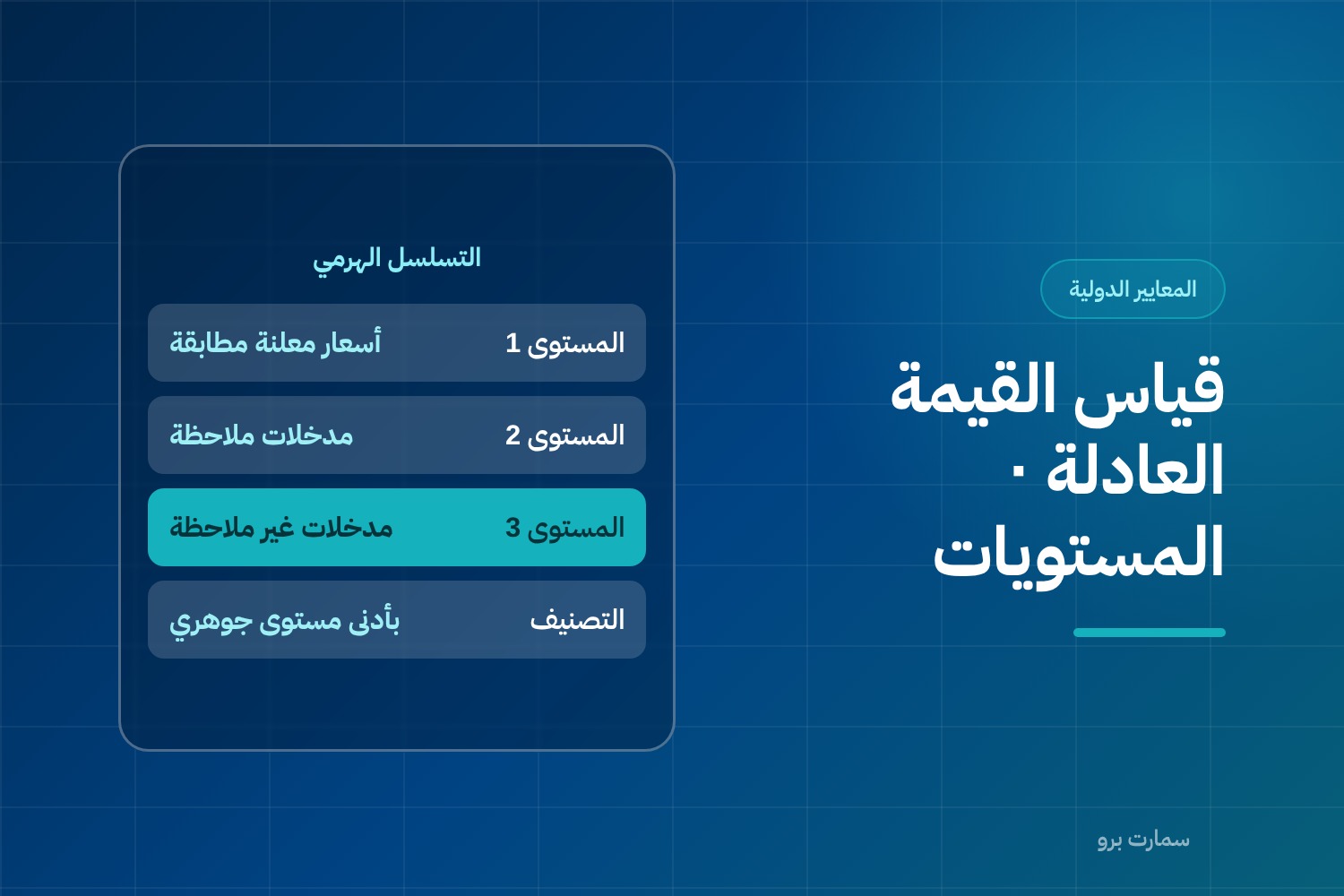
Before 2011, fair value was defined separately in each standard, so treatments differed and comparison was difficult. IFRS 13 then introduced a single definition, a single measurement framework and consistent disclosures.
One point is often overlooked: the standard does not require fair value measurement for any item. It tells you how to measure when another standard requires or permits fair value, not when to measure.
What is the definition, and what follows from it?
Fair value is the price that would be received to sell an asset or paid to transfer a liability in an orderly transaction between market participants at the measurement date.
This definition has three practical consequences:
- It is an exit price, not an entry price. What you paid to buy the asset is not necessarily its fair value.
- It is a market-based measurement, not an entity-specific one. It is viewed from the perspective of a market participant holding the asset, not from your own perspective.
- Your intention to hold or settle is entirely irrelevant. Planning to keep an asset for ten years does not change its fair value today.
Where does the standard not apply?
There are three scope exclusions:
| Item | Reference |
|---|---|
| Share-based payments | IFRS 2 |
| Leasing transactions | IFRS 16 |
| Measurements that resemble fair value but are not fair value | Net realisable value under IAS 2, and value in use under IAS 36 |
The last row is a frequent source of confusion: net realisable value in inventory valuation is not fair value, because it is an entity-specific amount that reflects the entity's own costs of completion and sale.
Why does the principal market come before the most advantageous one?
The transaction is assumed to take place in the principal market for the asset or liability, meaning the market with the greatest volume and level of activity. If there is no principal market, the most advantageous market is used.
The decisive rule: if a principal market exists, its price is used even if another market offers a better price. You must have access to that market, although you do not need to be able to transact in it on the measurement date itself.
What is highest and best use for non-financial assets?
A non-financial asset is measured assuming its highest and best use from a market participant's perspective. The use must meet three conditions together: it must be physically possible, legally permissible and financially feasible.
The current use is presumed to be the highest and best use unless market or other factors suggest otherwise. Land you use as a warehouse, where regulations allow commercial development, may have a fair value based on commercial use rather than on your current use.
What are the three valuation approaches?
Use techniques that suit the circumstances and for which sufficient data is available, maximising relevant observable inputs and minimising unobservable ones. The three approaches are:
- Market approach: transaction prices for comparable assets.
- Cost approach: the cost of replacing the asset's current service capacity.
- Income approach: discounting future cash flows to a present value.
At initial recognition, if the transaction price is fair value and the technique uses unobservable inputs, the technique must be calibrated so that it produces the transaction price. A change in valuation technique is treated as a change in accounting estimate under IAS 8, not as a change in policy.
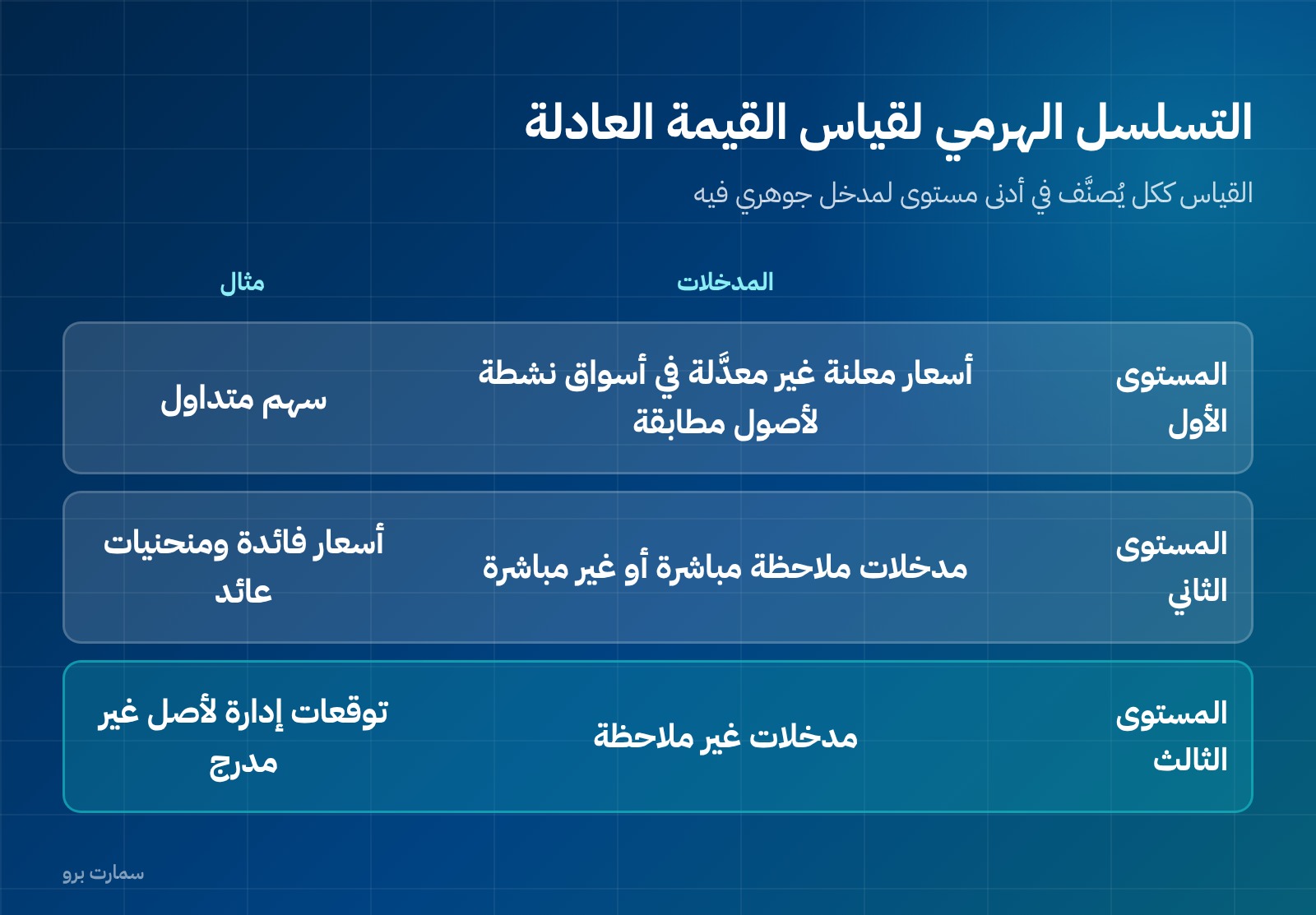
What are the three levels of the fair value hierarchy?
| Level | Inputs | Examples |
|---|---|---|
| Level 1 | Unadjusted quoted prices in active markets for identical assets that can be accessed at the measurement date | A share traded in an active market |
| Level 2 | Observable inputs, direct or indirect, other than Level 1 prices | Prices of similar assets, interest rates, yield curves, credit spreads |
| Level 3 | Unobservable inputs, used when relevant observable inputs are not available | Management's cash-flow forecasts for an unlisted asset |
The rule that governs classification: the measurement as a whole is classified at the lowest level of any input that is significant to it. A model that relies entirely on observable inputs except for one significant unobservable input is classified in full at Level 3.
Level 3 inputs may start from your own data, but they must be adjusted if market participants would use different data.
What must be disclosed?
The aim is to let readers assess the valuation techniques and inputs used. For each class, disclose: the fair value at the end of the period; its level in the hierarchy; transfers between Level 1 and Level 2, the reasons for them and the policy for determining when transfers occur; a description of the techniques and inputs, with quantitative information about significant Level 3 inputs; a reconciliation of Level 3 movements; a description of the valuation processes; and a narrative sensitivity analysis.
Quantitative disclosures are presented in tabular format unless another format is more appropriate.
What mistakes come up repeatedly in practice?
Three mistakes recur when mid-sized businesses apply this standard:
- Confusing entry price with exit price: treating the purchase cost as fair value years later. The definition is explicit that fair value is an exit price at the measurement date.
- Adjusting Level 1 prices: quoted prices in active markets for identical assets are used as they are, and are adjusted only in the very limited cases the standard specifies.
- Classifying a measurement at the highest level of its inputs instead of the lowest: a model with ten observable inputs and one significant unobservable input is a Level 3 measurement in full, with its heavier disclosures.
When is an external valuer worth it?
Not every fair value needs a certified valuer. But three signs call for one: the measurement is Level 3, the item is material to your financial statements, and its effect recurs year after year, as with investment property. In these cases the valuer's report becomes part of the audit file, not just an internal document.
What does this mean in practice?
Fair value appears in many items: investment property, financial instruments, assets acquired in business combinations, and revaluation of property, plant and equipment. The more unobservable inputs a measurement uses, the more important it becomes to document the assumptions: who estimated them, when, and on what basis. Auditors object less to the number itself than to the absence of a trail behind it.
The standard has been effective since 1 January 2013, and its official text is on ifrs.org.
What is the official title adopted in Saudi Arabia?
The approved Arabic title of this standard translates as "IFRS 13: Fair Value Measurement". The Saudi Organization for Chartered and Professional Accountants (SOCPA) endorsed it without any modification for application in the Kingdom.
Reference: Saudi Organization for Chartered and Professional Accountants, the document endorsing IFRS for application in the Kingdom, updated on 4/7/1447 AH.
Article visuals

Frequently asked questions
What is the definition of fair value?
Fair value is the price that would be received to sell an asset or paid to transfer a liability in an orderly transaction between market participants at the measurement date. It is an exit price based on the market, not on the specific entity.
Does IFRS 13 require items to be measured at fair value?
No. IFRS 13 sets out how fair value is measured when another standard requires or permits it. It does not extend the use of fair value measurement to any additional items.
What is the difference between the principal market and the most advantageous market?
The principal market is the market with the greatest volume and level of activity for the asset or liability, and its price is used even if another market offers a better price. The most advantageous market is used only when no principal market exists.
What are the three levels of the fair value hierarchy?
Level 1 is unadjusted quoted prices in active markets for identical assets, Level 2 is other observable inputs, direct or indirect, and Level 3 is unobservable inputs. The measurement as a whole is classified at the lowest level of any input that is significant to it.
Does the entity's intention affect fair value?
No. The intention to hold an asset or settle a liability is irrelevant, because fair value is measured from the perspective of a market participant, not from the entity's own perspective.