
How to Choose Property Management Software in Saudi Arabia
A practical guide to choosing property management software in Saudi Arabia: rent schedules, occupancy, post-dated cheques, arrears aging, owner statements and a pre-purchase checklist.
Author:سامي الحيدري
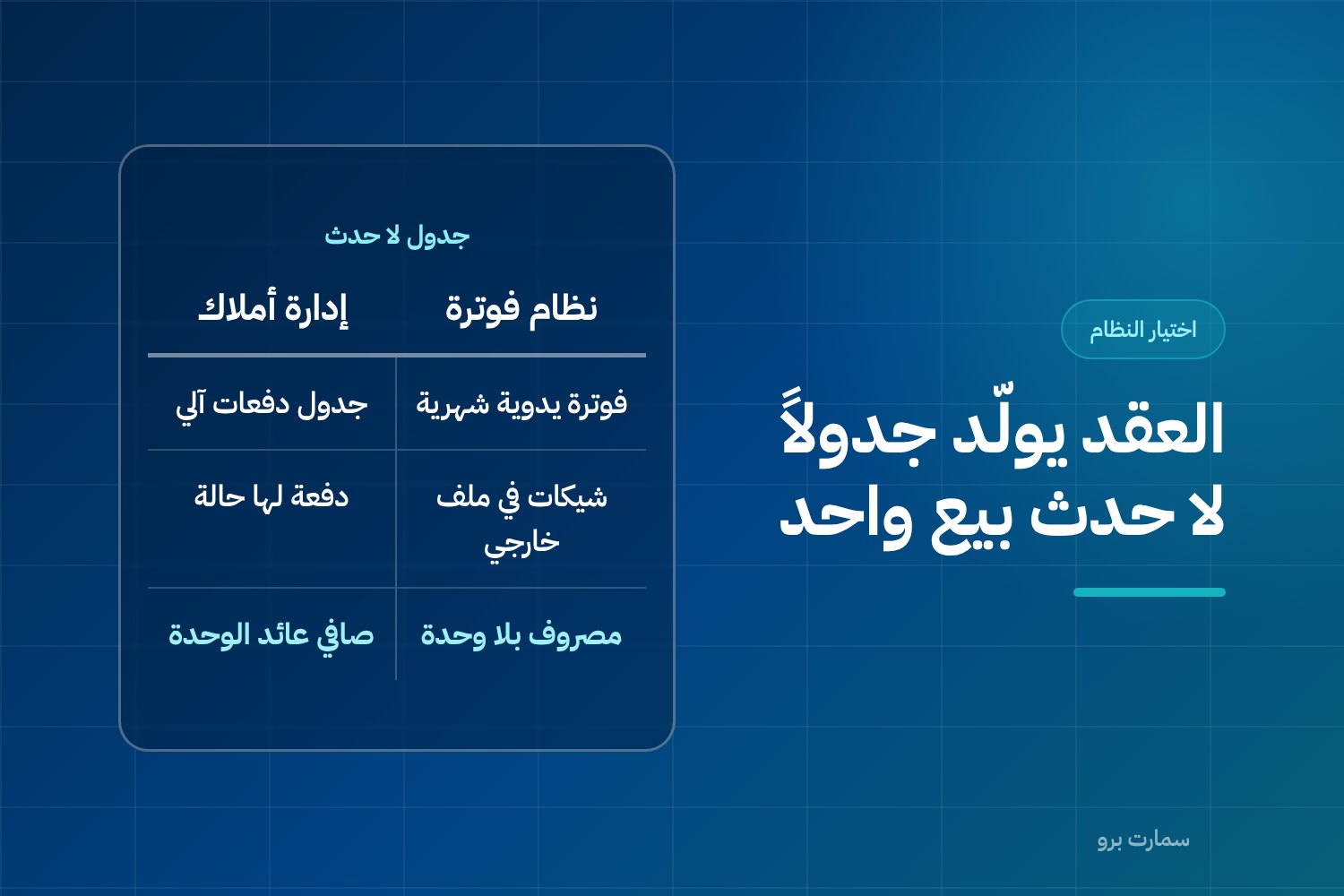
To choose property management software in Saudi Arabia, start with one test: does each lease automatically generate its own payment schedule? Rental income recurs on a schedule, not from one-off sales. The right system also tracks occupancy per unit, post-dated cheques, arrears aging, costs per unit and owner statements, with ZATCA Phase 2 e-invoicing built in.
Choosing property management software looks like an accounting decision. It is really a scheduling decision. What separates a company calmly managing fifty units from one drowning in Excel files is not how accurate its journal entries are. It is that rental income does not come from a single sale. It comes from a schedule of due dates that repeats across the life of each lease.
Any system built on the idea of "one invoice per transaction" will push you into an external spreadsheet for due dates. That spreadsheet becomes your real system, and the software becomes a place where results are entered late.
This guide compares types of systems and how they work, not product names. The figures below are hypothetical, to illustrate the method. They are not market prices, rent levels or industry rates.
Why does ordinary invoicing software break in property management?
General accounting or invoicing software is built around an event: a sale happens, an invoice is issued, the money is collected, the entry is closed. That logic works well for a shop or a service office.
Property management works the other way round. A lease is signed once, then creates financial obligations on dates known in advance for one, three or five years. Nobody "sells" anything in month six, yet an amount still falls due in month six.
If the system cannot generate those amounts from the lease automatically, the usual thing happens. One person in the office keeps the dates in a file, and when that person is away, the dates go with them.
You can diagnose the symptoms before you buy:
- Rent is invoiced by hand every month.
- Cheques sit in a drawer and are tracked in a separate file.
- Maintenance costs are posted to "general expenses" with no unit attached.
- You learn a lease has expired from the tenant, not from the system.
- The owner statement takes three hours to prepare by hand each month.
If you are still deciding between standalone accounting software and an integrated system, that is a separate question, covered in accounting software vs ERP for Saudi businesses.
Why does rental income need a schedule rather than a sale?
This is the backbone, and everything else branches from it. The first test of any system: is the lease a record in its own right that generates a payment schedule, or just a note in the tenant's file?
In a schedule-based system, you enter the lease once: the unit, the tenant, start and end dates, the contract value, and the number and dates of instalments. The system then creates a due line for each instalment, issues the document on time, and shows what is coming and what is overdue without anyone asking.
One point needs care. Rent is recognised over time, but the VAT obligation does not follow time alone. VAT becomes due on the earliest of three dates: the date of supply, the date the invoice is issued, or the date the consideration is received, in full or in part.
So if you receive an advance payment covering six months, the receipt itself triggers the VAT liability; it is not deferred until the months pass. A system that separates the accounting due schedule from the VAT tax point saves you repeated adjustments in every VAT return.
Because the treatment of rent varies with the type of property and the nature of the activity, this is not something a sales pitch can settle. Any classification of rent under VAT, or any other tax on property, should be confirmed with ZATCA or a tax adviser before you rely on it. The official reference is at the end of this guide.
How do you track occupancy and the cost of a vacant month?
In a shop, the item is what you sell. In property management, the unit is the item. In practice, every unit needs its own record: number, building, type, area, status (occupied, vacant, under maintenance), current lease and lease history.
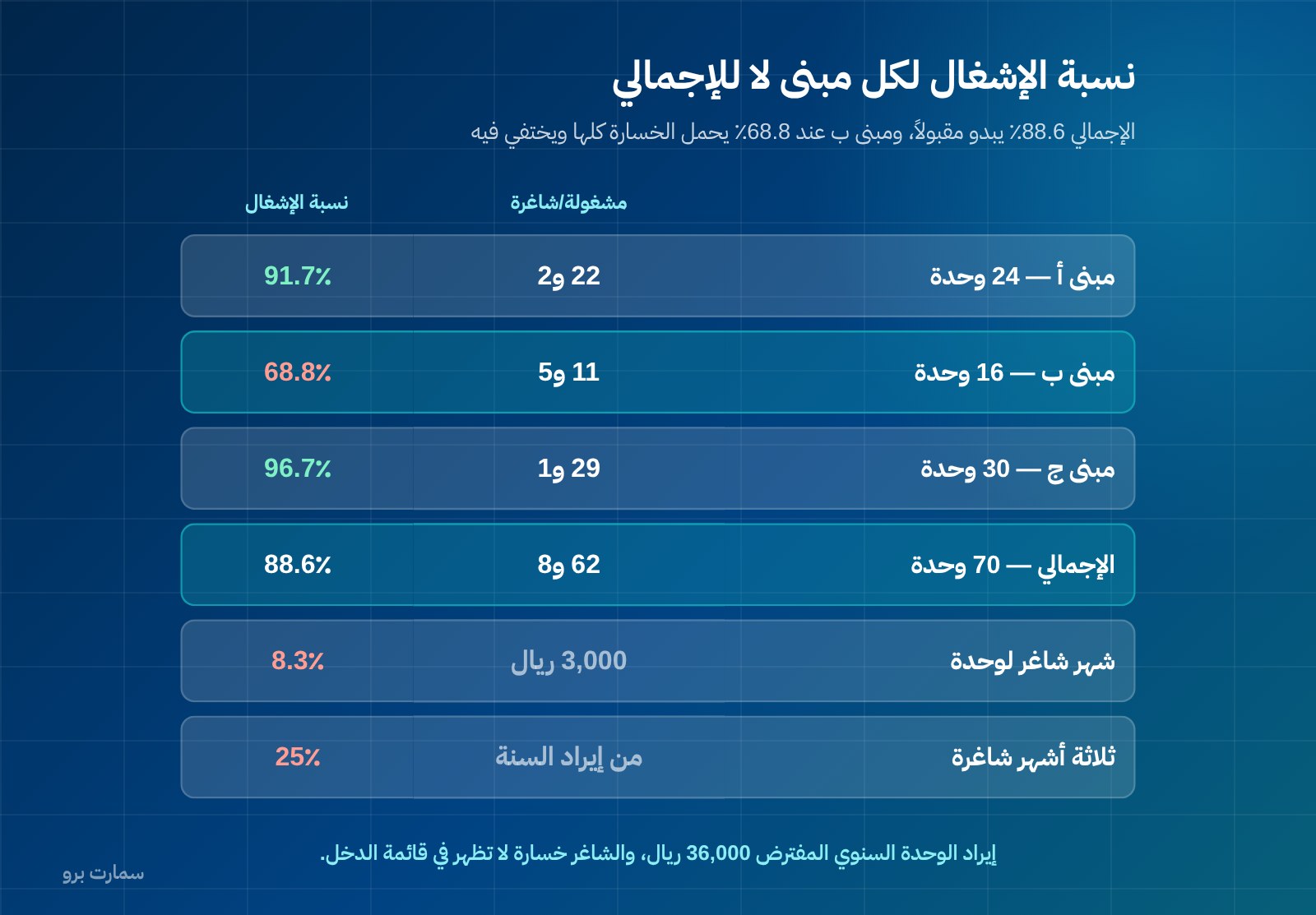
Without that record you cannot measure the most important number in this business: the occupancy rate, which is the share of units currently let. The figures below are hypothetical, to illustrate the method:
| Building | Units | Occupied | Vacant | Occupancy rate |
|---|---|---|---|---|
| Building A | 24 | 22 | 2 | 91.7% |
| Building B | 16 | 11 | 5 | 68.8% |
| Building C | 30 | 29 | 1 | 96.7% |
| Total | 70 | 62 | 8 | 88.6% |
The overall 88.6% looks acceptable. But Building B, at 68.8%, carries the entire loss, and the total hides it. This is the same mistake general accounting software makes: it shows you the bottom line and hides the lines that need a decision.
The cost of vacancy is clearer than it seems. If a unit's assumed annual income is SAR 36,000, one vacant month costs SAR 3,000, or 8.3% of that unit's annual income. Three vacant months mean 25% of the year's income is gone without appearing on any income statement, because revenue that never happened is never recorded. Vacancy is a silent loss, and a system that does not calculate occupancy cannot see it.
Which report do owners actually want? Cheques and deferred payments
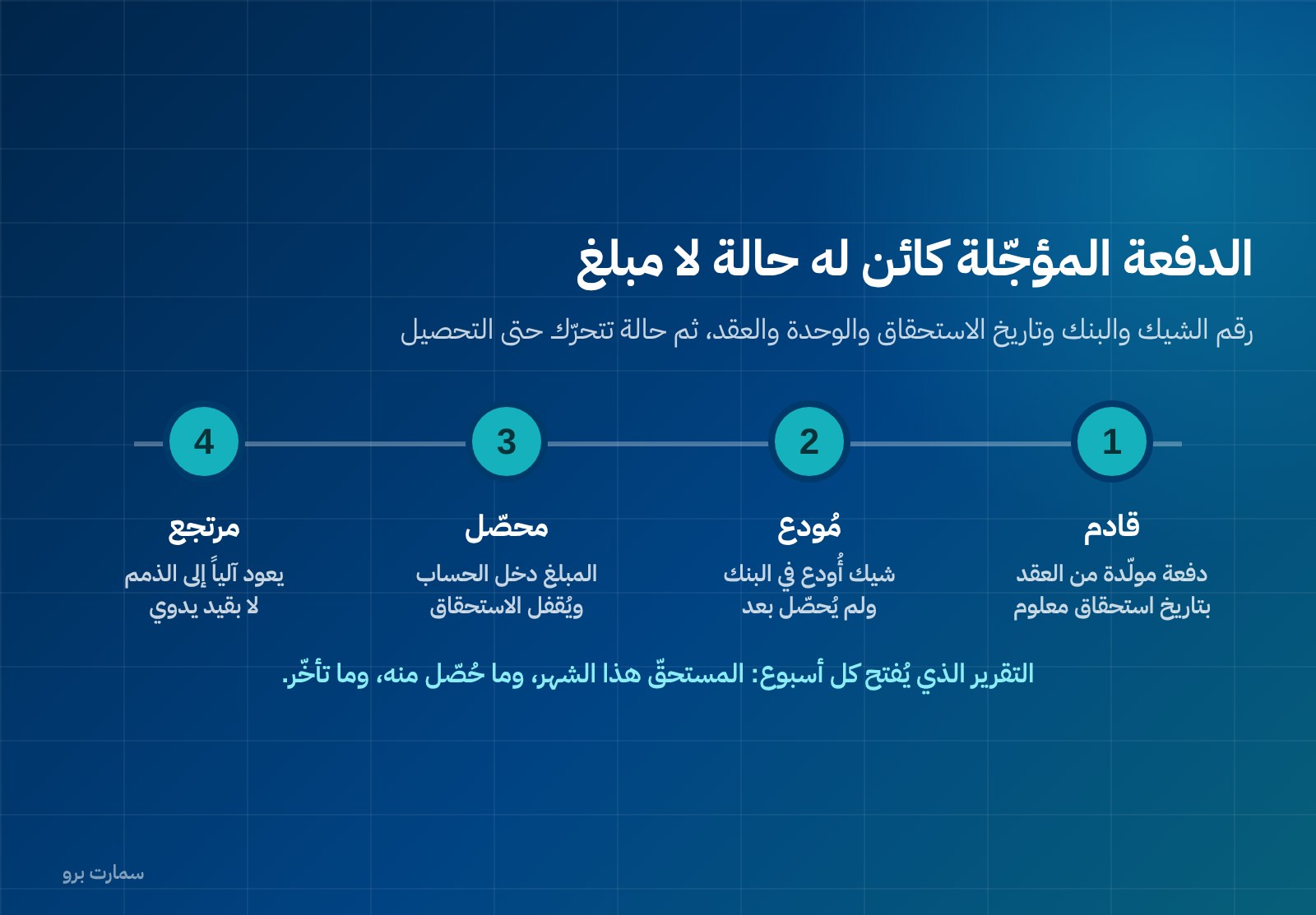
Ask an owner or property manager which report they open every week, and it will not be the income statement. It will be one table: what is due this month, what has been collected, and what is late.
That requires the system to treat a deferred payment as a record with a status, not just an amount in an account. A post-dated cheque is a cheque dated for a future due date and handed over at signing; each one needs its number or transfer reference, due date, bank, unit, lease and status (upcoming, deposited, collected, returned).
Most importantly, a returned cheque must move the amount back into accounts receivable automatically, not be corrected by a manual entry that someone has to remember.
The figures below are hypothetical, to illustrate the method:
| Unit | Tenant | Due date | Amount (SAR) | Status |
|---|---|---|---|---|
| A-104 | Tenant 1 | 01/02 | 9,000 | Collected |
| A-210 | Tenant 2 | 01/02 | 12,000 | Deposited |
| B-305 | Tenant 3 | 01/02 | 7,500 | Returned |
| B-112 | Tenant 4 | 15/02 | 10,000 | Upcoming |
| C-401 | Tenant 5 | 15/02 | 15,000 | Upcoming |
A table like this answers in a second a question that used to take an hour: how much will reach the bank this month, and how much is at risk. The condition is that it is built from the leases themselves, not from a parallel manual entry.
How should you read arrears: by tenant and by unit?
Arrears in this business cannot be read as a single total. You need two views: by tenant, so you know who to talk to, and by unit, so you know which asset causes a recurring problem with every tenant who occupies it.
An aging report splits outstanding amounts by how long they have been overdue: current, 1–30 days, 31–60, 61–90 and over 90. The figures below are hypothetical, to illustrate the method:
| Tenant | Unit | Current | 1-30 | 31-60 | Over 60 | Total |
|---|---|---|---|---|---|---|
| Tenant 3 | B-305 | 0 | 7,500 | 7,500 | 15,000 | 30,000 |
| Tenant 7 | B-118 | 6,000 | 6,000 | 0 | 0 | 12,000 |
| Tenant 9 | A-106 | 8,000 | 0 | 0 | 0 | 8,000 |
| Total | 14,000 | 13,500 | 7,500 | 15,000 | 50,000 |
This reading leads to a decision. Tenant 3 is not late; Tenant 3 has stopped paying, and the response is a legal process, not a friendly reminder. Tenant 7 is late every cycle, and the fix is changing the due date or the payment method. The SAR 50,000 total on its own cannot tell the two cases apart.
Why must expenses be posted to the unit?
Most buyers skip this point, yet it is what turns the system from a ledger into a decision tool. Every maintenance cost, every cleaning or lift contract, every utility bill and every improvement should carry the unit or building number at the moment of entry, not in a later monthly allocation.
The reason is simple. Income is split by unit by its nature. If expenses stay lumped together under "operating expenses", you are dividing detailed income by an unknown cost, and net return per unit becomes an invented number.
In practice, a unit that needs constant maintenance can be less profitable than a unit with lower rent, and you will never see that from a consolidated income statement.
What should be available:
- A maintenance work order linked to the unit.
- An expense linked to the work order.
- A split between recurring expenses and capital improvements.
- A simple report showing a unit's income minus its expenses for a period.
How should a system handle renewals and reminders?
A lease expiring is not a surprise. Its date is known from the day of signing. Even so, most losses in this business happen because nobody followed up on a written date.
The right system turns lease dates into automatic alerts:
- A lease approaching expiry, with enough time to negotiate.
- A payment still uncollected two days after it fell due.
- A cheque due for deposit within a week.
- A maintenance contract expiring.
- An insurance policy expiring.
The real test is not whether there is an "alerts screen" someone might open, but whether the notification reaches a named, responsible person.
Ask one specific question in the demo: how do I renew a lease with a rent increase? The right answer is that the system creates a new lease linked to the previous one and generates a new payment schedule. It should not edit the value on the old lease and lose the history of the previous period.
What do multiple owners and management fees require?
If your company manages property on behalf of owners, the product you sell is not occupancy or collection; it is trust. The one tool for building that trust is the monthly owner statement: a report showing each owner what was collected, what was spent on their units and what is due to them. It must be clear, on time, and traceable line by line to source documents.
This needs two things a general invoicing system does not do: keeping owners' funds separate from the company's own income in the books, and calculating the management fee automatically from the percentage or fixed amount set in each owner's agreement.
The figures below are hypothetical, to illustrate the method, for one owner's statement for one month:
| Item | Amount (SAR) |
|---|---|
| Rent collected | 48,000 |
| Maintenance on the owner's units | (3,200) |
| Utilities and cleaning | (1,800) |
| Management fee | (2,400) |
| Net due to owner | 40,600 |
A statement built this way ends the discussion before it starts, because every line is tied to a document. Preparing it by hand each month for twenty owners is the most common reason distributions run late.
You can look at SmartPro's real estate and property management solution and test the owner statement on one of your actual buildings before making any commitment.
What criteria should you use to compare property management software?
Compare criteria, not names. The table below compares types of systems as they work in practice:
| Criterion | General invoicing or accounting software | Specialised property management system | What to ask in the demo |
|---|---|---|---|
| Lease generates a payment schedule | Manual or missing | Core | Enter a lease with four instalments and ask for the schedule |
| Unit register and occupancy | Usually missing | Core | Ask for the occupancy rate of one building |
| Cheques and deferred payments with statuses | External file | Inside the system | Record a returned cheque and follow its effect |
| Arrears aging by unit | By customer only | By tenant and by unit | Ask for the report by unit |
| Expenses posted to the unit | Optional field | Required at entry | Ask for the net return of one unit |
| Renewal and due-date alerts | Missing | Date-driven | Ask for a notification before a lease expires |
| Owner statement and management fee | Manual | Ready-made report | Ask for a statement for one owner |
| Phase 2 e-invoicing | Varies | Built into issuing | Issue a document and inspect the XML |
| Full export of your data | Varies | Must be available | Ask for a full export |
For a broader comparison of accounting software features in the Saudi market and how to evaluate them, see how to choose the best accounting software in Saudi Arabia.
What does a tax invoice need to show for rent?
Leases with businesses usually mean a VAT-registered buyer, which calls for a standard tax invoice showing the buyer's name, address and VAT registration number. The system should store these details in the tenant's file and print them on every recurring document without repeated manual entry.
Under Phase 2 e-invoicing, the invoice is generated as XML to the UBL 2.1 standard, with a cryptographic stamp, a counter that is never reset, a hash chain linking each invoice to the one before it, and a QR code on simplified invoices. The most important practical consequence for anyone invoicing monthly rent: no editing an invoice after it is issued. Any correction to an amount, period or discount is handled with a credit or debit note linked to the original invoice.
Ask in the demo: how do I reduce a rent invoice issued with the wrong amount, or handle an early termination of the lease? The only correct answer is a credit note linked to the original document, not editing the document.
We explain the details of e-invoicing and what each invoice must carry in our ZATCA e-invoicing guide.
Note that the Zakat, Tax and Customs Authority (ZATCA) does not approve or certify software; it publishes an indicative list of qualified solution providers. Any phrase like "officially approved software" is a marketing description, not a regulatory approval, as we explain in what ZATCA-approved accounting software really means.
How do you test a system before you buy? Run it on one real building
Do not test the system on demo data. Pick one of your buildings and enter it in full:
- Enter the building and its units with their areas and status, then ask for the occupancy rate.
- Enter three leases with different terms and instalment counts, and check whether the system generated payment schedules automatically.
- Record the instalment cheques with their dates and banks, then ask for the report of what is due this month.
- Record a returned cheque, and check the amount went back to accounts receivable without a manual entry.
- Issue a standard tax invoice for a rent instalment to a business tenant, and check its name, address and VAT number.
- Issue a credit note against that invoice, and watch its effect on revenue, VAT and receivables.
- Post a maintenance expense to a specific unit through a work order, then ask for that unit's net return.
- Ask for the aging report by tenant, then by unit.
- Set a notification sixty days before a lease expires, and check that it reaches a named, responsible person.
- Renew one lease with an increase, and check that the previous period's history is not lost.
- Add an owner, link units to them, then ask for the owner statement with the management fee.
- Ask for a full export of your data. If you cannot take your data out, you are locked in, not subscribed.
If steps 2 and 11 fail, what you are looking at is not property management software; it is invoicing software with a "unit" field added.
What should the budget include beyond the licence price?
Compare the annual licence, the setup and entry of your existing buildings, units and leases, training for the collections team and not only the accountants, and any integration fees. Also include the cost of staying as you are: hours spent preparing owner statements by hand, a renewal date missed, a vacant month nobody noticed, and a cheque not deposited on time.
SmartPro publishes its prices on the pricing page, all including 15% VAT. Packages start at SAR 1,500 a year for Mini, SAR 4,500 for Pro and SAR 20,500 for Max. The Real estate system (properties, owners, tenants and lease contracts) can be added to a package at SAR 5,000 a year, and it is included in the Enterprise package, which is priced on request.
For a broader method of estimating the full cost of an integrated system and its line items, see what ERP costs in Saudi Arabia.
Where is the official reference?
For e-invoicing requirements, tax invoice rules, the timing of VAT liability and the indicative list of qualified solution providers, the only authoritative source is the Zakat, Tax and Customs Authority: zatca.gov.sa. Any regulatory claim about the treatment of rent or any tax on property made in a sales presentation should be checked there, or with a tax adviser, before you base a decision on it.
Key takeaway: Choose property management software that turns each lease into a payment schedule and tracks occupancy, cheques, arrears and expenses per unit. Then prove it by running one real building through the twelve-step checklist before you sign.
Read also
- Accounting software or ERP? A practical choice for Saudi businesses
- How to choose the best accounting software in Saudi Arabia
- ZATCA e-invoicing guide
To see it on your own portfolio, book a demo or start a free trial.
Article visuals
Frequently asked questions
What is the difference between property management software and general accounting software?
General accounting software is built around an event: a sale happens and an invoice is issued. Property management is built around a schedule: one lease creates amounts due on known dates for years. In practice, a specialised system generates the payment schedule from the lease itself and tracks occupancy and expenses per unit, while a general system pushes you into an external Excel file for due dates.
How do I measure the cost of a vacant unit?
Start from the unit's assumed annual income and divide it by twelve to get the cost of one vacant month. Using hypothetical figures to illustrate the method, a unit earning SAR 36,000 a year costs SAR 3,000 for each vacant month, or 8.3% of its annual income. The danger is that this loss never appears on an income statement, because revenue that did not happen is not recorded, so a system that does not calculate occupancy cannot see it.
When is VAT due on an advance rent payment in Saudi Arabia?
VAT becomes due on the earliest of three dates: the date of supply, the date the invoice is issued, or the date the consideration is received in full or in part. Receiving a payment that covers several months in advance therefore triggers the VAT liability on receipt, not when the period ends. Any classification of a specific type of rent should be confirmed with ZATCA or a tax adviser, and the reference is the ZATCA website.
How do I correct a rent invoice issued with the wrong amount, or a lease terminated early?
An invoice cannot be edited after it is issued; corrections are made with a credit or debit note linked to the original invoice. This is common in rentals because early terminations, discounts and settlements happen after invoicing. In a demo, ask the vendor to issue a credit note against a rent invoice and show its effect on revenue, VAT and the unit's receivables.