
Tailoring Workshop Licence via Balady: Steps and Documents
A tailoring workshop licence is issued online through Balady. Here are the steps, the required documents, and what to prepare before you apply so your application isn't rejected.
Author:سامي الحيدري
A tailoring workshop licence in Saudi Arabia is issued entirely online through the Balady platform, with a stated processing time of one to ten working days. The real timeline, though, depends on one thing: whether you prepared what is required before applying or after.
What delays most applications is not a complicated procedure. It is applying with a missing document, or with a shop that does not meet the requirements in the first place.
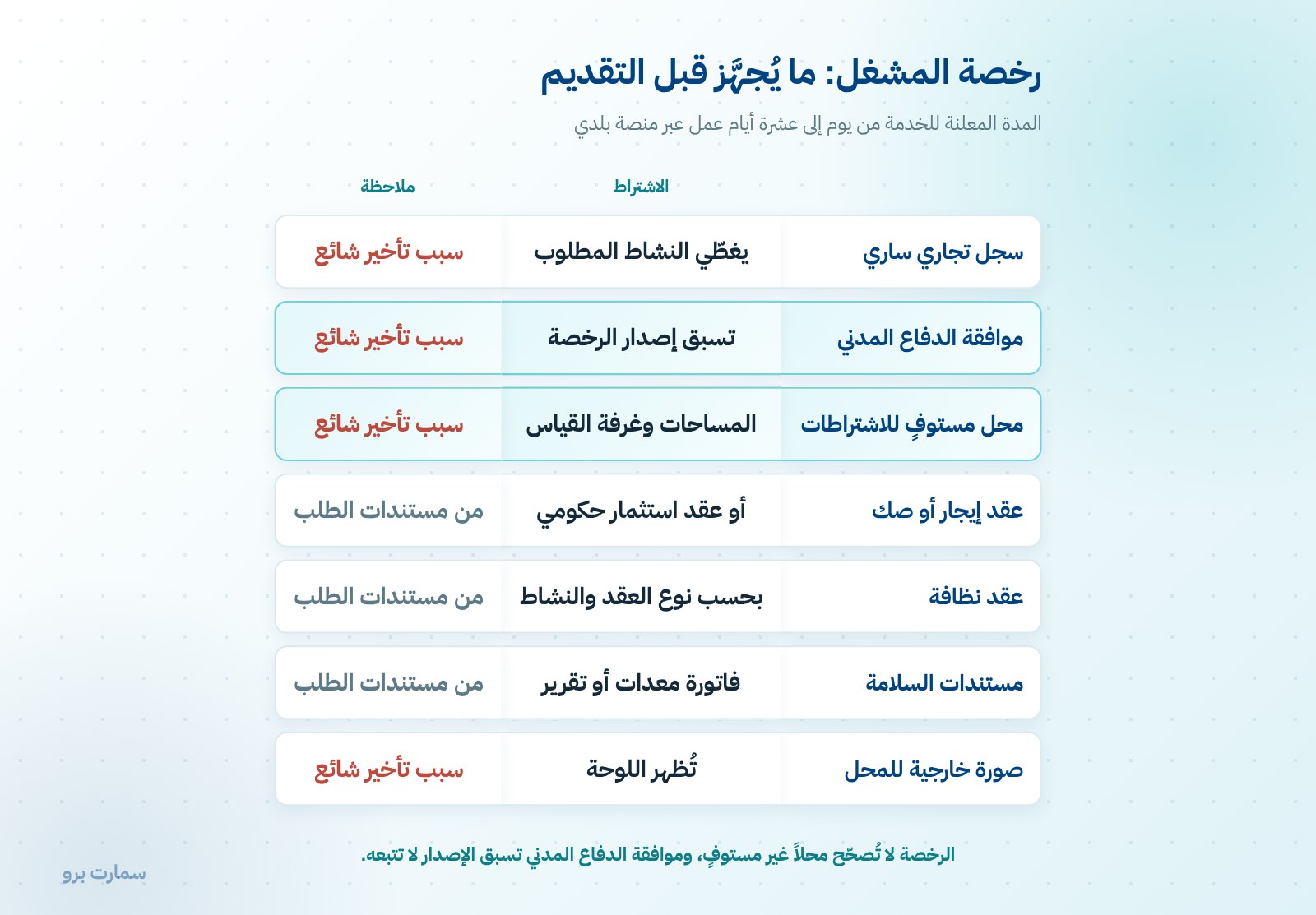
Tailoring workshop licence: what must be ready before you apply
| Requirement | Note |
|---|---|
| Valid commercial registration | Covers the activity you want to license |
| Civil Defense approval | Comes before the licence is issued, not after |
| Shop that meets the requirements | Floor areas, zones and the fitting room |
| Lease contract or title deed | Or an investment contract from a government body |
| Cleaning contract | Depending on the contract type and activity |
| Safety documents | Invoice for safety equipment or a Civil Defense report |
| Building permit | A copy of it |
| Exterior photo of the shop | Showing the signboard |
The third row matters most: a licence does not fix a shop that falls short. Review tailoring shop requirements with the exact figures before you sign the lease, not after.
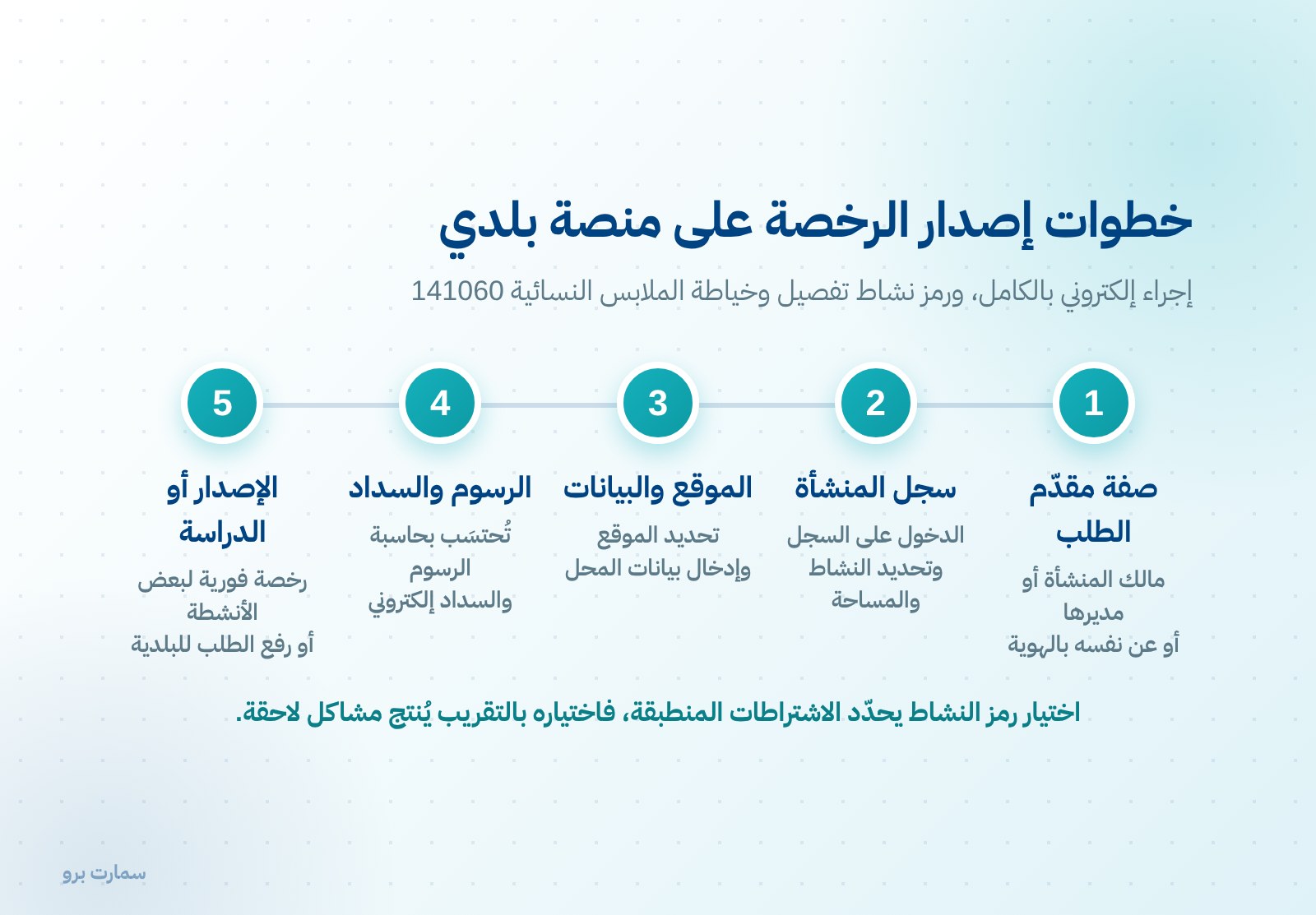
What are the steps on the Balady platform?
- Log in to the establishment record and select the activity and floor area.
- Set the location and enter the shop details.
- Pay the fees if the activity is one whose licence is issued instantly, or submit the application to the municipality if it needs review.
Fees are calculated with the fee calculator on the platform, and payment is made through the available electronic payment methods.
Who applies depends on how the licence is held: the owner or manager of the establishment if the licence is under a commercial registration, or the applicant on their own behalf if it is under a national ID.
Which activity code applies?
The activity women's clothing tailoring and dressmaking, which includes women's tailoring workshops, has the code 141060. This same code determines whether the Saudization decision applies to the establishment; the details are in batch production costing.
Choosing the code is not a formality. It determines which requirements apply, which authorities supervise you, and what obligations follow. Picking a code that is only roughly right creates problems that surface months later.
Is a qualification or diploma required?
No. The current requirements contain no condition that the applicant hold a qualification or a tailoring institute diploma. What circulates on this point is copied from older guides.
What is required is compliance with the municipal licensing law and its regulations, Civil Defense approval, a valid commercial registration covering the activity, and approval from the supervising authority where one exists.
Can you add other activities to the same licence?
If you plan to sell fabrics, shemaghs or ready-made clothing alongside tailoring, these are additional activities with restrictions:
- Their combined area must not exceed 50% of the total area on the licence.
- Each additional activity must be at least 6 m².
- The minimum area for the main activity must be preserved.
- Practising an activity not listed on the licence is prohibited.
The last rule is often broken in good faith, when a workshop starts selling supplies or accessories without amending its licence.
What comes after the licence is issued?
The licence is a beginning, not an end. These must be in place from day one:
- The unified electronic code displayed on the shop front and accessible outside working hours.
- Electronic payment methods working, with a sticker showing the accepted methods. Refusing them is prohibited.
- VAT registration when its conditions apply, and issuing invoices from day one. See the simplified invoice for tailors.
- Registering your employees with the relevant authorities.
What are the five most common causes of delay?
- A commercial registration that does not cover the activity being licensed.
- A shop that does not meet the area, zone or fitting-room requirements.
- Applying before Civil Defense approval, assuming it comes later.
- An exterior photo with no signboard, or an unclear one.
- Choosing an activity code that does not match what will actually be practised.
Four of the five can be fixed with an hour of review before applying, rather than weeks of waiting.
What should you check before signing the lease?
This is the most important moment in the whole project, because fixing the shop afterwards is costly or impossible:
- Measure the space and confirm it fits the required zones, not just the minimum area.
- Make sure a fitting room can be built to its specifications. See fitting room requirements.
- Check the safety requirements at the site before you commit.
- Ask the municipality which activities are permitted at that location.
What does the licence mean for your accounts from day one?
A licence creates an establishment with recurring obligations, not just a shop that opens its doors. From day one a fixed monthly cycle begins: invoices issued in an unbroken sequence, expenses recorded with their supporting documents, salaries paid on time, and a VAT return with a deadline that does not move.
A workshop that starts with organised bookkeeping from the first month never needs retroactive clean-up, which is the most expensive thing a small workshop owner goes through. One that postpones organisation until "things settle down" discovers a year later that it has a working shop with no numbers to base decisions on. See the chart of accounts guide for workshops.
How do renewals and changes to the licence work?
The licence has a validity period and is renewed through the same platform. Renewal depends on a valid commercial registration, lease contract and safety approvals, so if any one of the three expires, renewal stalls, not just the licence.
Any material change, such as adding an activity, changing the floor area or moving location, needs a licence amendment before it is carried out on the ground, not after. Making the change first and amending later is what creates violations that are hard to settle.
Where is the official reference?
The commercial licence issuance service, its conditions and documents are published on the Balady platform, and the approved requirements are held by the Ministry of Municipalities and Housing. These two are the reference whenever anything differs.
If you want to run all of the above without scattered spreadsheets, that is what the tailoring and dressmaking system does.
Key takeaway: The Balady procedure itself is quick; what decides the timeline is having a compliant shop, Civil Defense approval and the right activity code ready before you apply.
Read also
Article visuals
Frequently asked questions
How long does a tailoring workshop licence take?
The stated service time is one to ten working days, and the process is fully online through the Balady platform. The actual time depends on having complete documents and a shop that meets the requirements before you apply, not on the procedure itself.
What documents are required for the licence?
An exterior photo of the shop showing the signboard, the lease contract, title deed or investment contract, a cleaning contract depending on the contract type and activity, an invoice for safety equipment or a Civil Defense report, and a copy of the building permit. A valid commercial registration covering the activity is also required.
Does Civil Defense approval come before or after the licence?
Before. The requirements state that Civil Defense approval must be obtained before the licence is issued, so safety preparation comes before applying, not after. Applying before getting it is one of the most common causes of delay.
Can I sell fabrics alongside tailoring?
Yes, as an approved additional activity, provided the additional activities together do not exceed half of the total area on the licence, each one is at least six square metres, and the minimum area for the main activity is preserved. Practising an activity not listed on the licence is prohibited.