
Wedding Season in the Tailoring Workshop: A Backward Schedule from a Fixed Date
Wedding season runs on a backward schedule from a date that never moves. Longer lead times, three fittings per piece, a deposit that covers cost, and a weekly cap on group orders.
Author:سامي الحيدري
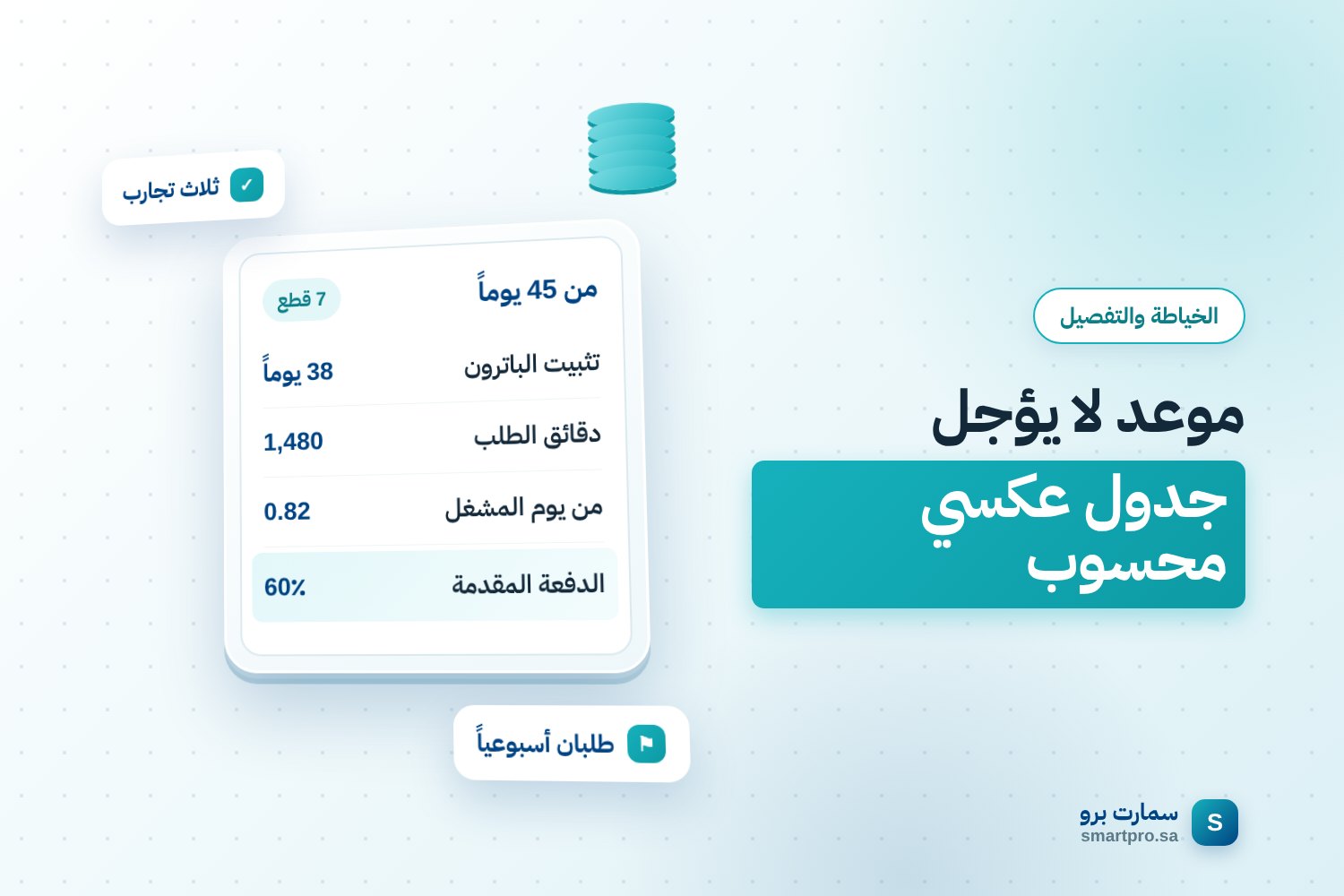
Wedding season is not a peak like Ramadan. The Ramadan peak is a pressure of volume. Wedding season brings a different kind of pressure: longer lead times, several fittings for a single piece, group orders from one family, and a date that does not move no matter what happens in your workshop.
A customer whose everyday thobe is three days late gets annoyed. A customer whose abaya misses the wedding night loses the whole occasion, and no compensation can give it back.
That is why this season is run on a backward schedule, not the usual queue. You start from the fixed date and count back, and you reserve the minutes before accepting the order, not after.
Wedding season: how is it different from everyday work?
| Item | Everyday work | Wedding order |
|---|---|---|
| Lead time | A few working days | Weeks |
| Fitting sessions | One or none | Three per piece |
| Order size | One or two pieces | Seven or more pieces for one family |
| Deadline | Can be moved with an apology | Fixed, cannot be postponed |
| Fabric | Usually from your own stock | Chosen by the customer, possibly imported |
| Cost of a mistake | Rework | A missed occasion |
The fourth row governs everything after it. A fixed date means the buffer is reserved before the deadline, not after it, and delivery happens two days before the night, not on the day itself.
How do you build a backward schedule from a date that doesn't move?
The schedule is written once, at order intake, and printed on the receipt with a copy for the customer. That way she knows her own obligations, not just yours.
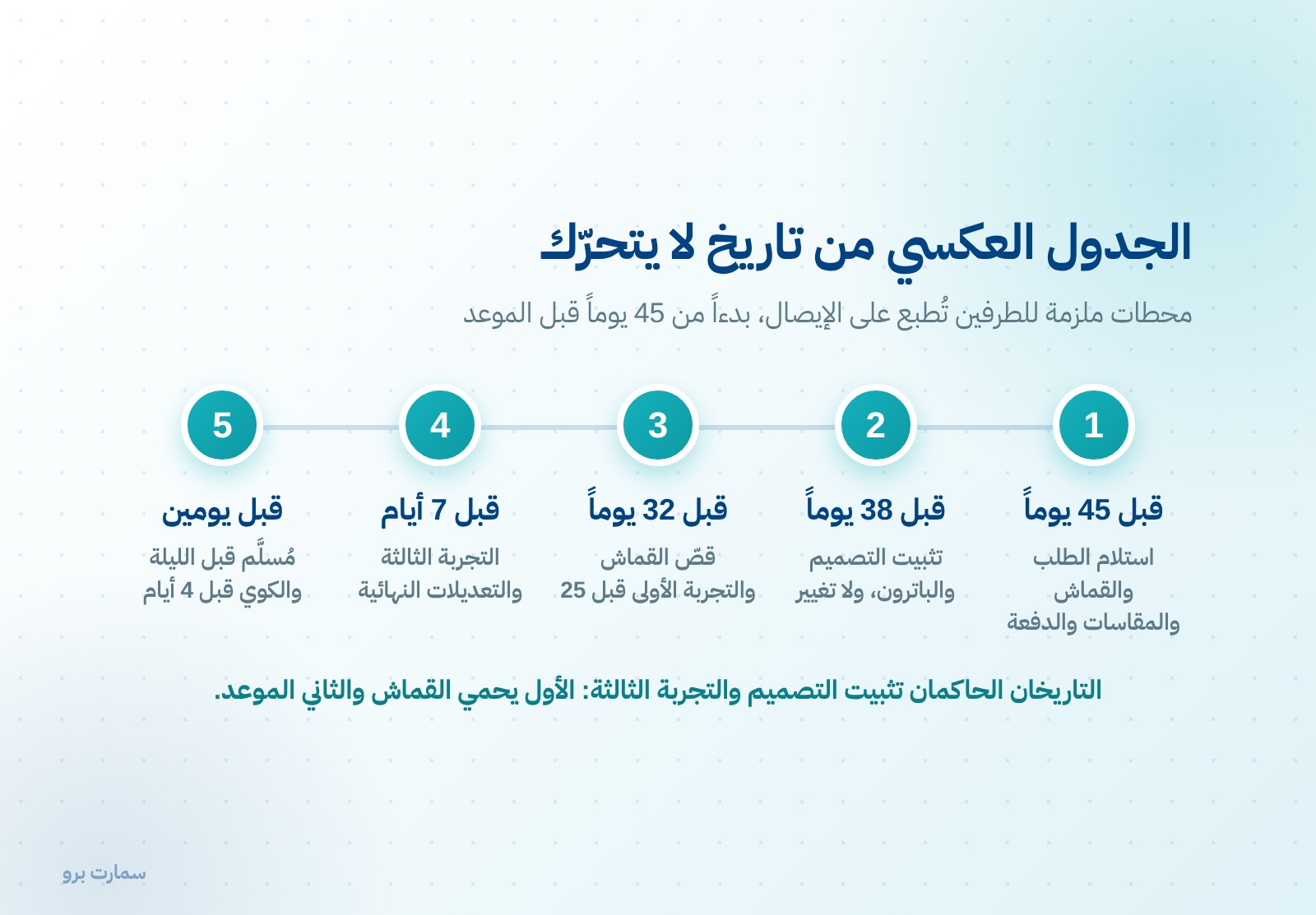
| Days before the date | Milestone |
|---|---|
| 45 days | Order, fabric, measurements and first payment received |
| 38 days | Design and pattern locked; no changes accepted after this |
| 32 days | Cutting |
| 25 days | First fitting on the basted shell |
| 16 days | Sewing complete |
| 12 days | Second fitting to size |
| 7 days | Third fitting and final alterations |
| 4 days | Pressing |
| 3 days | Ready |
| 2 days | Delivered |
The order path is the usual one — received → cut → sewn → pressed → ready → delivered — but the fittings are slotted in between as milestones with dates binding on both sides.
The two dates that govern everything are “design lock” and “third fitting”. A change after the first wastes fabric that has already been cut, and slipping past the second leaves no days for alterations. How to build dates from minutes and the queue is covered in setting a delivery date.
Worked example: one family's order
The figures below are hypothetical, to illustrate the method, and do not represent prevailing market prices. Using this series' parameters: labour at SAR 0.50 per minute, a fixed-overhead share of SAR 0.23 per minute, and 1,800 productive minutes in a working day.
Suppose a single family order: four plain thobes and three embroidered abayas.
| Item | Qty | Minutes per piece | Minutes |
|---|---|---|---|
| Plain thobe | 4 | 80 | 320 |
| Embroidered abaya | 3 | 340 | 1,020 |
| Extra third fitting | 7 | 20 | 140 |
| Total | 7 pieces | 1,480 |
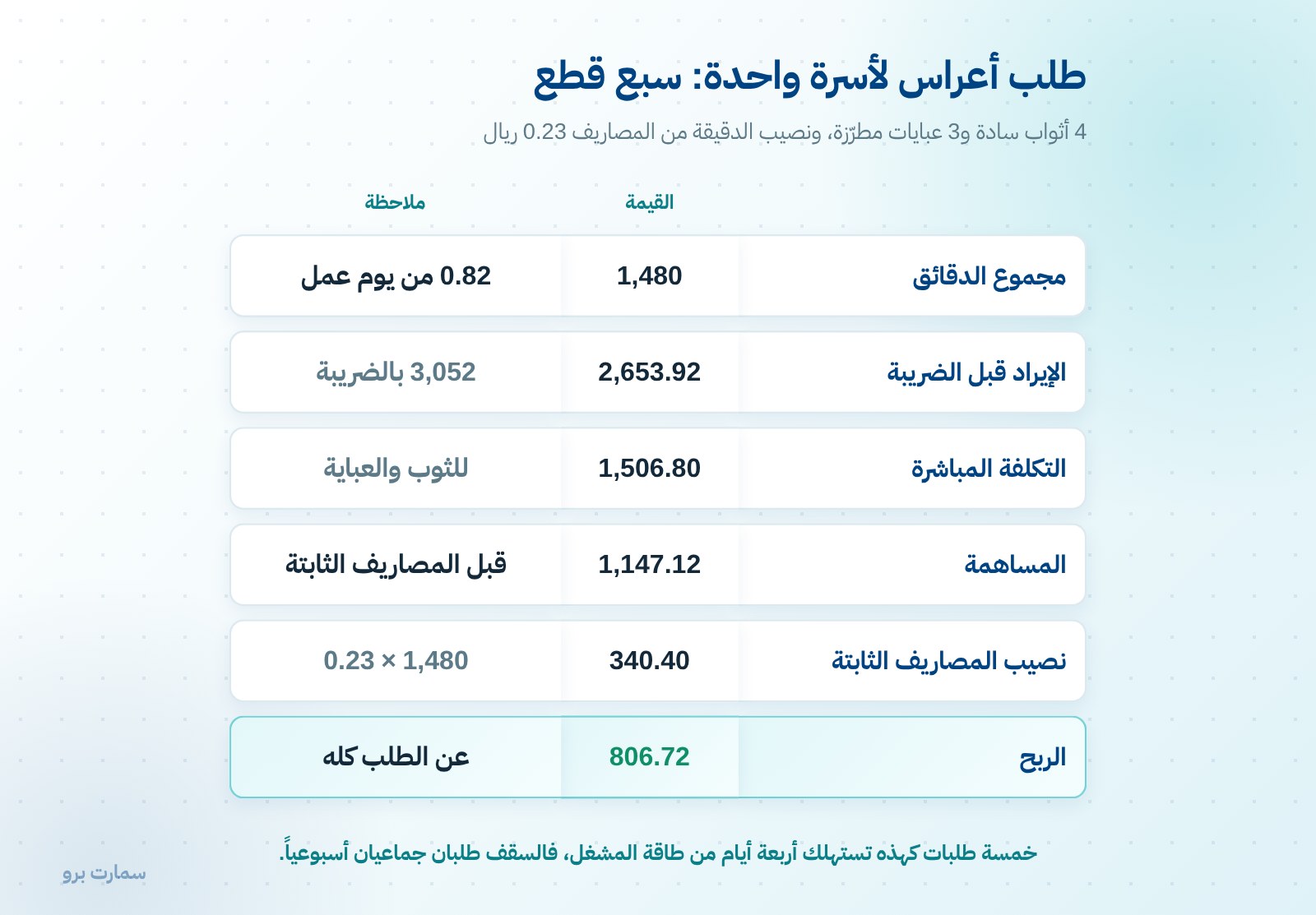
So one order takes up 1,480 ÷ 1,800 = 0.82 of a full workshop day. Five orders like this consume four days of the entire workshop's capacity. The embroidered abaya minutes come from itemised abaya pricing.
The order value at the series' prices: the thobe at SAR 280 including VAT, and the embroidered abaya at SAR 644:
- Including VAT: (4 × 280) + (3 × 644) = 1,120 + 1,932 = SAR 3,052
- Before VAT: (4 × 243.48) + (3 × 560) = 973.92 + 1,680 = SAR 2,653.92
- Direct cost: (4 × 103.10) + (3 × 364.80) = 412.40 + 1,094.40 = SAR 1,506.80
- Contribution: 2,653.92 − 1,506.80 = SAR 1,147.12
- Fixed-overhead share: 1,480 × 0.23 = SAR 340.40
- Profit: SAR 806.72
How big should the deposit be on a wedding order?
The usual rule — half up front — works for everyday orders but not here. The reason is pure arithmetic:
- A 50% deposit on 3,052 = SAR 1,526 including VAT, or 1,326.96 before VAT
- Direct cost is SAR 1,506.80
- A gap of SAR 179.84 comes out of your pocket before you collect it
Embroidered fabric raises the materials share of the order value, so the percentage needed to cover cost goes up. The minimum here: 1,506.80 × 1.15 = SAR 1,732.82, or 56.8% of the order value.
That is why a 60% deposit is the consistent choice for season orders: SAR 1,831.20 including VAT, or 1,592.35 before VAT. It covers direct cost and leaves a SAR 85.55 margin. It is split across two milestones: the first at intake, the second at design lock.
How deposits are treated in invoicing, and what must be issued for them, is explained in deposits and VAT and the simplified invoice for tailors.
What cancellation and postponement terms should you set?
Cancellations are not the exception this season, and agreeing on them in advance is cheaper than negotiating them during a dispute. The right yardstick is not the number of days left but the stage the piece has reached.
For one embroidered abaya from the example above, with amounts before VAT:
| When cancelled | What is charged | Amount (SAR) |
|---|---|---|
| Before cutting | Design and pattern minutes, 30 × 0.50 | 15.00 |
| After cutting, before sewing | Fabric 135 + waste 10.80 + 15.00 | 160.80 |
| After sewing, before embroidery | + 190 minutes × 0.50 + trims 14 | 269.80 |
| After embroidery | Full price, and the piece is handed over | 560.00 |
Postponement gets its own clause: moving the date before the cutting date is rescheduled at no charge. After it, the pieces have already reserved their minutes and fabric, so the schedule cannot be redone without cost.
Why should fitting sessions be booked, not waited for?
A fitting session is a tailor's time, not waiting time. In the example above, the total fitting minutes are (3 × 60) + (4 × 20) = 260 minutes, worth 260 × 0.73 = SAR 189.80 in labour and fixed-overhead share.
So each session is treated as an appointment booked for a specific hour, not “come any time”. A customer who misses her session wastes minutes reserved for her, then crowds out other customers' sessions in the final days.
- A specific hour in writing, with a reminder message the day before.
- A maximum of three sessions in the quoted price; anything beyond is priced by its minutes.
- One rescheduling allowance; after that, the whole backward schedule moves forward.
- A list of what is measured in each session, so no need is discovered at the last one.
The fitting room itself has requirements published by the Ministry of Municipalities and Housing, detailed in fitting room requirements and tailoring shop requirements.
How many group orders can you accept per week?
A group order looks like a big win, and it is, until you accept more than you can handle and every deadline falls at once.
The cap is calculated in minutes, not in number of orders. If you allocate 40% of weekly productive minutes — 10,800 × 40% = 4,320 minutes — then 4,320 ÷ 1,480 = two group orders a week, no more, however strong the demand.
The remaining 60% is not idle time. It keeps everyday work alive: the alterations and regular orders that fill the schedule once the season ends. How to calculate capacity is in workshop capacity, and the thresholds for pausing intake are in when to stop taking orders.
What does a group discount actually cost?
The family asks for a discount because there are seven pieces, and the arithmetic answer is clearer than haggling.
A 10% discount on the order = SAR 305.20 including VAT, or SAR 265.39 before VAT. The order profit is SAR 806.72, so it drops to SAR 541.33.
In other words, a ten percent price discount takes 32.9% of the profit. A better alternative is a service rather than a price cut: an extra fitting session, delivery, or a premium garment bag and hanger — cheaper in riyals and more memorable for the customer.
Which three mistakes break a wedding deadline?
First: accepting design changes after cutting. Cut fabric does not go back on the roll; a change means new fabric and a new lead time. The cut-off is announced at intake, not when the change is requested.
Second: delivering on the day of the occasion. The two days before it are not a luxury; they are the last chance for an alteration that only shows up when the full outfit is worn.
Third: mixing season minutes with everyday minutes in one queue, so the group order eats into the appointments of other customers who were promised earlier. Separation starts with a written weekly cap.
Official reference
Requirements for tailoring shops and fitting rooms are published by the Ministry of Municipalities and Housing, and they are the reference in case of any discrepancy. Invoicing and deposits are covered in the simplified invoice for tailors.
Everything described here is run in practice in SmartPro's tailoring system: orders, measurements, fabrics and invoicing in one place.
Key takeaway: Plan wedding orders backward from the fixed date, take a deposit that covers direct cost, and cap season work in minutes each week so no deadline falls.
Read also
To see how this works with your own orders, start a free trial of SmartPro or book a short demo.
Article visuals
Frequently asked questions
How much lead time does a wedding order need?
It is calculated backward from the date of the occasion, not forward from the intake day. In the hypothetical schedule, the order is received 45 days before, the design is locked 38 days before, cutting happens 32 days before, and sewing is complete 16 days before. The piece is delivered two days before the date, not on the day itself.
How big should the deposit be on wedding orders?
Higher than half the amount, because embroidered fabric raises the materials share. In the hypothetical example, direct cost was SAR 1,506.80 on an order worth SAR 3,052, so the minimum is 56.8%. That is why a 60% deposit is consistent, split between intake and design lock.
How many group orders should I accept per week?
Count in minutes, not orders. If you allocate 40% of weekly productive minutes, which is 4,320 minutes, and a seven-piece group order uses 1,480 minutes, the cap is two orders a week, no more. The remaining 60% is kept for everyday work and alterations that fill the schedule after the season ends.
How much does a group discount cost me?
More than it looks. In the hypothetical example, a 10% discount equals SAR 265.39 before VAT, while the order profit is SAR 806.72, so the discount takes 32.9% of the profit. The alternative is a service rather than a price cut, such as an extra fitting session or delivery, which costs less and leaves a stronger impression.