
School Uniforms: A Thin-Margin Production Line with a Fixed Deadline
School uniform work is contract production, not individual tailoring. Batch cost versus single-piece cost, contribution per minute, size-range pricing, and how to set payments and a delivery schedule.
Author:سامي الحيدري

A school uniform order is not just a large tailoring order. It is a different line of business. The customer is an institution, not an individual. The garment is repeated, not unique. Margins are thin, volumes are high, and the deadline is the first day of school, which never moves.
Most workshops still treat it like individual tailoring. They price by eye, measure every student one by one, and accept the whole school. Then, halfway through, they find the order has eaten the month's capacity.
This article covers the economics first. It then explains how to price a size range, how to measure a whole school in two days, how to set payments and a delivery schedule, and what to put in the contract.
How are school uniform economics different from tailoring?
| Item | Individual tailoring | School uniforms |
|---|---|---|
| Customer | End consumer | Institution buying under a contract |
| Pattern | One per customer | One per size |
| Cutting | Piece by piece | Several layers at once |
| Margin per piece | Wide | Thin |
| Volume | A few pieces | Hundreds |
| Deadline | Negotiable | First day of school |
| Repeat business | Not guaranteed | Annual, if delivered well |
The last two rows are why this work is worth taking at all. A deadline known from the start of summer lets you plan. Annual repeat business turns the patterns and size lists into assets you build once and use for years.
What does a uniform piece cost on its own versus in a batch?
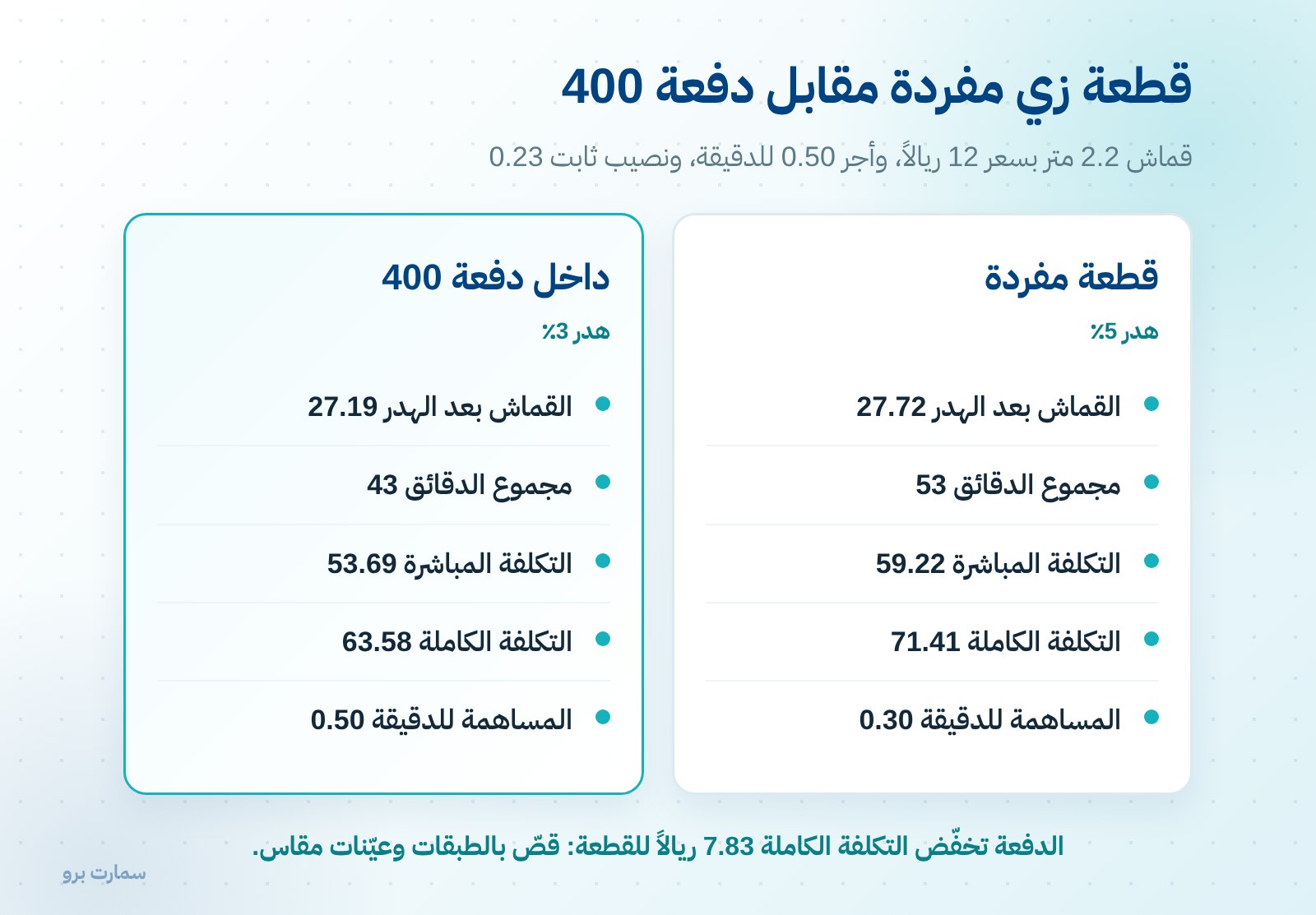
The figures below are hypothetical and only illustrate the method. They do not represent market prices. They use the parameters applied throughout this series: labour at SAR 0.50 per minute, a fixed-overhead share of SAR 0.23 per minute, and 2.2 metres of uniform fabric at SAR 12 per metre.
| Item | Single piece | In a batch of 400 |
|---|---|---|
| Net metres | 2.2 | 2.2 |
| Waste rate | 5% | 3% |
| Fabric after waste | 27.72 | 27.19 |
| Cutting minutes | 8 | 4 |
| Measuring minutes | 8 | 2 |
| Sewing and pressing minutes | 37 | 37 |
| Total minutes | 53 | 43 |
| Labour | 26.50 | 21.50 |
| Trims and accessories | 5.00 | 5.00 |
| Direct cost | 59.22 | 53.69 |
| Fixed-overhead share | 12.19 | 9.89 |
| Full cost | 71.41 | 63.58 |
The batch cuts the full cost by SAR 7.83 per piece, and the saving comes from two places, not one. Layered cutting lowers waste by two percentage points and halves cutting minutes. Fit samples (ready-made sample garments in each size that students try on) shorten measuring time. How to measure your actual waste is covered in fabric cutting waste.
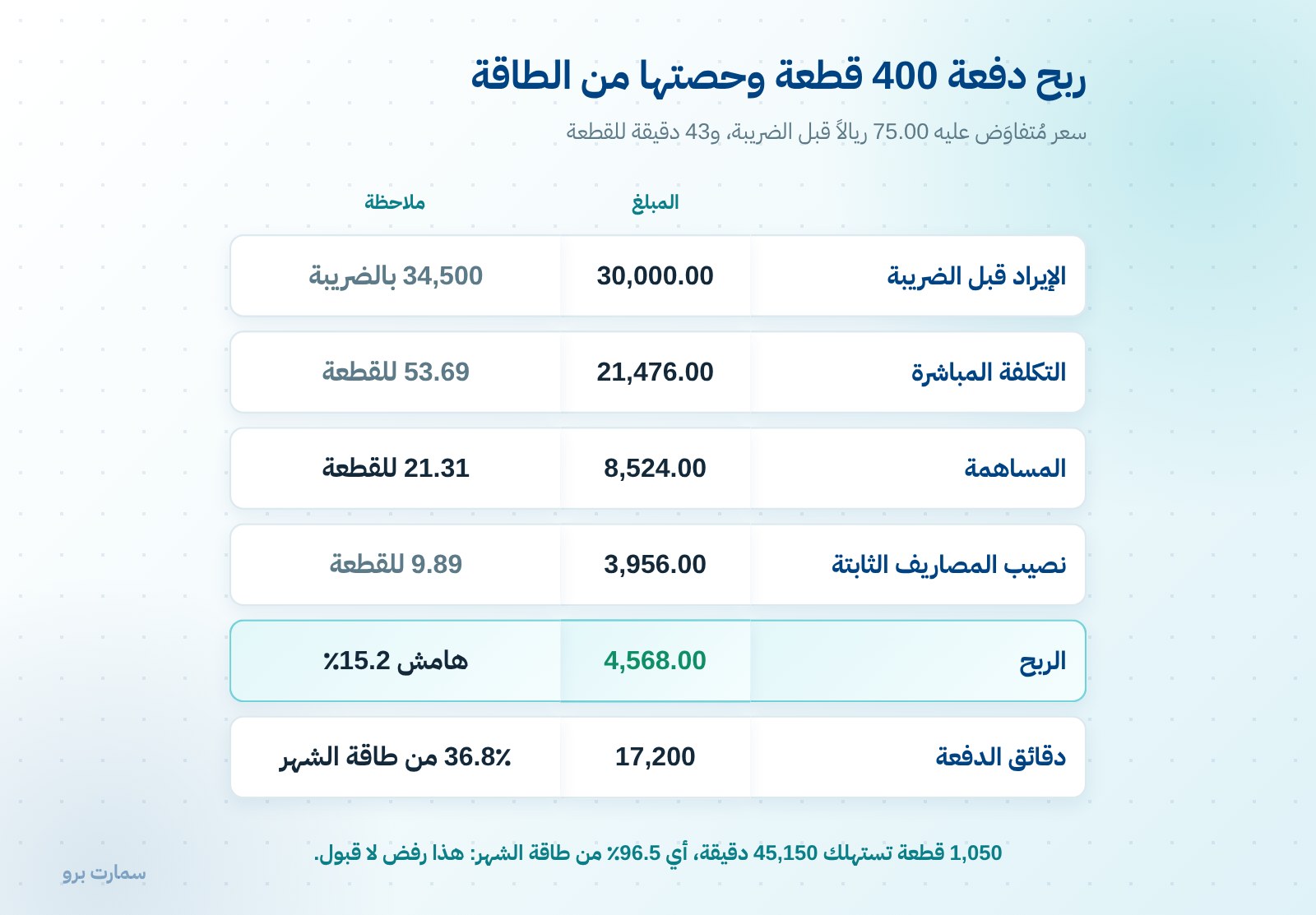
If the negotiated price is SAR 86.25 including 15% VAT, that is SAR 75.00 before VAT. Profit in the batch is then 75.00 − 63.58 = SAR 11.42 per piece, a margin of 15.2%.
Why is contribution per minute the number that decides?
Percentage margin alone is misleading here. Contribution is the price before VAT minus the direct cost. When minutes are your constraint, each product should be judged by the contribution it earns for every minute it occupies:
| Product | Contribution per piece | Minutes | Contribution per minute |
|---|---|---|---|
| Plain thobe | 140.38 | 80 | 1.75 |
| Uniform piece (batch) | 21.31 | 43 | 0.50 |
| Uniform piece (single) | 15.78 | 53 | 0.30 |
A uniform minute earns about thirty percent of a thobe minute. The meaning is clear: do not take this work in a full season, but do take it when your minutes would otherwise sit empty.
That is where it belongs. An idle minute earns nothing and still carries its share of fixed overhead with no revenue, so any positive contribution beats it. The thobe figures come from the true cost of tailoring a thobe, and how to rank products when capacity is full is covered in when to stop taking orders.
How should you price the size range?
A quote with one price for every piece loses money on the pieces that fall outside the standard sizes. A piece that needs individual measuring takes more minutes and should be priced as a separate line.
Assume this size distribution across 400 pieces:
| Size | Share | Pieces |
|---|---|---|
| 6 | 8% | 32 |
| 8 | 14% | 56 |
| 10 | 20% | 80 |
| 12 | 22% | 88 |
| 14 | 18% | 72 |
| 16 | 12% | 48 |
| Out of range | 6% | 24 |
| Total | 100% | 400 |
That gives 24 out-of-range pieces, each needing ten extra minutes for measuring and individual cutting: 10 × 0.73 = SAR 7.30 of extra cost. Price them with a fee of SAR 10 before VAT, stated in the quote rather than claimed afterwards.
Six sizes cover 94% of the volume, and that is the core of working with a size range: you build the pattern six times, not four hundred.
How do you measure a whole school in two days?
Measuring every student individually is the tailoring method, and it is the most expensive thing you can do here.
- Individual measuring: 420 students × 8 minutes = 3,360 minutes
- Fit samples in six sizes: 420 × 2 minutes = 840 minutes, plus 24 out-of-range students × 8 minutes = 192 minutes, for a total of 1,032 minutes
- Saving: 2,328 minutes, or 2,328 ÷ 1,800 = 1.3 full workshop days
The method in two lines: a ready set of fit samples in the six sizes is tried on each student, and the size is recorded on one list with the student's name, class and number. Only students who fit none of the sizes are measured by hand. How to document the list is covered in measurement records.
How large an order can your workshop handle?
Quote the quantity you can handle, not the quantity the school asks for. Assume a school of 420 students averaging 2.5 pieces each, or 1,050 pieces:
- 1,050 × 43 minutes = 45,150 minutes
- Effective monthly minutes in this series: 46,800
- That is 96.5% of the entire month's capacity for a single order
That is a decline, not an acceptance. A sensible offer is 400 pieces: 400 × 43 = 17,200 minutes, or 36.8% of monthly capacity, which leaves the rest for alterations and the tailoring work that never stops.
| Item | 400 pieces |
|---|---|
| Revenue before VAT | 30,000.00 |
| Revenue including VAT | 34,500.00 |
| Direct cost | 21,476.00 |
| Contribution | 8,524.00 |
| Fixed-overhead share | 3,956.00 |
| Profit | 4,568.00 |
How to calculate effective minutes is explained in workshop capacity.
How should payments and deliveries be scheduled?
Size the first payment to the fabric, not to a customary percentage. Fabric for 400 pieces is 400 × 2.2 × 1.03 = 906.4 metres, at SAR 12 per metre = SAR 10,876.80.
| Payment | Timing | Share | Amount before VAT |
|---|---|---|---|
| First | On signing and locking the size list | 40% | 12,000.00 |
| Second | On delivery of the first 100 pieces | 30% | 9,000.00 |
| Third | On final delivery | 30% | 9,000.00 |
The first payment covers the fabric with SAR 1,123.20 to spare. Without it, you would be financing the school rather than supplying it.
Deliver in batches, not all at once: 100 pieces a week × 43 minutes = 4,300 minutes, or 39.8% of effective weekly minutes. Each batch follows the usual path: received → cut → sewn → pressed → ready → delivered.
Because the customer is an institution rather than an end consumer, the invoice requirements differ. The details are in standard vs simplified tax invoices, the simplified invoice for tailors and VAT on deposits.
What clauses belong in a school uniform contract?
- Quantity with a minimum and a maximum, not an estimate that swells after signing.
- The date the size list is locked, with any change after it priced as a new order.
- The out-of-range piece price, separate from the base price.
- A batch delivery schedule with dates and quantities.
- Who receives the goods and who signs for them.
- The replacement allowance for measuring errors, its cap, and the deadline for claims.
- What happens to surplus fabric if the quantity falls below the minimum.
- The payment schedule, tied to delivery milestones rather than dates alone.
The clause most often forgotten is the size-list lock date. A list that changes after cutting means fabric already cut to a size that no student owns.
Which mistakes destroy the season's profit?
First: one price for every piece. Out-of-range pieces take more minutes, and without a stated fee they eat into a contribution that is already thin.
Second: accepting the whole school. An order that takes 96.5% of a month's capacity knocks out every tailoring deadline, so you lose customers who earn SAR 1.75 a minute for work that earns SAR 0.50.
Third: cutting piece by piece as if these were individual orders, which throws away half the saving that makes the work worthwhile in the first place.
Where is the official reference?
Rules on invoicing institutions, receiving payments and showing VAT are published by the Zakat, Tax and Customs Authority (ZATCA), which is the reference in any disagreement.
Putting this into practice is easier when orders, fabric and invoices sit in one system: see the tailoring workshop management system.
Key takeaway: Treat school uniforms as contract production: cost them at batch parameters, price out-of-range sizes separately, and accept only the quantity your idle minutes can absorb, with the first payment covering the fabric.
Read also
- Workshop capacity in minutes
- Fabric cutting waste: measuring the real rate
- Measurement records in the workshop
To see how a tailoring workshop can run orders, measurements and invoices in one place, start a free trial or book a demo.
Article visuals
Frequently asked questions
How do I price a school uniform order?
Build the cost on batch parameters, not single-piece ones. In the hypothetical example, the full cost inside a batch of 400 pieces was SAR 63.58 against SAR 71.41 for a single piece, because layered cutting reduces waste and cutting minutes. Then add a separate fee for pieces that fall outside the size range.
How many pieces should I accept in one order?
Decide by minutes, not by quantity. In the hypothetical example each piece takes 43 minutes, so a school asking for 1,050 pieces would use 45,150 minutes, or 96.5% of a full month's capacity. A sensible offer is 400 pieces at 36.8% of capacity, leaving the rest for tailoring and alterations.
How can I measure a whole school quickly?
Use a ready set of fit samples in six sizes that students try on, and record each student's size with their name and class on one list. In the hypothetical example this took 1,032 minutes against 3,360 for individual measuring, a saving of 1.3 workshop days. Only students outside the size range are measured by hand.
Why is the margin on school uniforms thinner than on tailoring?
Because the contribution per minute is lower. In the hypothetical example a thobe earns SAR 1.75 per minute while a uniform piece in a batch earns only SAR 0.50, about thirty percent. That is why this work should be taken when minutes would otherwise be idle, not in a full season.