
The Payslip: What It Must Show, and the Three Numbers That Make It Correct
A payslip explains how a salary reached its final figure. Here are the earnings and deduction lines it should carry, and the three numbers where most errors happen.
Author:سامي الحيدري
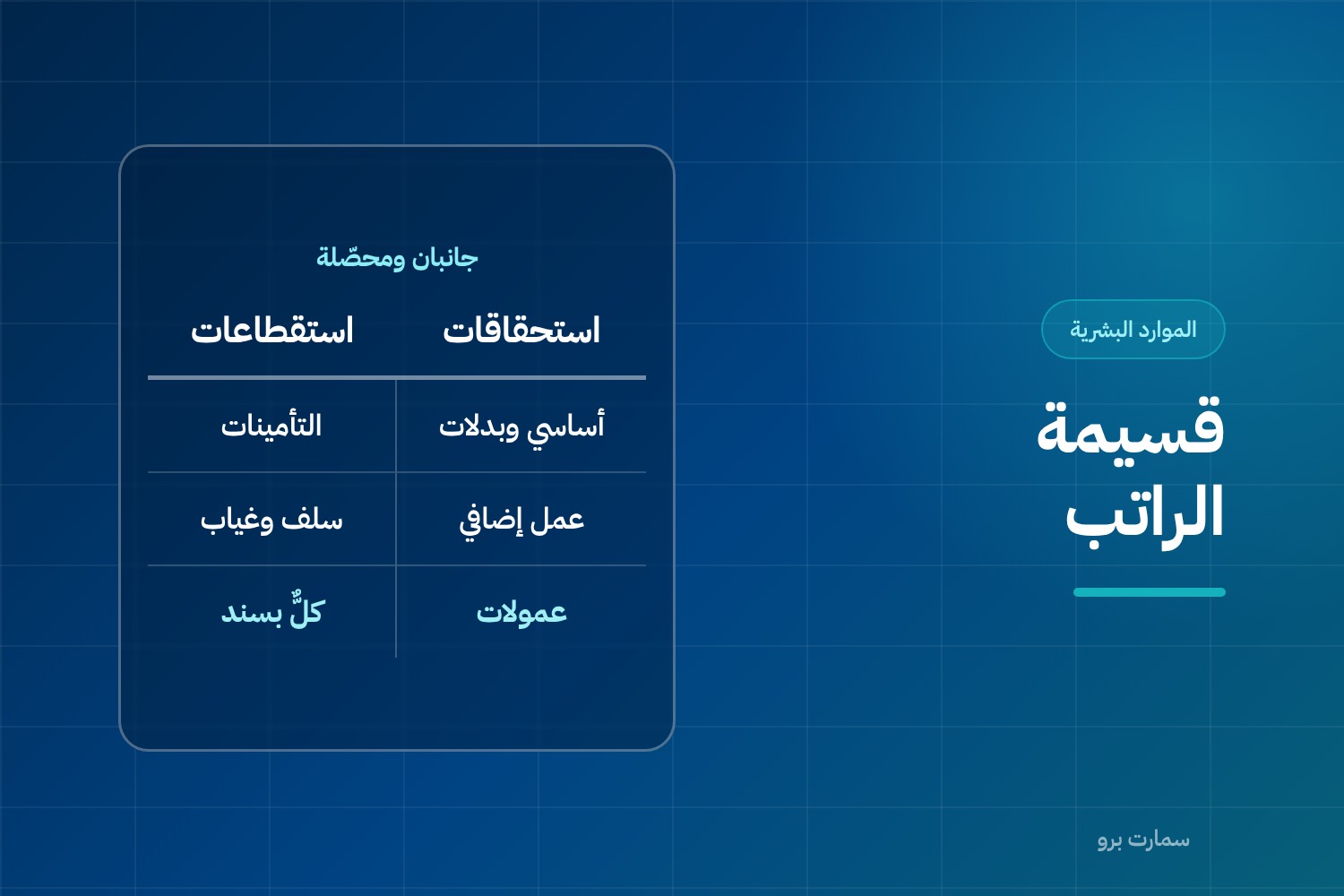
A payslip is not a transfer notice. It is the statement that shows an employee how their salary reached the amount transferred: what they earned, what was deducted, and on what basis. A payslip that shows a single number explains nothing, and it is the main reason employees ask questions at the end of every month.
It is also the first document requested when a dispute arises, so its layout is not a cosmetic matter.
What should a payslip include?
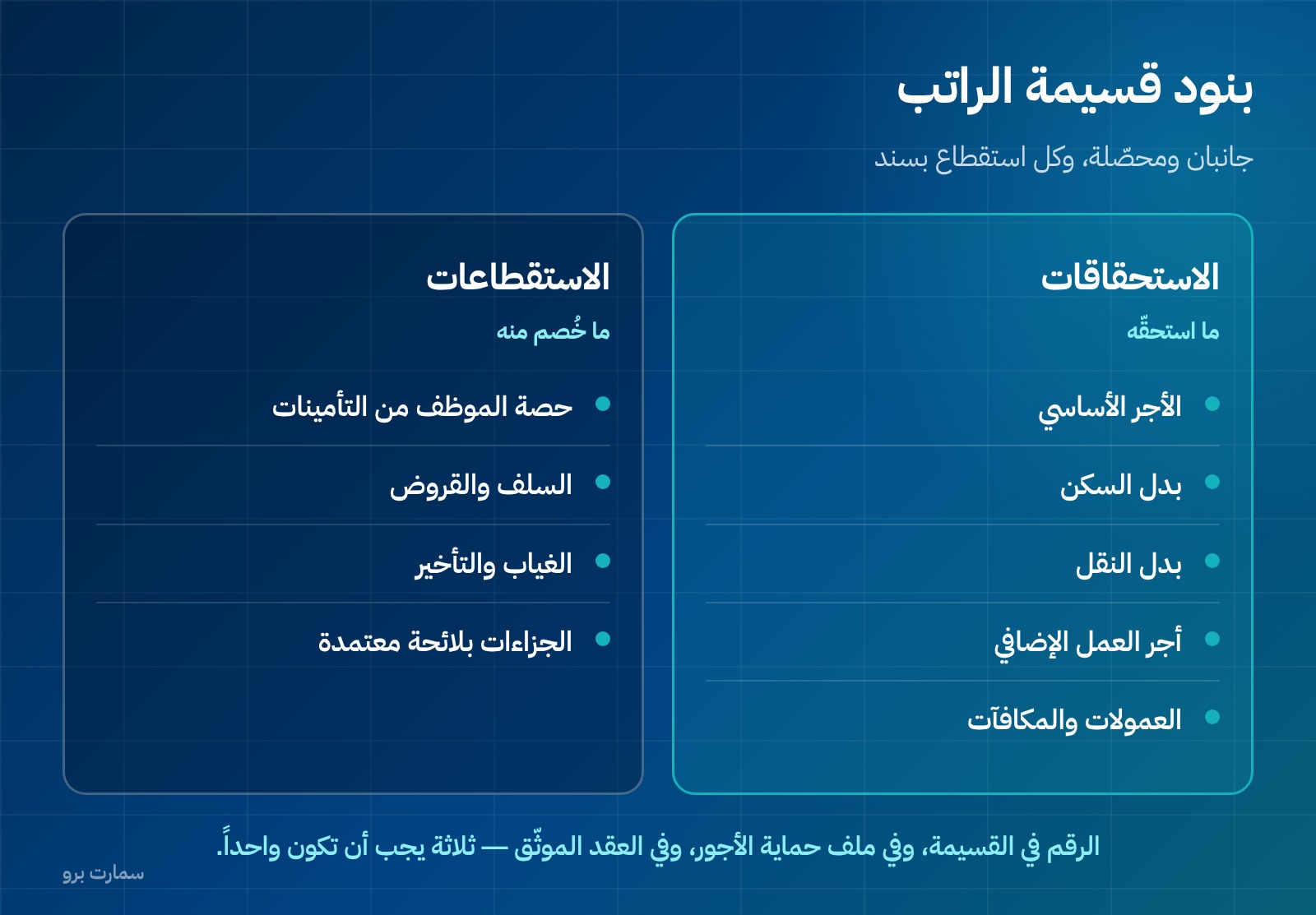
Identifying details: the company's name and number, the employee's name and employee number, job title, the period the statement covers, the payment date, and the number of days actually worked.
Earnings side:
- Basic wage
- Housing allowance
- Transport allowance
- Other allowances (nature-of-work, phone, communication)
- Overtime pay
- Commissions and bonuses
- Leave pay, if paid out
Deductions side:
- The employee's share of social insurance (GOSI)
- Advances and loans
- Absence and lateness
- Penalties, if any, and only under an approved work regulation
- Any other deduction backed by a supporting document
The bottom line: total earnings, total deductions, net pay, and the payment method and account number.
Which numbers make a payslip correct?
Three numbers must be consistent on the payslip, and most errors happen in the relationship between them.
First: the contributory wage. The contributory wage is the portion of pay on which GOSI contributions are calculated. It is not the gross salary, nor the basic wage alone, and it is capped at SAR 45,000 a month. What is included in it and what is not is explained in the GOSI contributory wage, and it is the figure most often miscalculated in payroll.
Second: the correct contribution rate for this employee. A single company today can have employees on different rates, because the new social insurance law applies to people with no contribution periods before 3 July 2024. So the employee's share is not one number for everyone; the rate table is set out in GOSI contribution rates.
Third: the hourly rate for overtime. It is the basic hourly wage plus fifty per cent, and it may be replaced with paid compensatory leave if the worker agrees. The calculation is covered in overtime calculation.
How much can an employer deduct from a salary?
An employer cannot deduct whatever it likes from a salary. Deductions are governed by statutory limits that differ by reason, whether an advance, a penalty or a debt. The details are in salary deduction limits.
The practical rule: every line on the deductions side needs supporting evidence. An advance has a signed acknowledgement, a penalty has an approved regulation and a documented procedure, and an absence has an attendance record. A line without evidence is a dispute waiting to happen.
What does a completed payslip look like?
The figures below are hypothetical, used to illustrate the method, not taken from a real case. A Saudi employee covered by the new system, a full working month, 10 hours of overtime:
| Earnings | Amount (SAR) |
|---|---|
| Basic wage | 8,000 |
| Housing allowance | 2,000 |
| Transport allowance | 800 |
| Overtime pay (10 hours) | 625 |
| Total earnings | 11,425 |
| Deductions | Amount (SAR) |
|---|---|
| Employee's GOSI share | Calculated on the contributory wage |
| Advance instalment | 500 |
| Total deductions | Depends on the applicable system |
The overtime hourly rate here: basic wage 8,000 ÷ 30 days ÷ 8 hours = SAR 33.33 an hour, plus fifty per cent = SAR 50, × 10 hours = SAR 625.
Note that the calculation used the basic wage alone, not the gross. Anyone who calculates it on 10,800 pays an increase that is not legally due, and anyone who leaves out the fifty per cent pays less than is owed. Both mistakes are common.
The GOSI share is deliberately left without a number: its rate varies with the employee's system, and the base it is calculated on has its own definition. Putting a single number here would produce a wrong payslip for most of the people reading it.
When should the payslip be handed over?
With the payment or before it, not weeks later and only on request. Electronic delivery through an employee portal is clearer and cheaper than paper, and it leaves a documented record of when the employee viewed it, which is what a dispute needs, not the salary.
An employee portal solves two problems at once: it ends manual requests for salary certificates, and it lets every employee see their own pay breakdown, so fewer questions arise in the first place. In SmartPro, the Human Resources system handles payroll and payslips, with an employee portal and a Mudad wage protection file available as add-ons.
How does the payslip relate to wage protection?
This is where the payslip meets regulatory compliance. The Wage Protection System checks that wages are paid on time and in the amounts stated in documented contracts, through a real-time technical link with banks. The period allowed for uploading wage protection files is now thirty days, down from two months.
That means the figure on your payslip, the figure in the wage protection file and the figure in the documented contract are three numbers that must be one. A mismatch is not an internal housekeeping issue; it is data that the authorities read. The details are in the Wage Protection System.
How is a payslip recorded in the books?
The payslip is the front end of an accounting entry, and that entry is not two lines:
| Side | Line |
|---|---|
| Debit | Salaries and wages expense (total earnings) |
| Debit | Social insurance expense, employer's share |
| Credit | Social insurance payable (both shares) |
| Credit | Advances and custody (amount recovered) |
| Credit | Salaries payable (net) |
Then, on transfer: debit salaries payable, credit bank. The full entry is explained in the payroll journal entry, and the operating cycle in the payroll run guide. In SmartPro, payroll is wired into Finance & Accounting, so these entries are generated rather than typed.
Recording salaries as a single net entry, salaries expense against bank, hides the employer's GOSI share and shows a labour cost lower than the real one. The full picture is in the total cost of an employee.
What are the most common payslip mistakes?
- A payslip showing net pay only. It explains nothing and generates a question every month.
- Calculating GOSI on the basic wage alone or on the full gross. Both are wrong; the correct base is the contributory wage as defined.
- One rate for all employees even though two systems run in parallel.
- A deduction without supporting evidence. Legally, the riskiest line on the payslip.
- No payslip at all. The most common in small businesses: the salary is transferred and the employee is assumed to have understood.
What should you do now?
Open one employee's payslip from last month and check four things: that the contributory wage is calculated, not assumed; that their contribution rate matches their system; that every deduction has supporting evidence; and that the net pay matches what left the bank and what was uploaded in the wage protection file.
If any of them differs, the fault lies in the payroll run, not the payslip; the payslip simply exposed it. The most frequent causes are explained in payroll mistakes.
Sources for the rules: the Ministry of Human Resources and Social Development and the General Organization for Social Insurance. This is general explanation, not legal advice.
Key takeaway: A correct payslip rests on three consistent numbers: the contributory wage, the employee's own GOSI rate, and overtime calculated on basic pay plus 50%. Every deduction needs evidence, and the net must match the bank transfer and the wage protection file.
To see payroll, payslips and the accounting entry working together, start a free SmartPro trial or book a demo.
Article visuals
Frequently asked questions
What items should a payslip include?
Identifying details for the company, the employee, the period, the payment date and days worked. Then the earnings side: basic wage, housing and transport allowances, other allowances, overtime pay and commissions. Then the deductions side: the employee's GOSI share, advances, absence and penalties, followed by the total of each side, net pay and the payment method.
What is the employee's GOSI share calculated on?
It is calculated on the contributory wage, which is neither the gross salary nor the basic wage alone, and is capped at SAR 45,000 a month. The rate itself can differ between employees in the same company, because the new social insurance law applies to people with no contribution periods before 3 July 2024.
How is overtime pay calculated on a payslip?
Overtime is paid at the basic hourly wage plus fifty per cent. It may be replaced with paid compensatory leave if the worker agrees, in which case it appears on the payslip not as an amount but as a leave balance.
Can an employer deduct from a salary without supporting evidence?
No. Every deduction line needs evidence: an advance has a signed acknowledgement, a penalty has an approved regulation and a documented procedure, and an absence has an attendance record. Deductions are also subject to statutory limits that vary by reason, and a line without evidence is a dispute waiting to happen.
How does the payslip relate to the Wage Protection System?
The Wage Protection System checks that wages are paid on time and in the amounts stated in documented contracts, through a real-time link with banks, and files must be uploaded within thirty days. The figure on the payslip, the figure in the wage protection file and the figure in the documented contract must therefore be the same number.